 ProMapRanker
Best Accessible Alternatives to Staircases in 2026

Key takeaways
- Ramps suit short rises and entryways, while platform lifts suit porch and garage access for wheelchair users.
- Home elevators and through floor lifts suit travel between interior floors, with more space and building work needed.
- Pneumatic vacuum elevators suit multi storey homes where a pit or machine room is not wanted, at a higher price.
- Incline platform lifts suit wheelchair users who need to travel along a staircase without transferring.
- Always get a professional home assessment and check local building codes before you buy, since fit depends on space, weight and structure.
Quick comparison
| Pick | Great for | Pricing starts at | Free tier | |
|---|---|---|---|---|
 National Ramp | Modular entry ramps | See website | No | Visit |
 EZ-Access | Threshold and portable ramps | See website | No | Visit |
 Harmar Vertical Platform Lift | Porch and garage access | See website | No | Visit |
 Savaria Home Elevator | Multi floor home access | See website | No | Visit |
 Stiltz Through Floor Lift | Compact two floor lift | See website | No | Visit |
 Pneumatic Vacuum Elevators | Pit free multi storey lift | See website | No | Visit |
 Garaventa Incline Platform Lift | Wheelchair travel on stairs | See website | No | Visit |
 Lifeway Mobility | Full home access service | See website | No | Visit |
 Acorn Stairlift | Seated travel on stairs | See website | No | Visit |
The best accessible alternatives to staircases
Stairs block access for wheelchair users, for people with limited mobility, and for anyone carrying heavy items or recovering from injury. The options below are not all the same job. Some handle a single step at a door, some handle a porch, and some handle travel between floors. Safety note: get a professional assessment, check local building codes, and confirm weight limits and emergency backup before you buy any lift or elevator.
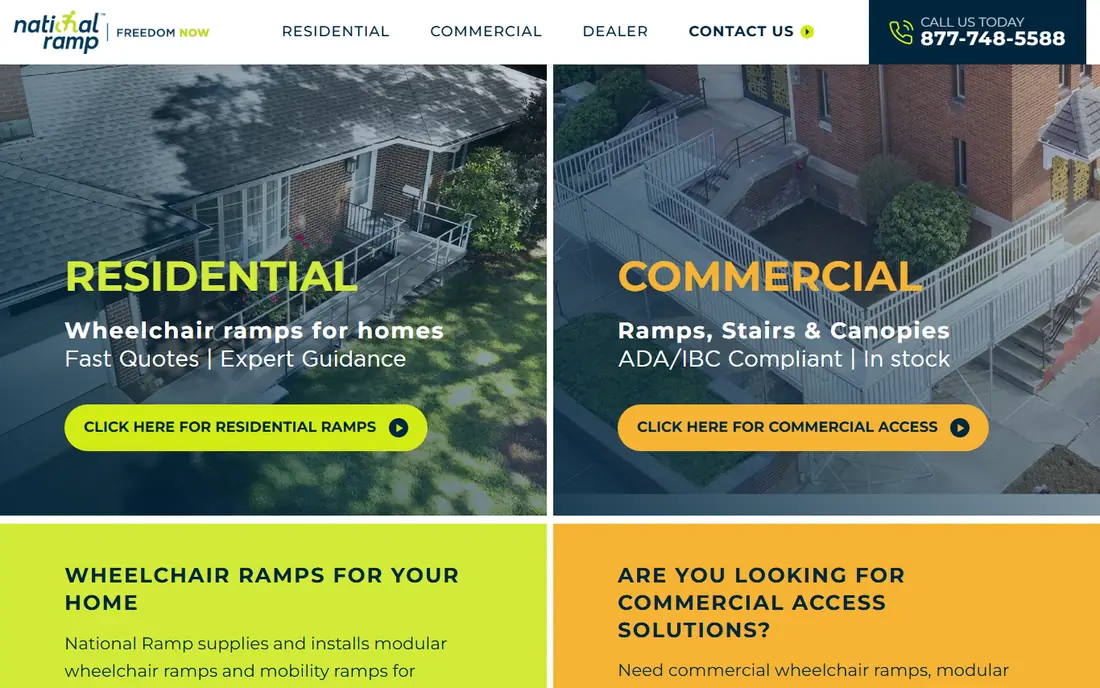
National Ramp provides modular wheelchair ramps for home entries, porches and garages. Modular sections are built off site and assembled at the home, which keeps install time short and avoids a long concrete build. If you move or your needs change, sections can often be adjusted or reused, which is a benefit over a fixed concrete ramp.
The main limit is space. A safe slope needs length, so a high porch in a small yard may need a ramp that turns or wraps, and that takes room. Ramps also suit short rises best. For a full flight of interior stairs, a lift or elevator below will be more practical, even though it costs more.
- Modular ramps can be installed quickly
- Can be moved or adjusted if needs change
- No power or mechanical parts to maintain
- Needs length for a safe slope
- Less practical for tall rises or tight yards
EZ-Access covers the small gaps that larger systems miss. Threshold ramps handle a raised doorway, portable ramps help with a vehicle or a short step, and modular options cover small entries. That range helps when the main barrier is a few inches at a door, not a whole staircase.
Do not expect a threshold ramp to solve a full flight of stairs. Each model has a rise, length and weight limit, and using a ramp beyond those limits is unsafe. Check the product specs for your wheelchair or scooter plus user weight, and get advice if the rise is more than a few inches. For small, clear barriers, EZ-Access is a low cost and practical start.
- Wide range from threshold ramps to portable ramps
- Useful for travel and temporary needs
- Simple to place and store in many cases
- Not a full home access solution
- Weight and rise limits must be checked for each model
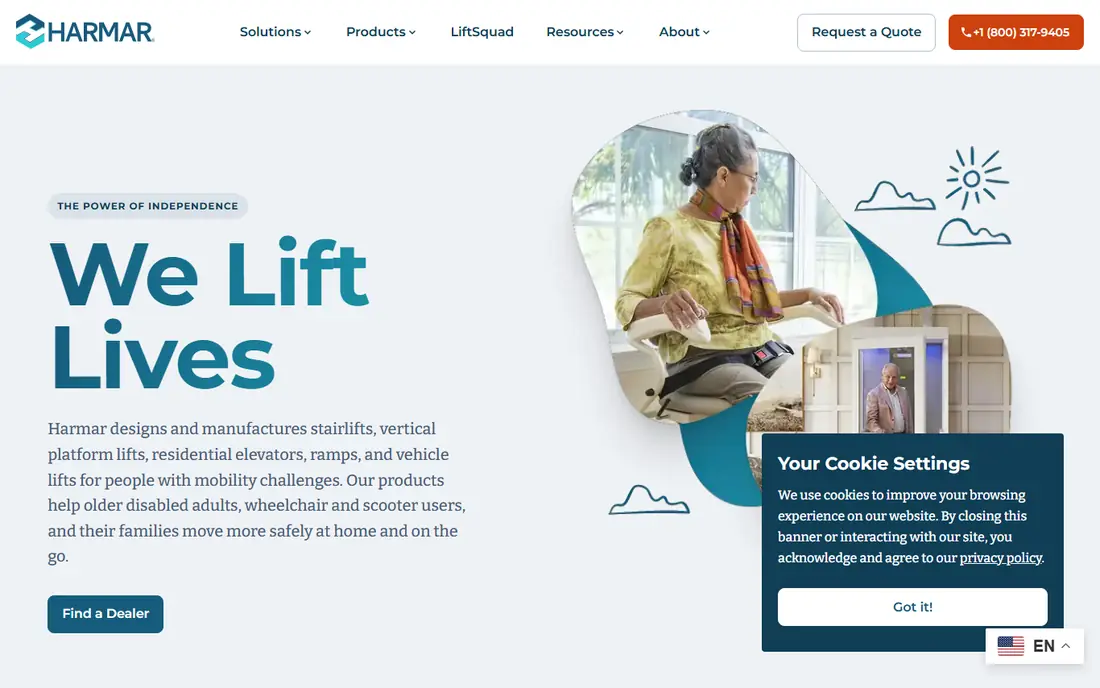
Harmar vertical platform lifts, often called porch lifts, work like a small elevator for short vertical distances. You roll onto a platform, press a control, and travel up to a porch, deck or garage entry while staying in your wheelchair or scooter. That no transfer design is a key benefit for people who cannot transfer safely onto a seat.
Travel height is limited, usually to a porch or a short floor change, not to a full second storey. You also need clear space for the platform, gates and landing, and outdoor models need weather protection and maintenance. For entry access where a ramp would be too long, a Harmar lift is a strong middle option between a ramp and a full elevator.
- Lets a wheelchair user travel without transferring
- Compact for the height it covers
- Indoor and outdoor models available
- Limited travel height compared with an elevator
- Needs space for platform and landing access
Savaria makes home elevators and through floor lifts for travel between interior floors. Larger cab models can carry a wheelchair user and a companion, and some models handle heavier power chairs. For a home where daily life spans two or three floors, an elevator gives the most complete access, since it does not require a transfer and can also carry groceries, laundry and other items.
The cost and building work are higher than for ramps or porch lifts. You need space for the cab and enclosure, a suitable wall or shaft, and professional install and servicing. Savaria models differ in cab size, travel distance and support needs, so a home assessment is essential. For long term, whole home access, Savaria is a leading name to shortlist.
- Carries a wheelchair user plus others in larger cabs
- Suits long term multi floor access
- Battery backup on many models for power cuts
- Needs building work and space for a shaft or enclosure
- Higher cost than ramps or platform lifts
Stiltz through floor lifts are designed for homes where a full elevator shaft would be too large. The lift travels through a cut in the floor between two levels, using self supporting rails in some models, which reduces structural work compared with a traditional elevator. That compact design helps in smaller homes and in retrofit projects.
Most Stiltz models serve two floors, not three or four, and cab size matters for wheelchair users. A standard cab suits a standing user with a walking aid, while a larger cab is needed for many wheelchairs. Check cab dimensions against your device before you buy, and confirm ceiling height and floor structure with the installer. For a compact two floor solution, Stiltz is worth a close look.
- Compact footprint for a through floor lift
- Self supporting rails on some models
- Suits homes with limited space
- Limited to two floors in most models
- Cab size limits some larger wheelchairs
Pneumatic vacuum elevators use air pressure to move a circular cab inside a clear tube, which removes the need for a pit, a shaft or a machine room. That makes them attractive for multi storey homes where building work must stay light, and the open design suits modern interiors where a traditional elevator would feel bulky.
Price is high, and cab size is a key limit. Smaller models suit one standing user, while larger models are needed for a wheelchair user, so check dimensions and weight limits carefully. Servicing also needs a specialist, since the system differs from a standard elevator. If you want multi floor access with minimal building work and you can accept the price, this is a distinctive option.
- No pit or machine room needed
- Circular design suits open plan homes
- Can serve multiple floors
- Higher price than many lifts
- Cab size and weight limits vary by model
Garaventa incline platform lifts follow the path of the stairs, like a stairlift, but carry a platform instead of a chair. A wheelchair user rolls onto the platform, which folds away when not in use, so other people can still use the stairs. That design helps in homes where a through floor lift or elevator is not practical, but the staircase itself is sound.
Stair width, structure and turns affect fit and price, and curved stairs cost more than straight stairs. The lift is also slower than an elevator and more visible in the home. For a wheelchair user who needs to use an existing staircase without transferring, Garaventa is one of the most direct solutions in this list.
- Follows the staircase so no new shaft is needed
- Lets a wheelchair user travel without transferring
- Folding platform keeps stairs usable for others
- Needs a suitable staircase width and structure
- Slower and more visible than a home elevator
Lifeway Mobility is a dealer and installer rather than a single product, and that service model matters for home access. A local team can assess your home, compare ramps, platform lifts, stairlifts and elevators, handle install, and provide service after the job. For owners who do not know which solution fits, that guidance can prevent a costly wrong choice.
Availability depends on region, and final pricing follows a home survey, so you cannot compare Lifeway on a simple price list. The value is in the assessment, the range of products and the aftercare. If you want one company to handle the whole job from survey to service, Lifeway is a practical shortlist option, especially for multi product needs.
- Home assessment and install from one dealer
- Covers ramps, lifts and elevators
- Service and maintenance support after install
- Availability varies by region
- Final price depends on a home survey
Acorn stairlifts are included here because, for many people, the barrier is not the staircase itself but the effort and fall risk of climbing it. A stairlift carries a seated user up and down a full staircase on a rail, with controls, a seatbelt and battery backup on many models. Straight stair installs are often quick, while curved stairs need a custom rail.
A stairlift is not wheelchair access. You must be able to transfer onto the chair, sit safely and stand at the top, and the chair needs clear space at both ends. If you can transfer safely, a stairlift is often the lowest cost full staircase solution. If you cannot transfer, choose a platform lift or elevator above instead.
- Fast install for straight stairs
- Lets a seated user travel a full staircase
- Outdoor and curved models available
- Requires a safe transfer onto and off the chair
- Not suitable for wheelchair users who cannot transfer
How we picked these
We compared official product pages, dealer guides and home access resources for each option, and kept only products and services that are live and usable in October 2026. We looked for a clear access job, such as a threshold, a porch, a staircase or a full floor change, and we noted space, transfer and building limits honestly. We did not claim hands-on testing we did not do, and we did not list a product as wheelchair accessible when it requires a transfer. Where a price could not be verified, since most lifts are quoted after a survey, we wrote See website rather than guessing.
What to check before you switch
Start with a professional home assessment. An assessor can measure door widths, stair width, ceiling height, floor structure and landing space, and can check whether a ramp slope, a platform size or a lift cab will actually work in your home. That survey also helps you compare quotes fairly, since lift prices depend on those details.
Check safety, power and maintenance
Ask about weight limits for user plus device, battery backup during a power cut, safety sensors, gate locks and annual servicing. Check who provides service in your area and how quickly they respond, since a lift that is out of service can block access to part of your home.
Check codes, grants and future needs
Local building codes, planning rules and fire safety rules affect lifts and elevators, and some areas offer grants or tax help for home access work. Ask your dealer and your local authority about rules and support before you sign. Also think ahead: a solution that fits today should still work if mobility changes, so favour options with spare weight and size capacity where you can.
Frequently asked questions
What is the cheapest accessible alternative to staircases?
Threshold and portable ramps are the cheapest, followed by modular entry ramps. Costs rise for platform lifts, stairlifts, through floor lifts and home elevators, in that broad order. Final prices depend on rise, length, staircase shape and building work, so get a quote after a survey.
Can a wheelchair user use a stairlift?
No, not while staying in the wheelchair. A stairlift requires a transfer onto a chair. Wheelchair users should look at ramps, vertical platform lifts, incline platform lifts or home elevators, which allow travel without transferring.
Do I need planning permission for a home lift?
Rules vary by location, building type and whether the lift is inside or outside. Internal through floor lifts often need building approval, while external lifts may need planning review. Check with your local authority and your dealer before you order.
How much space does a ramp need?
A safe ramp needs length for its slope, plus level landings at the top and bottom. A higher rise needs a longer ramp, which is why tall porches in small yards often suit a platform lift better. Your assessor can measure the slope and landing space for your home.
What is the difference between a platform lift and a home elevator?
A platform lift usually covers a short rise, such as a porch, and carries one wheelchair user on an open platform. A home elevator covers full floors in an enclosed cab and can carry more people and items. Platform lifts cost less and need less building work, while elevators give more complete access.
Sources
See where you really rank - block by block
ProMapRanker scans Google Maps across a grid of your service area. Simple monthly plans from $19, white-label on every plan.
Start freeKeep reading
 zscaler alternatives
Best Zscaler Alternatives in 2026
Looking for zscaler alternatives? We compare 9 SASE and zero trust platforms on architecture, data protection, pricing, and fit for your network and team.
Read → zapier alternatives free
Best Zapier Alternatives Free in 2026
Nine automation tools for zapier alternatives free in 2026, all with genuinely free tiers, plus free plan limits, starting prices and upgrade paths explained.
Read → which platform is best for online reputation
Which Platform Is Best for Online Reputation in 2026
Wondering which platform is best for online reputation? We compare 8 review, listing, and response tools for small and multi-location businesses and agencies.
Read →