 ProMapRanker
Best Ably Alternatives in 2026

Key takeaways
- Pusher and PubNub are the closest managed replacements, with fixed tiers and usage-based pricing respectively.
- Firebase and Supabase suit teams whose data already lives in those platforms, rather than teams that need pure messaging.
- Socket.IO, Centrifugo, and Soketi suit self-hosted teams that want control and no per-message bill.
- Liveblocks suits collaborative apps, while Azure SignalR suits Microsoft-centered teams.
- Compare messages, connections, and fan-out together, since each vendor counts usage differently.
Quick comparison
| Pick | Great for | Pricing starts at | Free tier | |
|---|---|---|---|---|
 Pusher Channels | Simple managed pub and sub | $49 per month | Yes | Visit |
 PubNub | Global realtime messaging | $98 per month | Yes | Visit |
 Firebase Realtime Database | Mobile apps on Google Cloud | Free | Yes | Visit |
 Supabase Realtime | Postgres-driven realtime | $25 per month | Yes | Visit |
 Socket.IO | Self-hosted WebSocket apps | Free | Yes | Visit |
 Centrifugo | Self-hosted broadcast server | Free | Yes | Visit |
 Soketi | Pusher-compatible self-hosting | Free | Yes | Visit |
 Liveblocks | Collaborative apps | $25 per month | Yes | Visit |
 Azure SignalR Service | Microsoft realtime apps | See website | Free trial | Visit |
The best Ably alternatives
Ably is realtime messaging infrastructure for live updates, chat, notifications, and collaboration, so a good alternative must handle connections, message delivery, presence, and history in a way that fits your app. We compared official feature pages, pricing pages, documentation, and public reviews, and we focused on pricing models, connection limits, message counting, and self-hosting. Usage-based billing makes headline prices hard to compare, so check your own traffic shape first.
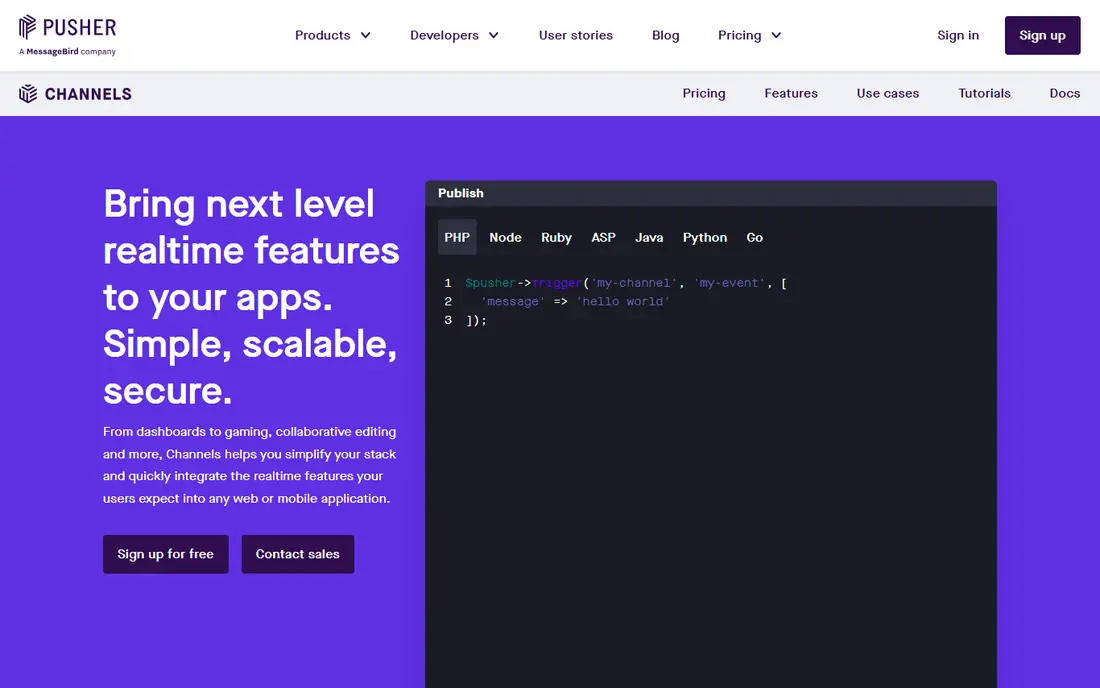
Pusher Channels is the simplest managed replacement for many Ably use cases. You publish events to channels, clients subscribe, and Pusher handles the WebSocket connections and delivery. Fixed tiers make budgeting easy: you pick a daily message volume and a concurrent connection limit, and you know the monthly price in advance.
The catch is fan-out counting. One event sent to many subscribers counts as one message per subscriber delivered, so a broadcast to a large room costs far more than a single message. When limits are exceeded, new connection attempts can be blocked, which makes capacity planning important for live events. For small to mid-size apps with predictable traffic, Pusher's simplicity is a real advantage.
- Simple fixed tiers for budgeting
- Free sandbox for prototypes
- Clear WebSocket pub and sub model
- One broadcast to many subscribers counts per delivery
- Limits block new connections when exceeded
PubNub suits apps that need global realtime messaging with history, presence, and server-side functions. Its SDK coverage spans mobile, web, and embedded platforms, which helps teams building across devices. Message history and presence support chat, live dashboards, and collaboration features without building those pieces from scratch.
Pricing is based on monthly active users and transactions, with a free tier up to 200 users and a Starter plan at $98 per month for 1,000 users in public comparisons. That model works well when user counts are predictable, but it can grow quickly when many occasional users each trigger transactions. Model your active users and transaction volume together before you commit, and watch overage rates.
- Global network and broad SDK coverage
- Message history and presence features
- Functions for server-side logic
- Monthly active user pricing can grow fast with many low-use users
- Transaction overages add cost
Firebase Realtime Database is a practical choice when your app already runs on Firebase. Data syncs in real time to connected clients, and clients resync automatically after a reconnect, which covers many live update needs without a separate messaging service. The free Spark plan supports 100 simultaneous connections, which is enough for a prototype.
The billing model is the part to watch. Firebase charges for database reads, writes, and connection time on paid plans, so a chatty app with frequent reads can cost more than a pure messaging service at the same scale. That makes Firebase best for mobile-first apps where realtime updates are tied closely to stored data, rather than for high-frequency broadcast to huge audiences.
- Free Spark plan for prototypes
- Real-time sync tied to your data
- Automatic resync after reconnects
- Costs scale with reads and writes, not just messages
- Can grow expensive as read patterns increase
Supabase Realtime is the natural pick when your data already lives in Postgres on Supabase. Database changes broadcast to subscribed clients over WebSockets, so a new row, an update, or a delete can trigger a live UI change without extra polling. Because it is open source and bundled with Supabase, teams already using Supabase get realtime features without a second vendor.
The limits are tighter than on Pusher or PubNub. The free tier covers 200 concurrent clients, and the Pro plan at $25 per month raises that to 500, with message limits to match. That is enough for many internal tools and small apps, but not for a massive public broadcast. If your app is Supabase-native, the simplicity outweighs those limits. If you need huge scale, a dedicated service fits better.
- Realtime updates driven by Postgres changes
- Open source
- Bundled with the wider Supabase platform
- Connection and message limits are lower than dedicated messaging services
- Best for Supabase-native apps
Socket.IO is the classic self-hosted choice for WebSocket apps, and it remains a strong Ably alternative for teams that want full control. It supports rooms for grouped clients, namespaces for separate channels, and fallbacks for older browsers. The library is free, widely documented, and familiar to many Node.js developers, which shortens the learning curve.
The trade-off is operations. You handle scaling across servers, presence tracking, message history, and reconnection logic yourself, or you add adapters and stores to cover them. That is fine for a small app on one server, and it becomes real engineering work at scale. If you want no per-message bill and full control, Socket.IO is a solid foundation. If you want managed scale, Pusher or PubNub will save time.
- Free and widely used
- Rooms, namespaces, and fallbacks built in
- Large community and documentation
- You run scaling, presence, and history yourself
- Multi-server setups need extra adapters
Centrifugo is a self-hosted realtime server built for broadcasting messages to many clients, with presence and history support. It is language-agnostic, so backends in different languages can publish to it, and clients can subscribe over WebSockets and other transports. That makes it a good middle ground between a raw library and a managed service.
As with Socket.IO, you own hosting, scaling, and monitoring. Centrifugo gives you more server structure out of the box, but you still need to plan capacity, backups, and upgrades. For teams that want a dedicated realtime server without a per-message bill, and that have the skills to run it, Centrifugo offers a clean, focused design.
- Free and open source
- Built for broadcast and presence
- Language-agnostic client libraries
- You host and scale it
- Advanced history and analytics need extra setup
Soketi is the easiest self-hosted path for teams already using Pusher-style code. Because it speaks the Pusher protocol, many existing clients and server libraries work with minimal changes, which lowers migration risk. It is free and open source, so there is no per-message bill, and you can run it on your own server or cloud instance.
The limits mirror its design. Soketi follows the Pusher protocol rather than copying every Ably feature, so apps that rely on Ably-specific guarantees should check compatibility carefully. You also own uptime, scaling, and monitoring. For a Pusher-shaped app that wants to cut managed costs, Soketi is a practical, low-risk move.
- Pusher protocol compatible, so migration is easier
- Free and open source
- Self-hosted with no per-message cost
- You run scaling and reliability yourself
- Feature set follows the Pusher protocol, not Ably's full feature set
Liveblocks suits a different slice of the realtime market: collaborative apps where several people edit, comment, or move through the same document at once. It provides presence, shared storage, and collaboration helpers that would take significant work to build on a raw messaging service. Modern SDKs for web frameworks make integration faster for product teams.
The catch is scope. Liveblocks is not a general-purpose broadcast service for huge public audiences, and its pricing is based on monthly active users, starting at $25 per month in public comparisons. If your app is a multiplayer editor, a whiteboard, or a collaborative dashboard, Liveblocks can save months of work. If you need raw pub and sub at scale, a messaging service fits better.
- Built for multiplayer editors and collaborative tools
- Presence and storage helpers
- Modern SDKs
- Focused on collaboration, not general broadcast
- Pricing rises with monthly active users
Azure SignalR Service is the managed answer for teams already building on Microsoft technology. It handles the scaling of SignalR hubs, so .NET and web apps can push live updates without running their own connection servers. Integration with Azure Functions, App Service, and other Azure tools makes it a natural fit for an Azure-native architecture.
Pricing is usage-based, with a free tier for development and paid tiers based on units and message volume, so we list it as See website rather than fixing a single figure. Teams outside the Microsoft stack will find less value here, since the main benefit is integration. For Azure shops, it removes a major scaling headache at a predictable cloud cost.
- Managed SignalR for .NET and web apps
- Scales connections without self-hosting hubs
- Integrates with Azure services
- Best for Microsoft-centered stacks
- Pricing is usage-based and needs a calculator check
How we picked these
We compared official feature pages, pricing pages, documentation, and public reviews for realtime messaging tools that are live in October 2026. We required a real realtime path, whether managed, database-driven, or self-hosted, and we weighed pricing models, connection limits, history, presence, and SDK coverage. We did not claim hands-on testing, and we used See website where pricing depended on usage or a calculator.
What to check before you switch
Start by measuring your traffic in the vendor's own units. Count peak connections, messages per day, fan-out per broadcast, and monthly active users, since each vendor bills a different combination. A service that looks cheap on messages can be expensive on connections, and vice versa.
Next, test delivery guarantees that matter to your app. Check ordering, history, presence accuracy, and reconnect behavior under a real load test, not just a demo. Confirm SDK support for every platform you ship, and check how the service handles a traffic spike, including whether it blocks, queues, or bills overages. Finally, run a small production slice on the new service before a full migration, so billing surprises show up while they are still small.
Frequently asked questions
What is the closest Ably alternative?
Pusher Channels is the closest simple managed alternative for pub and sub, while PubNub is closer for global messaging with history and functions. The right pick depends on whether you value fixed pricing, global reach, or specific delivery guarantees. Compare fan-out counting and connection limits on your real traffic before choosing.
Can I self-host an Ably alternative for free?
Yes, Socket.IO, Centrifugo, and Soketi are free and open source, and you pay only for your own hosting. Self-hosting removes per-message bills but adds work for scaling, monitoring, and reliability. Small apps save money easily, while large apps should budget engineering time for operations.
Is Firebase a good replacement for Ably?
Firebase suits apps whose realtime updates are tied to stored data, especially mobile apps already on Google Cloud. It is less suited to high-frequency broadcast to huge audiences, since costs scale with reads and writes. If your app is Firebase-native, it is a practical choice. If you need pure messaging at scale, a dedicated service fits better.
How does Pusher pricing compare with PubNub pricing?
Pusher uses fixed tiers based on daily messages and connections, which makes budgeting simple. PubNub uses monthly active users and transactions, which suits predictable user counts but can grow with many low-use users. Model both on your own numbers, including fan-out, before you decide which is cheaper for your app.
Do these tools support presence and history?
Most do, but details vary. Pusher and PubNub offer presence, PubNub and Firebase offer history through storage, and self-hosted tools need configuration for history and presence at scale. Check the exact behavior for your use case, including how long history is kept and how presence handles reconnects.
Which alternative is best for collaborative editing?
Liveblocks is the best pick here for collaborative editing, thanks to presence and shared storage helpers built for multiplayer apps. Socket.IO and Centrifugo can also power collaboration, but you will build more of the editing logic yourself. Choose Liveblocks when collaboration is the product, not just a feature.
Sources
- https://www.vibereference.com/backend-and-data/realtime-websocket-platforms
- https://websocket.org/comparisons/managed-services/
- https://ably.com/compare/pubnub-vs-supabase
- https://pusher.com/channels
- https://www.pubnub.com
- https://firebase.google.com/products/realtime-database
- https://supabase.com/realtime
- https://socket.io
- https://centrifugal.dev
- https://soketi.app
- https://liveblocks.io
- https://azure.microsoft.com/en-us/products/signalr-service
See where you really rank - block by block
ProMapRanker scans Google Maps across a grid of your service area. Simple monthly plans from $19, white-label on every plan.
Start freeKeep reading
 zyte alternatives
Best Zyte Alternatives in 2026
These zyte alternatives cover managed scraping APIs, proxy networks and no code tools for lawful collection from your own or consented sources only in 2026.
Read → zerto alternatives
Best Zerto Alternatives in 2026
Compare the best zerto alternatives for disaster recovery and replication, with recovery targets, cloud options and honest trade-offs for teams in 2026.
Read → zerofox alternatives
Best ZeroFox Alternatives in 2026
We compared 9 zerofox alternatives for brand protection, phishing takedowns, dark web monitoring, and social impersonation, with clear coverage notes.
Read →