 ProMapRanker
Best Weekdone Alternatives in 2026


Dedicated OKRs with strategy maps · Pricing starts at: €8 per user per month
Key takeaways
- Perdoo and Tability are the closest dedicated OKR replacements, with Perdoo offering a free plan for up to 5 users and Tability starting at $6 per user per month.
- If goals need to sit next to performance reviews, 15Five and Lattice make more sense than a standalone OKR tool, even though they cost more per seat.
- Mooncamp and Quantive suit teams that want a clean, focused OKR workflow without buying a full people platform.
- Betterworks and Profit.co are built for larger, more structured programs, so small teams may find them heavier than they need.
Quick comparison
| Pick | Great for | Pricing starts at | Free tier | |
|---|---|---|---|---|
| Perdoo | Dedicated OKRs with strategy maps | €8 per user per month | Yes | Visit |
 Tability | Simple weekly check-ins | $6 per user per month | Free trial | Visit |
 Mooncamp | Clean, modern OKR tracking | €7 per user per month | Free trial | Visit |
 15Five | Goals tied to performance reviews | $11 per user per month | Free trial | Visit |
 Lattice | Goals inside a people platform | See website | No | Visit |
 Betterworks | Structured enterprise goal programs | $8 per user per month | No | Visit |
 Profit.co | OKRs with task tracking | See website | Free trial | Visit |
 Quantive | Data-linked OKRs and dashboards | $9 per user per month | Free trial | Visit |
The best Weekdone alternatives
Weekdone is built around weekly status updates and OKRs, so the best replacements keep that weekly rhythm while adding clearer goal tracking, better reporting, or a closer link to performance work. We focused on tools that still actively support OKRs in October 2026.

Perdoo is the most direct Weekdone replacement for a team that wants OKRs as the main job, not a side feature. The free plan covers a small team with the full OKR workflow, which makes it a low risk way to learn the method before paying. Its strategy map helps a manager show how a team goal connects to a company goal, instead of leaving goals as a flat list.
The split between OKRs and KPIs is a practical strength. OKRs track ambitious, time bound goals, while KPIs track ongoing health measures, and Perdoo keeps those two ideas apart rather than mixing them into one number. That clarity helps in review meetings, because a missed key result does not get hidden inside a steady KPI. The trade-off is the billing structure. Paid plans need at least 5 seats and run quarterly or annually, so a very small team that outgrows the free plan should check the total cost before committing.
- Free plan for up to 5 users
- Clear separation of OKRs and KPIs
- Strategy map links company goals to team goals
- Paid plans require at least 5 paid seats
- No monthly billing, with quarterly billing as the shortest paid option
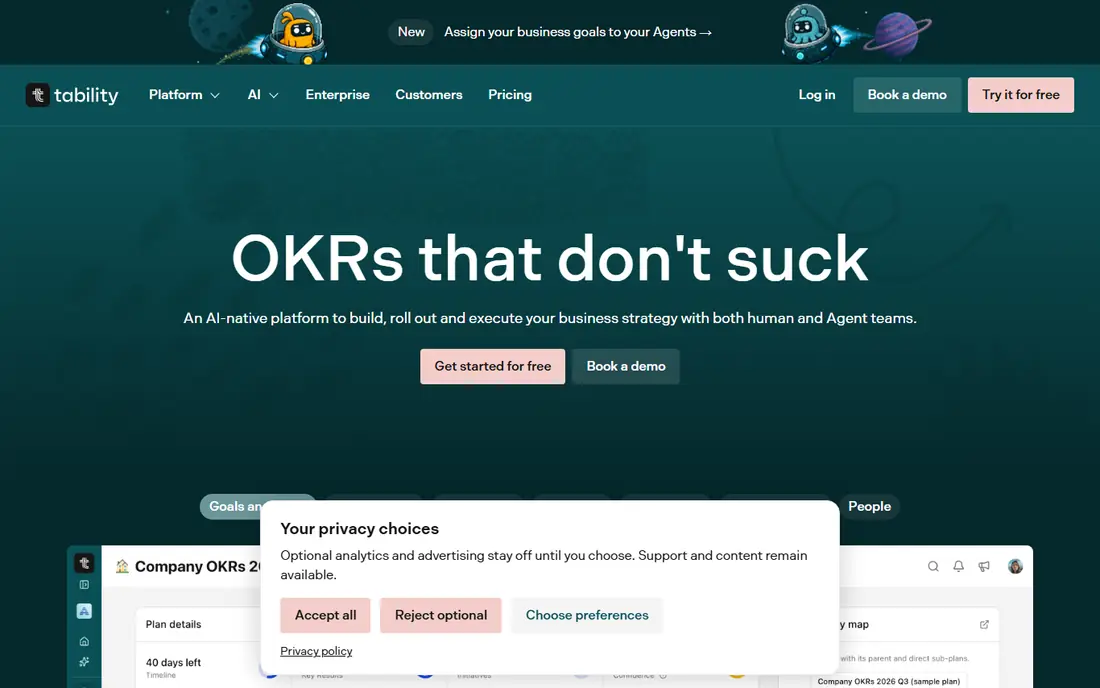
Tability wins on habit. Each goal owner gets a reminder, enters a number, picks a confidence level, and adds a short note, and that small routine is what keeps OKRs alive between quarterly planning sessions. For teams that liked Weekdone for weekly reporting, this is the closest feel in the list, with less setup and a cleaner interface.
The pricing is straightforward for a small team. Basic starts at $6 per user per month on annual billing, and Premium adds data connectors and extra view-only seats. The main catch is that there is no free plan that lasts forever, only a 14-day trial, so a team on a tight budget should compare it with Perdoo first. Tability also stays focused on goals and check-ins, so teams that need deep project management will still need another tool for daily task work.
- Short weekly update routine
- Basic plan starts at $6 per user per month
- Two free view-only seats per paid seat on Premium
- No permanent free plan
- Smaller teams may outgrow the Basic plan quickly

Mooncamp suits a team that wants OKRs to look inviting rather than administrative. The layout is plain and visual, which matters when goals are shared in a meeting and everyone needs to read progress at a glance. It also covers KPIs and feedback, so a manager can keep recognition and goal progress in the same place without buying a separate people tool.
The five-seat minimum is worth noting for a team of two or three, since the monthly total will reflect five seats even if fewer people edit goals. Mooncamp also leans toward simplicity, which is a strength for adoption and a limit for a team that wants heavy customization or complex approval chains. For a mid-size team that wants a focused OKR tool with a pleasant interface, it is a strong pick.
- Easy to read OKR and KPI views
- Essential plan starts at €7 per user per month
- Feedback features sit alongside goals
- Five-seat minimum on paid plans
- Annual billing only on the plans we checked
Where Weekdone stops at weekly updates, 15Five connects goals to the wider performance conversation. A manager can run a weekly check-in, give feedback, and later tie that same work to a review, all in one place. That link is useful when goals are meant to shape development conversations, not just sit on a dashboard.
The pricing catch is plan placement. OKRs sit in the Perform plan at $11 per user per month, not in the cheaper Engage plan, so a team that only wants goals will pay for performance features too. For a team already planning to buy performance software, that bundle can be good value. For a team that only wants OKRs, a dedicated tool like Perdoo or Tability will usually cost less.
- OKRs sit next to check-ins, feedback, and reviews
- Perform plan starts at $11 per user per month
- Strong manager coaching tools
- OKRs are not in the cheaper Engage plan
- Cost rises fast for larger teams
Lattice is the pick when goals are part of a people program rather than a standalone habit. Its Goals and OKRs product connects to performance reviews, engagement surveys, and feedback, which helps HR teams show how individual work links to company direction. Companies that already run reviews in Lattice can add goals without teaching staff a second system.
The downside is scale and cost structure. Lattice prices its products separately and applies a minimum annual spend on some plans, so a small team should get a quote before assuming it fits a modest budget. It is also a larger platform to administer than a dedicated OKR tool, which can slow down a team that just wants weekly check-ins. For a growing company that already needs performance software, though, it is a coherent choice.
- Goals and OKRs sit next to reviews, engagement, and feedback
- Well suited to larger companies with HR-led programs
- Wide integration options
- Pricing is sold per product with a minimum annual spend on some plans
- More platform than a small team needs
Betterworks is built for organizations that run goals as a formal program, with alignment across departments and regular calibration. Its strength is structure: goals cascade, progress is visible across teams, and managers can link goal work to performance discussions. That discipline helps a larger company avoid the common problem of goals that are written once and then forgotten.
For a small team, that same structure can feel like overhead. There is no free plan, and the implementation takes more planning than a tool like Tability or Mooncamp. Teams that want a light weekly check-in tool should look elsewhere first. Teams that need governance, reporting depth, and a consistent process across many managers will get more from Betterworks.
- Strong goal alignment views for larger organizations
- Combines goals with performance conversations
- Established enterprise feature set
- Setup can feel heavy for a small team
- No free plan
Profit.co appeals to teams that want goals and the work behind them in one view. OKRs link to tasks, so a key result is not just a number on a dashboard but a set of assigned actions with owners and due dates. Its KPI library also helps teams that track many operational measures alongside their quarterly goals.
The main drawback is pricing transparency. Public pricing is limited, and buyers generally need a quote, which makes quick budget comparisons harder than with Perdoo or Tability. The feature set is also broad, so a new user may need a week or two to learn where everything sits. For a team that wants OKR, task, and review work combined, the breadth is a real advantage once that learning period passes.
- OKRs connect to tasks and performance reviews
- Wide KPI library
- Task integration keeps goals tied to daily work
- Public pricing is limited, so budgeting needs a quote
- Interface can take time to learn
Quantive, formerly Gtmhub, is the choice for teams that want key results updated from real business data rather than manual entry alone. Its integrations pull numbers from other systems into dashboards, which cuts down on copy and paste work and makes progress harder to fudge. For a data-led team, that link between goals and source systems is the main reason to pick it.
That power comes with setup work. Connecting data sources, building dashboards, and agreeing on definitions takes longer than starting a simple weekly check-in tool. A small team with a handful of goals may find Tability or Mooncamp faster to adopt. A larger or more analytical team that already tracks metrics in several tools will likely find the extra setup worth it.
- Wide integration options for pulling in data
- Customizable dashboards
- Good fit for data-led teams
- More configuration than a simple check-in tool
- Smaller teams may not use the full integration depth
How we picked these
We compared official feature pages, pricing pages, app store listings, and public reviews for OKR and goal tracking tools that are live in October 2026. We kept only tools that still offer OKR tracking as a core feature, and we left out tools that have been folded into another product or discontinued. Prices shown are the entry paid rates we found in recent vendor and pricing comparisons, and where pricing is quote based we wrote See website rather than guessing a number.
How to choose the right OKR tool for your team
Start with the habit you will actually keep. If weekly check-ins are the goal, pick the tool with the shortest update routine and test it for two full weeks with real goals, not demo data. If goals must feed performance reviews, choose a platform that already handles reviews, even if the seat price is higher, because running two systems usually costs more in time than it saves in subscription fees.
Match the tool to your team size
A team of five or fewer should weigh free plans and seat minimums first. Perdoo covers up to 5 users free, while Mooncamp and Perdoo both apply seat minimums on paid plans. A larger team should weigh reporting, permissions, and integrations more heavily, since those features decide whether goals stay visible across departments.
Check the total cost, not just the seat price
Seat prices hide minimums, view-only seats, and add-ons. Ask how many seats you must buy, whether viewers cost money, and which features sit on higher tiers. A tool that looks cheap per seat can cost more overall if every viewer needs a paid license or if OKRs sit on a premium plan.
Frequently asked questions
What is the best Weekdone alternative for a small team?
Perdoo is a strong starting point because its free plan covers up to 5 users with the full OKR workflow. Tability is another good option if your team values a short weekly check-in routine and is willing to pay from $6 per user per month.
Do these tools replace weekly status updates?
Most of them keep a weekly check-in routine, and Tability and Perdoo are built around it most directly. The difference is that OKR tools tie each update to a measurable key result, so a status note also shows progress toward a goal.
Can I use an OKR tool without performance reviews?
Yes. Dedicated tools like Perdoo, Tability, Mooncamp, and Quantive work well on their own, with no review features required. Platforms like 15Five and Lattice add reviews, but you do not have to use that part if goals are your only need.
Which Weekdone alternative is cheapest?
Perdoo is cheapest for a team of up to 5 users, since the free plan costs nothing. Beyond that, Tability at $6 per user per month and Mooncamp at €7 per user per month are among the lowest paid entry points in this list.
How long does it take to switch OKR tools?
A dedicated tool can usually be set up in a day or two if goals are already written, with a week or two for the team to settle into the check-in habit. Larger platforms like Lattice and Betterworks take longer, since they involve more setup, permissions, and training.
Sources
- https://www.effy.ai/blog/okr-software
- https://www.tability.io/compare/platforms/pricing
- https://peerbie.com/blog/okr-software/
- https://www.perdoo.com
- https://www.tability.io
- https://www.mooncamp.com
- https://www.15five.com
- https://www.lattice.com
- https://www.betterworks.com
- https://www.profit.co
- https://www.quantive.com
See where you really rank - block by block
ProMapRanker scans Google Maps across a grid of your service area. Simple monthly plans from $19, white-label on every plan.
Start freeKeep reading
 zoho books alternatives
Best Zoho Books Alternatives in 2026
Compare the best zoho books alternatives for small business accounting, from QuickBooks Online and Xero to FreshBooks, Wave, and Sage in 2026, with pricing.
Read → zluri alternatives
Best Zluri Alternatives in 2026
Compare zluri alternatives for 2026, with SaaS management platforms for app discovery, spend tracking, renewals, and automation for IT, finance and procurement.
Read → zerobounce alternatives
Best ZeroBounce Alternatives in 2026
Best zerobounce alternatives for list hygiene: compare 8 email verification tools for bulk cleaning, real-time checks and catch-all handling in 2026 today.
Read →