 ProMapRanker
Best TechTarget Alternatives in 2026

Key takeaways
- TechTarget is strongest for first-party research from technology buyers, so the closest swap depends on whether you need that same audience or broader intent signals.
- Bombora and 6sense suit teams that want topic surge data across many publisher sites, while Demandbase suits teams that want ads, orchestration, and intent in one platform.
- ZoomInfo is the practical pick when contact data matters as much as intent, because it pairs account signals with names, titles, and direct contact details.
- G2 Buyer Intent and TrustRadius suit software vendors well, since their signals come from buyers already comparing products in a category.
- Most enterprise intent tools are priced on request, so ask for total cost, topic limits, seat limits, and contract length before you sign.
Quick comparison
| Pick | Great for | Pricing starts at | Free tier | |
|---|---|---|---|---|
 Bombora | Broad topic surge signals | See website | Free trial | Visit |
 6sense | Predictive account scoring | See website | Free trial | Visit |
 Demandbase | Account-based advertising and orchestration | See website | Free trial | Visit |
 ZoomInfo | Intent plus contact data | See website | Free trial | Visit |
 G2 Buyer Intent | Software buyers comparing products | See website | No | Visit |
 TrustRadius | Review-site buyer intent | See website | No | Visit |
 Madison Logic | Multi-channel account activation | See website | No | Visit |
 Dealfront | Website visitor identification | See website | Yes | Visit |
The best TechTarget alternatives
TechTarget built its name on technology buyers researching products on its own publications. The tools below do not copy that exact audience, but they cover the same jobs in different ways: finding accounts that are researching, ranking them, and turning that interest into outreach, ads, or sales conversations. We compared official feature pages, pricing pages, and public product descriptions for each one.

Bombora tracks changes in topic consumption across a cooperative network of business publisher sites, then flags accounts whose interest in a topic has risen sharply. That surge idea is easy for a sales team to act on, because it gives a reason to call now rather than a vague list of companies in a market. It also works across many industries, not only technology, which helps vendors that sell into several verticals at once.
The main gap is execution. Bombora tells you which accounts are showing interest, but you still need a contact source and an outreach plan to reach the right people inside those accounts. Teams that already own a contact database or a CRM with good coverage will get more from it than teams starting from scratch. Ask how many topics are included, how surge scores are calculated, and which integrations are included in the quoted price.
- Large publisher co-op for topic signals
- Clear surge concept for prioritising accounts
- Widely integrated with other sales and marketing tools
- Signals alone do not supply contact details
- Pricing is not published
- Smaller teams may find the annual commitment heavy

6sense aims to predict where an account sits in its buying journey, rather than simply reporting that it read an article. It pulls together website activity, third-party intent, and CRM data, then scores accounts and suggests next steps. For a team with a defined target account list, that ranking can save a lot of time, because reps can start with accounts that look closest to a decision.
The trade-off is complexity and cost. A predictive model needs clean CRM data and regular review, or its scores will reflect bad inputs. Smaller teams may also struggle to justify an enterprise platform when a simpler surge tool would do. Run a pilot on a small set of accounts, compare the predicted stage with what sales actually finds, and only expand if the predictions hold up in real conversations.
- Buying-stage predictions for accounts
- Combines first-party and third-party signals
- Strong orchestration for sales and marketing teams
- Pricing is not published
- Setup and tuning take time
- Best suited to larger revenue teams
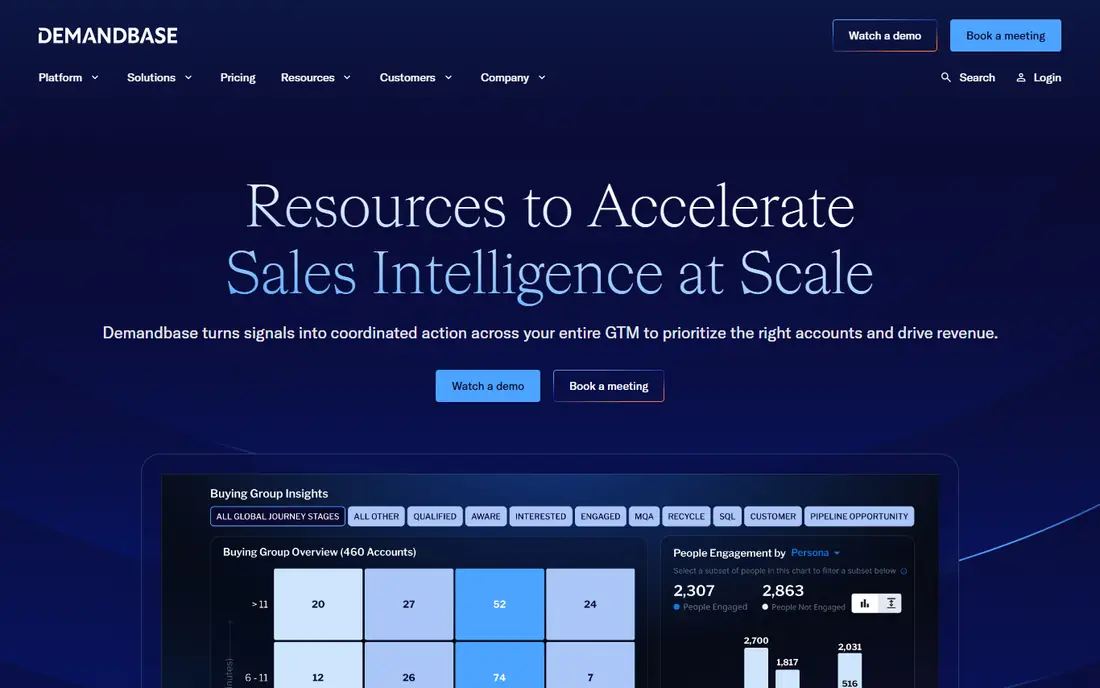
Demandbase is built for account-based marketing, where marketing and sales agree on a target list and then work those accounts together. Intent signals help choose the accounts, advertising helps reach people inside them, and orchestration tools help sales follow up at the right moment. That joined-up approach is its main advantage over a standalone intent feed, especially for vendors with long sales cycles.
It is not a quick fix for a weak target list. If your ideal customer profile is vague, Demandbase will simply help you reach the wrong accounts more efficiently. It also works best when sales and marketing share goals and data, which is an organisational change as much as a software purchase. Ask for a demo using your own account list, and check how much of the platform your team will actually use in the first three months.
- Intent, advertising, and sales orchestration in one platform
- Account-level targeting for B2B campaigns
- Useful for coordinated marketing and sales plays
- Pricing is not published
- Enterprise focus can make it costly for small teams
- Advertising results still depend on creative and offer quality
ZoomInfo appeals to teams that want one place to find an account, see a signal, and then find a person to contact. That matters because intent alone often leaves sales asking who to call. With ZoomInfo, a rep can move from a surging account to a filtered list of titles in the same workflow, which shortens the gap between signal and outreach. Its company data also helps with segmentation by size, industry, and technology use.
The catch is that you need to check what is actually included in your quote. Intent, phone numbers, and other features are often packaged separately, so two ZoomInfo contracts can look very different. Data accuracy also needs spot checks, especially for smaller companies and newer roles. Before you buy, test a sample of contacts in your own market and confirm how credits, exports, and seats are counted.
- Large contact and company database
- Intent signals sit beside contact details
- Familiar prospecting workflow for sales teams
- Pricing is not published and varies by package
- Data quality varies by region and role
- Intent is an add-on in some packages
G2 Buyer Intent is different from broad topic intent because it is tied to behaviour on a software review site. When an account visits your category page, compares you with a rival, or reads reviews, that is a strong sign it is already shopping. For software vendors, that bottom-of-funnel signal can be more useful than a general topic surge, because the buyer has already narrowed the field.
The limit is scope. If your buyers do not use G2, or your category is thin on that site, the signal volume will be low. It also works best when your G2 profile is complete and your reviews are current, since buyers will judge you on what they see there. Treat it as a complement to broader intent, not a replacement for a full prospecting database, and check whether intent is sold as an add-on to a profile subscription.
- Signals from buyers actively comparing software
- Useful for competitive displacement
- Pairs naturally with a G2 profile and reviews
- Only relevant if buyers research on G2
- Pricing is not published
- Value depends on your category presence
TrustRadius gives vendors a view of accounts engaging with review content, category pages, and comparisons on its platform. That behaviour sits close to a purchase decision, which is why it suits vendors that want to catch buyers during evaluation rather than early research. The review content itself is also useful, because buyers often read peer views before they talk to sales, and a current set of reviews can support that stage.
As with G2, the main risk is coverage. Categories with little traffic will produce few signals, and the tool will not help much if your buyers research elsewhere. It is also worth asking how intent data is delivered, whether it includes contact-level detail or account-level detail only, and how it connects to your CRM. Use it alongside broader intent if you want both early research signals and late-stage comparison signals.
- Intent from buyers reading reviews and comparisons
- Review content supports trust during evaluation
- Useful for retention and competitive plays
- Pricing is not published
- Signal volume depends on category traffic
- Smaller vendors may see fewer signals
Madison Logic focuses on activating target accounts across channels, using several signals to decide which accounts to prioritise. That includes intent-style signals plus content engagement, which can help a vendor reach accounts that are researching but have not yet raised a hand. For enterprise teams running account-based programmes, that activation layer can be more valuable than a raw data feed.
The downside is that managed and multi-channel services can be harder to compare on price and performance than a simple software subscription. You need clear reporting on which accounts were reached, what they engaged with, and what sales did next, or the programme can look busy without producing pipeline. Ask for reporting examples, check how leads and engagement data flow into your CRM, and agree on success measures before the first campaign.
- Multi-signal account targeting
- Content syndication and advertising options
- Suited to enterprise account-based programmes
- Pricing is not published
- Managed elements can reduce direct control
- Best for teams with a clear account strategy
Dealfront, formerly Leadfeeder, identifies companies that visit your website, even when no one fills in a form. That first-party signal is useful because it shows real interest in your own product, not just a general topic. A sales team can follow up with a relevant message about the pages visited, which usually lands better than a cold note based on a broad topic surge alone.
It will not replace third-party intent, because it only covers people who already found you. Anonymous company identification also has limits, since it cannot reliably name the individual visitor, and some traffic will remain unidentified. The free plan makes it a low-risk way to test whether visitor identification adds value, and it pairs well with a broader intent tool once you know which accounts you are already attracting.
- Identifies companies visiting your website
- Free plan for getting started
- Practical complement to third-party intent
- Company-level detail only for anonymous visitors
- Accuracy varies by visitor type
- Paid tiers are priced on request
How we picked these
We compared official feature pages, pricing pages, and public product descriptions for intent and account-based tools that serve technology sellers. We favoured tools with a clear signal source, a current product, and a realistic path from signal to outreach, ads, or sales follow-up. We left out tools that only sell contact lists with no intent layer, and tools whose main product is a general CRM with no intent focus. Prices are shown as See website where the vendor does not publish a starting price, because inventing a contract figure would mislead a buyer.
What to check before you buy intent data
Start with the signal source, not the sales pitch. Ask whether signals come from the vendor's own sites, a publisher co-op, review behaviour, or your own website traffic, and ask how recent the signals are. A surge from last quarter is far less useful than a surge from last week. Also ask whether you get account-level signals, contact-level signals, or both, because that decides how much extra work sales must do before outreach.
Next, check the practical limits in the contract. Topic counts, account counts, seat counts, export limits, and data refresh rates all affect the real cost. A low headline price with a small topic allowance can become expensive fast, while a higher price with generous limits may work out cheaper per usable account. Finally, run a short pilot on accounts your sales team already knows, and compare the tool's scores with real outcomes. If the highest-scored accounts do not convert into conversations, the model or the data source is not a good fit for your market, however polished the dashboard looks.
Questions to ask on a demo
Ask for a live look at signals for accounts in your target list, not a generic demo set. Ask how the vendor handles data quality, how often signals refresh, and what happens when a signal turns out to be wrong. Ask which CRM and sales tools are supported without extra integration work, and ask for a written breakdown of what is included in the quoted tier. Those answers tell you more than a feature list, and they make it easier to compare two vendors that sound similar on paper.
Frequently asked questions
What is the closest TechTarget alternative?
There is no exact copy, because TechTarget's strength is first-party research from technology buyers on its own publications. Bombora is close for broad topic surge data, 6sense is close for predictive account scoring, and G2 Buyer Intent is close for software buyers comparing products. Pick based on whether you need broad coverage, prediction, or late-stage comparison signals.
Is TechTarget only for technology companies?
TechTarget is built around technology buyers, so it fits vendors selling IT, software, security, and related products and services. Companies outside technology will usually get better coverage from a broader intent provider such as Bombora or Demandbase, which tracks topics across many industries. Check signal coverage in your own market before you assume a tech-focused tool will work for you.
Do I need contact data as well as intent data?
In most cases, yes. Intent tells you which account is interested, but sales still needs a person to contact. Tools such as ZoomInfo bundle the two, while tools such as Bombora pair best with a contact database you already own. Budget for both layers, or choose a platform that includes both, so signals do not sit unused.
How much do TechTarget alternatives cost?
Most enterprise intent tools are priced on request, with annual contracts and limits on topics, accounts, and seats. Smaller tools such as Dealfront offer a free starting tier, while larger platforms can run into five figures per year. Ask for total cost including implementation, integrations, and any add-on modules, and compare cost per usable account rather than headline price alone.
Can small teams use intent data?
Yes, but start small. A website visitor tool or a focused surge tool is easier to manage than a full predictive platform, and it gives a faster read on whether intent helps your sales process. Avoid buying a large topic allowance before you know which topics actually predict conversations in your market.
How do I measure whether intent data is working?
Track how many flagged accounts turn into conversations, meetings, and pipeline, compared with accounts that were not flagged. Also track time from signal to first outreach, because a slow follow-up wastes a fresh signal. Review those numbers monthly, drop topics that never convert, and expand topics that consistently lead to real sales conversations.
Sources
See where you really rank - block by block
ProMapRanker scans Google Maps across a grid of your service area. Simple monthly plans from $19, white-label on every plan.
Start freeKeep reading
 zoho books alternatives
Best Zoho Books Alternatives in 2026
Compare the best zoho books alternatives for small business accounting, from QuickBooks Online and Xero to FreshBooks, Wave, and Sage in 2026, with pricing.
Read → zluri alternatives
Best Zluri Alternatives in 2026
Compare zluri alternatives for 2026, with SaaS management platforms for app discovery, spend tracking, renewals, and automation for IT, finance and procurement.
Read → zerobounce alternatives
Best ZeroBounce Alternatives in 2026
Best zerobounce alternatives for list hygiene: compare 8 email verification tools for bulk cleaning, real-time checks and catch-all handling in 2026 today.
Read →