 ProMapRanker
Synup vs Birdeye

Key takeaways
- Synup publishes location-band pricing from $49 a month for one location, with reviews and listings bundled in every plan.
- Birdeye does not publish a price, and buyers report figures around $299 a month, so the real cost only appears after a sales conversation.
- Synup fits agencies and franchises that want a published price and white-label reporting from the Premium tier up.
- Birdeye fits multi-location brands that want reviews, messaging, surveys and AI tools in one enterprise platform.
- Both cover listings and reviews, but Synup is the transparent buy and Birdeye is the broader platform.
Quick comparison
| Pick | Great for | Pricing starts at | Free tier | |
|---|---|---|---|---|
 Synup | Listings and reviews at a published price | $49 per month (Solo, 1 location) | Free trial (14 days) | Visit |
 Birdeye | Reviews, messaging and surveys at scale | quote only | No | Visit |
Synup vs Birdeye in detail

Synup is a local presence platform that pushes business data to more than 200 directories, monitors and generates reviews, tracks local visibility and packages branded reporting. Its pricing page, read in October 2026, publishes location-band plans: Solo at $49 a month for one location, Premium at $299 a month for up to 10 locations, Pro at $499 a month for up to 25 locations, and Scale at $899 a month for up to 50 locations. Enterprise above 50 locations is custom priced. Annual billing saves 20 percent, and a 14-day free trial is offered. Every plan includes every feature, and white-label reporting starts on Premium.
Synup also includes an AI visibility report, called Synup AEO, which writes 16 local discovery prompts per location and reports how the business appears in AI answers. The report refreshes monthly and can be shared as a read-only link. The location-band model has one clear limit: the price jumps sharply between bands, so a business with 11 locations pays the Pro price of $499 a month, while a business with 10 locations pays $299. That step means a buyer should count locations carefully before choosing a tier, because one extra location can nearly double the bill.
Some third-party reviews report a different Synup plan structure, with Startup, Agency and Scale tiers at $79, $199 and $799 a month on annual billing, plus per-location modules at $20 to $50 each for listings, reviews, social and SEO. That reading conflicts with the location-band prices published on the vendor pricing page in October 2026, and the conflict itself is worth knowing: Synup has changed its pricing model over time, and the page you read today is the only reliable source. Confirm the plan names, the location limits and whether modules are charged on top before you sign, and ask the vendor to put the quote in writing.
- Published prices by location band with every feature in every plan
- White-label reporting from Premium up
- Price jumps sharply at each location band
- Some sources report a different plan structure, so confirm the current page
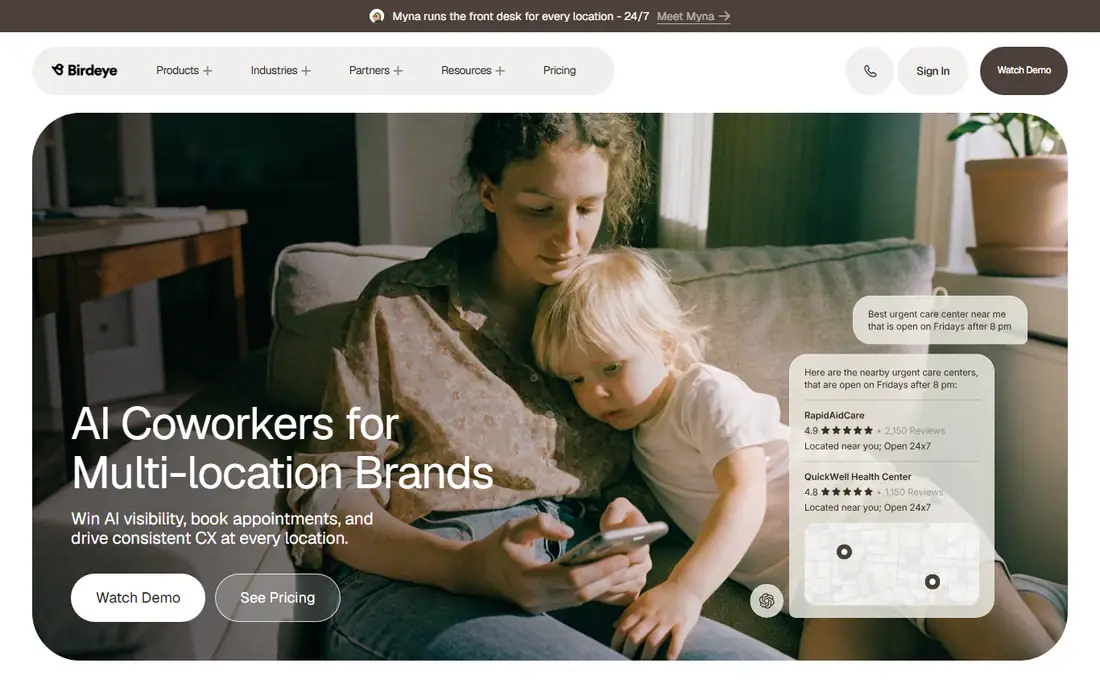
Birdeye is a customer experience platform for multi-location businesses, built around reviews, messaging, surveys and listings. It collects reviews from Google, Facebook and more than 150 other sites, lets teams reply from one inbox, sends review requests by text and email, and runs surveys that feed into the same dashboard. It also includes listings management, social publishing, webchat, payments and AI tools that draft replies and summarise customer sentiment. That breadth is the main reason large brands choose it: one platform covers the whole post-visit relationship, from the review request to the payment and the follow-up survey.
Birdeye does not publish a price. Its website asks buyers to book a demo or talk to sales, and third-party reports put the entry figure around $299 a month, though that number is not vendor-confirmed and the real price depends on location count, features and contract length. Birdeye offers no free plan, and the sales-led process means a small business cannot judge the cost from the website alone. The platform is built for scale, with multi-location dashboards, role-based access and reporting that suit franchises, healthcare groups, auto dealers and home services chains.
Birdeye suits a brand with many locations that wants one vendor for reviews, messaging and surveys. A single-location business with a tight budget will find the quote-only model and the enterprise feature set heavy, and a cheaper tool may cover its review requests for a fraction of the cost. An agency should confirm whether the price is per location, which AI features are included, and how the contract handles adding locations mid-term, since those three points drive the total more than the headline figure. A buyer who only needs listings and reviews at a published price will find Synup simpler to budget for.
- Reviews, messaging, surveys, listings and AI tools in one platform
- Strong fit for multi-location brands
- Quote-only pricing with no published entry price
- Enterprise scale and sales process can be heavy for small buyers
Which one fits your setup
| Your setup | Pick | Why | Monthly cost from | | Single location, published price | Synup | Solo at $49 a month, all features included | $49 | | 2 to 10 locations, white-label reports | Synup | Premium includes white-label from $299 a month | $299 | | Franchise, 25 to 50 locations | Synup | Pro or Scale bands with bundled AI visibility report | $499 to $899 | | Multi-location brand, reviews plus surveys | Birdeye | Reviews, messaging, surveys and AI in one platform | Quote only | | Enterprise, 100 or more locations | Birdeye | Multi-location dashboards and role-based access | Quote only |
How we chose
We compared vendor pricing pages, product pages and documentation for both tools, and we read third-party reviews that quoted the vendor pages in October and November 2026. We checked the starting price of each plan, what the entry tier includes, whether a free plan or trial exists, and which features sit behind a higher tier or a sales quote. We compared the two on listings distribution, review management, messaging, surveys, AI visibility and reporting, and we noted where each tool stops, such as Synup pricing jumping between location bands and Birdeye keeping its price behind a sales conversation. We found two conflicting Synup price readings in third-party sources and reported both, with the vendor pricing page as the primary source. We did not test either product hands-on, and we did not claim that one lifts rankings, since no vendor publishes a controlled test of that kind.
What to check before you buy
Check how many locations you manage, because Synup charges by location band and the price jumps sharply at each step, so 11 locations costs far more than 10. Ask Synup to confirm the current plan names and whether any module is charged on top of the plan, since third-party sources report two different plan structures. With Birdeye, ask for a written quote that names the per-location price, the included features and the contract length, since nothing is published. Confirm the trial terms: Synup offers a 14-day trial, while Birdeye offers a demo but no free plan. Check whether AI visibility reporting is included or charged separately, since Synup bundles a monthly AI report and Birdeye prices AI tools by tier. Finally, confirm who owns the data and how exports work if you cancel, because moving review history and listings to another platform takes planning. Before you commit, check how each platform handles duplicate listings, because a franchise that has moved offices or changed phone numbers can carry old listings that confuse customers and search engines. Synup includes duplicate suppression in its listings product, so ask how it finds duplicates and whether removal is automatic or needs a manual request. Birdeye also manages listings, so ask the same question and confirm which publishers it covers. Check the review response workflow too: who on your team replies, whether replies can be drafted by AI and approved by a person, and whether the platform logs every reply for later review.
Frequently asked questions
Is Synup cheaper than Birdeye?
Yes, for most buyers who can read the price. Synup publishes Solo at $49 a month for one location, while Birdeye does not publish a price and third-party reports put its entry figure around $299 a month. The gap reflects different scopes: Synup sells listings and reviews at a published price, while Birdeye sells a broader platform with messaging, surveys and AI tools. A buyer who needs only listings and reviews will spend less on Synup.
Why do Synup prices differ across review sites?
Because Synup has changed its pricing model over time. The vendor pricing page read in October 2026 publishes location-band plans from $49 a month for one location, while some third-party reviews report Startup, Agency and Scale tiers at $79, $199 and $799 a month plus per-location modules. The vendor page is the primary source, but the conflict shows why you should confirm the plan names, the location limits and any module charges in writing before you sign.
Does Birdeye publish its pricing anywhere?
No. Birdeye keeps its pricing behind a sales conversation, and its website asks buyers to book a demo for a quote. Third-party reports put the entry figure around $299 a month, but that number is not vendor-confirmed and the real price depends on location count, features and contract length. Ask for a written quote that names the per-location price and the included features.
Which tool is better for a franchise?
Synup fits franchises that want a published price and a clear location-band cost, since Pro at $499 a month covers up to 25 locations with every feature included. Birdeye fits franchises that want reviews, messaging and surveys in one platform with multi-location dashboards and role-based access. The deciding factor is scope: a franchise that needs listings and reviews alone will find Synup simpler, while one that needs surveys and AI tools across many locations will find Birdeye broader.
Does Synup include AI visibility reporting?
Yes. Synup includes an AI visibility report, called Synup AEO, which writes 16 local discovery prompts per location and reports how the business appears in AI answers. The report refreshes monthly and can be shared as a read-only link. Birdeye also offers AI tools, but they are priced by tier and the details only appear in a sales quote, so compare the two on what is actually included before you choose.
Sources
See where you really rank - block by block
ProMapRanker scans Google Maps across a grid of your service area. Simple monthly plans from $19, white-label on every plan.
Start freeKeep reading
 Up Review alternatives
Up Review Alternatives
Up Review alternatives for local businesses and agencies: 8 review tools with real starting prices, free plans, and the trade offs that decide which one fits.
Read → Uberall vs Yext
Uberall vs Yext compared on listings, reviews, local pages and AI search. See which platform fits your location count, team and budget before you buy.
Read → Uberall vs Birdeye
: Which Local Suite Fits
Uberall vs Birdeye compared on listings, reviews and pricing, with the quote-only trap explained and cheaper picks for single shops and multi-location brands.
Read →