 ProMapRanker
SOCi vs Yext: Local Marketing Compared

Key takeaways
- Both SOCi and Yext hide their prices behind a sales quote, so neither tool lets you budget without a call.
- SOCi covers listings, reviews, social, local ads and surveys in one platform, while Yext leads on listings accuracy and local search through its knowledge graph.
- SOCi suits multi-location brands that want one team running local marketing, while Yext suits brands whose listings accuracy across hundreds of publishers matters most.
- Yext also offers local pages and site search, while SOCi leans on social scheduling, ad management and AI automation.
- Small businesses should look elsewhere first, because both tools are priced and sold for multi-location teams.
Quick comparison
| Pick | Great for | Pricing starts at | Free tier | |
|---|---|---|---|---|
 SOCi | All-in-one local marketing for multi-location brands | quote only | No | Visit |
 Yext | Listings accuracy and local search at scale | quote only | No | Visit |
SOCi vs Yext head to head
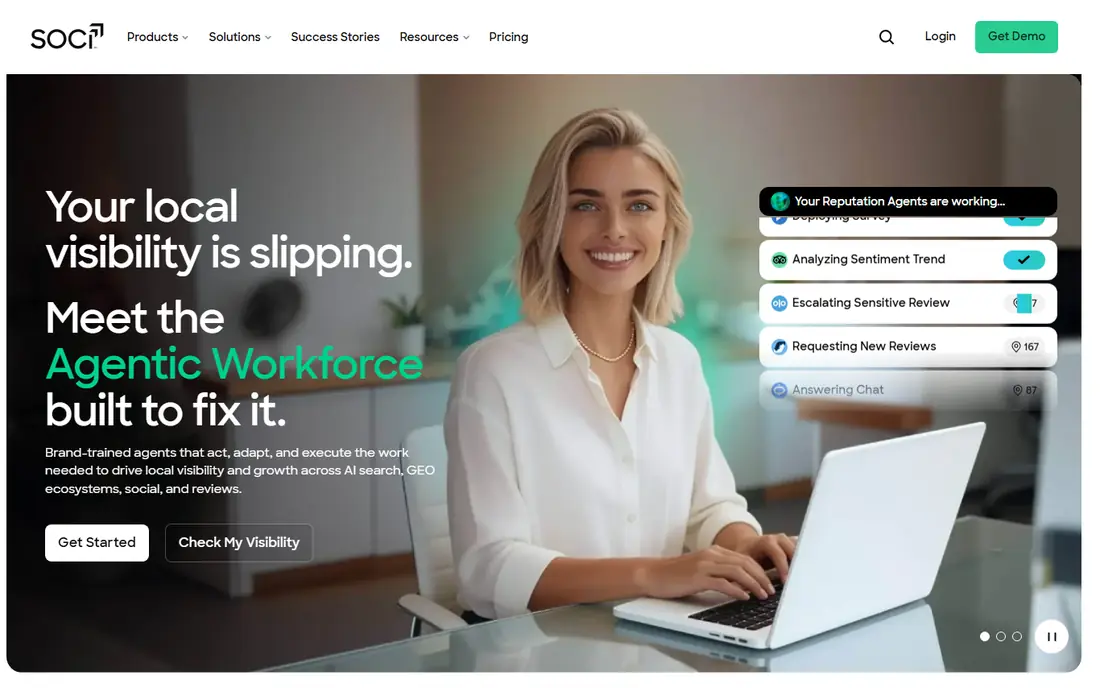
SOCi is a local marketing platform built for multi-location brands, franchises and agencies that manage many locations at once. It combines listings management, review monitoring and response, social media publishing, local advertising, surveys and AI automation in one system, so a brand can run its whole local presence from a single dashboard. The platform is designed for teams that need central control with local flexibility, letting head office set the brand rules while each location publishes its own social posts and answers its own reviews. SOCi also offers Genius AI, which drafts social content, review replies and ad copy, and automates routine local marketing tasks that would otherwise eat hours every week. SOCi does not publish any prices. There is no starter figure on its website, and third-party pricing guides do not carry a consistent entry number either, so the only way to learn the cost is a sales conversation and a written quote for your location count and the modules you need. That is normal for enterprise local marketing software, but it makes early comparison hard, because you cannot tell whether SOCi costs more or less than Yext until both sales teams have quoted you. SOCi also offers no free plan and no published free trial, so evaluation happens through a demo. Buyers should ask about the contract length, the renewal terms, the onboarding fees and the per-location cost, and get every figure in writing before signing. The breadth of SOCi is its main strength. A brand that buys SOCi can replace separate tools for listings, reviews, social scheduling, local ads and surveys with one contract and one login, and the reporting rolls up to the brand level while still showing each location. That suits franchises, restaurant groups, retail chains and healthcare groups with dozens or hundreds of locations. The limits are clear too. A single-location business will find SOCi heavy and expensive, because the platform is sold and priced for teams that manage many locations. The AI features help small teams, but they do not change the fact that pricing is quote only and onboarding is sales-led. For a multi-location brand that wants one platform for daily local marketing work, SOCi is a strong contender worth a demo.
- Covers listings, reviews, social, ads and surveys in one platform
- AI automation helps small local teams do more
- No published prices, so every quote needs a sales call
- Built for multi-location brands, not single-location businesses
Yext is a local search and listings platform built around its knowledge graph, a structured store of business facts such as name, address, phone number, hours, services and menus. When a fact changes in the knowledge graph, Yext pushes the update to Google, Apple Maps, Facebook, Yelp and hundreds of other publishers, so customers see the same correct information everywhere they search. That accuracy matters most for brands with many locations, where a wrong phone number or old hours on one directory can send customers to the wrong place. Yext also offers review monitoring and response, local pages for every location, and Yext Search for the business website, which answers customer questions from the same knowledge graph. Yext does not publish its prices. Every plan is priced by quote through a sales conversation, based on your location count, the publishers you need and the modules you choose. Third-party guides do not carry a consistent entry figure either, so the only way to learn the cost is a sales call followed by a written quote. Yext offers no free plan and no published free trial, so evaluation happens through a demo. Buyers should ask about the contract length, the renewal terms, the per-location cost, the onboarding fees and the cancellation notice, and get every figure in writing before signing. Because pricing is quote only, two similar businesses can pay different amounts, and the only honest comparison is two written quotes for the same location count and feature set. Yext leads on listings depth, and that is the reason most buyers pick it. Its publisher network is broad, its sync is fast, and its duplicate suppression and data quality controls help large brands keep hundreds of listings clean. The trade-off is that reviews and social are secondary to listings in the Yext platform, so a brand that wants deep social scheduling or local ad management may need a second tool, or pick SOCi instead. Yext also suits brands that want local pages and site search from the same knowledge graph, which SOCi does not offer in the same way. For a brand whose biggest local search problem is wrong or missing listings, Yext is the stronger fit despite the opaque pricing.
- Knowledge graph keeps listings accurate across hundreds of publishers
- Local pages and site search extend the platform
- No published prices, so every quote needs a sales call
- Listings-led focus means reviews and social are secondary
How we chose
We compared the vendor pricing pages, feature lists and plan documents for SOCi and Yext, and we checked third-party pricing guides that read those same pages in September and October 2026. We looked at what each plan includes, what costs extra, and which features sit behind a higher tier or a sales call. We did not run hands-on tests and we did not invent ratings, customer counts or test results. Where the vendors hide a price, we say so. Where two sources disagree, we use the figure from the most recent check and note the conflict. Prices change, so confirm the current figure with the vendor before you buy.
What to check before you buy
Ask each vendor for a written quote that covers your exact location count, because both SOCi and Yext price everything by quote and two similar businesses can pay different amounts. Confirm the contract length, the renewal terms and the cancellation notice, since enterprise terms are set by sales for both tools. Count the extra fees before you compare quotes, including onboarding, training and any per-location charges that sit outside the headline figure. Check which publishers each tool covers, because a listings tool that misses the directories your customers use is a poor buy at any price. Test how review requests and replies work, because both tools monitor reviews, but the response workflow and AI drafting differ. Ask who runs the daily work, since SOCi leans on social and ads while Yext leans on listings accuracy, and the team that uses the tool should pick the workflow it will actually run. Finally, check the reporting against your real needs, since brand-level rollups matter most when you manage dozens of locations.
| Business size | Best pick | Why it fits | Monthly cost at reported rates | | 1 location, local marketing | Neither, look at GatherUp or NiceJob | Both tools are built and priced for teams | $95 to $99 with published prices | | 10 locations, listings accuracy | Yext | Knowledge graph keeps facts correct everywhere | Quote only, get it in writing | | 10 locations, all-in-one marketing | SOCi | Listings, reviews, social, ads and surveys | Quote only, get it in writing | | 50 locations, social and ads | SOCi | Central control with local social and ads | Quote only, volume pricing applies | | 500 locations, listings at scale | Yext | Publisher network and data quality controls | Quote only, enterprise pricing applies |
Frequently asked questions
Which is cheaper, SOCi or Yext?
There is no public answer, because neither vendor publishes prices. Both tools are priced by quote through a sales conversation, based on your location count and the modules you need, and third-party guides do not carry a consistent entry figure for either one. The only honest comparison is two written quotes for the same location count, with the same features, contract length and renewal terms. Never budget on a reported figure alone.
Does SOCi publish its prices?
No, SOCi does not publish prices on its website, and third-party pricing guides do not carry a consistent entry number either. Every plan is priced by quote through a sales conversation, based on your location count and the modules you need. Ask the sales team for a written quote that lists the per-location cost, the contract length, the renewal terms, the onboarding fees and the cancellation notice before you compare it with any other tool.
Does Yext offer a free trial?
Yext does not publish a free plan or a free trial. Evaluation happens through a sales demo and a custom quote, and the final price depends on your location count, the publishers you need and the modules you choose. Ask the sales team what trial or pilot options exist for your business, and get the contract length, renewal terms and cancellation notice in writing before you sign. Never assume a trial exists because a competitor offers one.
Which tool is better for listings management?
Yext leads on listings management, because its knowledge graph is built to keep business facts accurate across hundreds of publishers, with duplicate suppression and data quality controls for large brands. SOCi also manages listings, but listings are one module inside a broader local marketing platform, not the core of the product. If listings accuracy is your biggest problem, Yext is the stronger pick. If you want listings plus social and ads in one place, SOCi fits better.
Which tool is better for a franchise?
It depends on what the franchise needs most. SOCi suits franchises that want one platform for listings, reviews, social publishing, local ads and surveys, with central brand control and local flexibility for each location. Yext suits franchises whose listings accuracy across hundreds of publishers matters most, and that also want local pages and site search from the same knowledge graph. Get quotes from both and compare the same feature set.
Should a single-location business buy either tool?
Usually not. Both SOCi and Yext are built and priced for multi-location teams, with sales-led onboarding and quote-only pricing. A single-location business will get more value from a tool with published prices, such as GatherUp at $99 per month or NiceJob at $95 per month, with a free trial included. Move to SOCi or Yext when you manage enough locations that central control, brand reporting and listings accuracy matter more than the lowest price.
Sources
See where you really rank - block by block
ProMapRanker scans Google Maps across a grid of your service area. Simple monthly plans from $19, white-label on every plan.
Start freeKeep reading
 Up Review alternatives
Up Review Alternatives
Up Review alternatives for local businesses and agencies: 8 review tools with real starting prices, free plans, and the trade offs that decide which one fits.
Read → Uberall vs Yext
Uberall vs Yext compared on listings, reviews, local pages and AI search. See which platform fits your location count, team and budget before you buy.
Read → Uberall vs Birdeye
: Which Local Suite Fits
Uberall vs Birdeye compared on listings, reviews and pricing, with the quote-only trap explained and cheaper picks for single shops and multi-location brands.
Read →