 ProMapRanker
Best Qualaroo Alternatives in 2026

Key takeaways
- Hotjar is the closest match for on site feedback, because it pairs surveys with heatmaps and session insight in one tool.
- Survicate fits teams that want feedback across website, email and product, with analysis that turns answers into actions.
- Typeform and SurveyMonkey suit general surveys, with Typeform winning on design and SurveyMonkey on template and panel depth.
- Qualtrics is the research grade pick, but its pricing and setup suit larger teams with formal research needs.
- Our pick for most small teams is Survicate for targeted feedback, with Hotjar when behaviour insight matters as much as answers.
Quick comparison
| Pick | Great for | Pricing starts at | Free tier | |
|---|---|---|---|---|
 Hotjar | On site surveys plus behaviour insight | See website | Yes | Visit |
 Survicate | Multi channel customer feedback | See website | Yes | Visit |
 Qualtrics | Research grade surveys | See website | Free trial | Visit |
 SurveyMonkey | General surveys and templates | Free | Yes | Visit |
 Typeform | Beautiful conversational surveys | Free | Yes | Visit |
 Userpilot | In product surveys and onboarding | See website | Free trial | Visit |
 Zonka Feedback | Customer experience surveys | See website | Free trial | Visit |
 Refiner | In product micro surveys | See website | Free trial | Visit |
 SurveySparrow | Conversational feedback surveys | See website | Free trial | Visit |
The best qualaroo alternatives
Qualaroo is a survey and feedback tool, so every product below collects feedback or survey answers. None of them is Qualaroo itself. The list covers website feedback, product feedback and general research.

Hotjar is the natural first look for a team replacing an on site survey tool. A survey can ask why visitors leave a page, while heatmaps show where they click and recordings show where they stall. That combination answers both what happened and why a visitor thinks it happened, in one account.
The limit is research depth. Hotjar surveys are best for short, targeted questions, not long questionnaires with complex logic. Teams that need deep branching, panels or statistical analysis should pair Hotjar with a research tool, or pick Qualtrics or SurveyMonkey for the survey itself.
- Surveys sit alongside heatmaps and recordings
- Feedback widgets are easy to place on a site
- Templates cover common on site questions
- Survey logic is simpler than a full research tool
- Higher plans are needed for larger traffic and full features
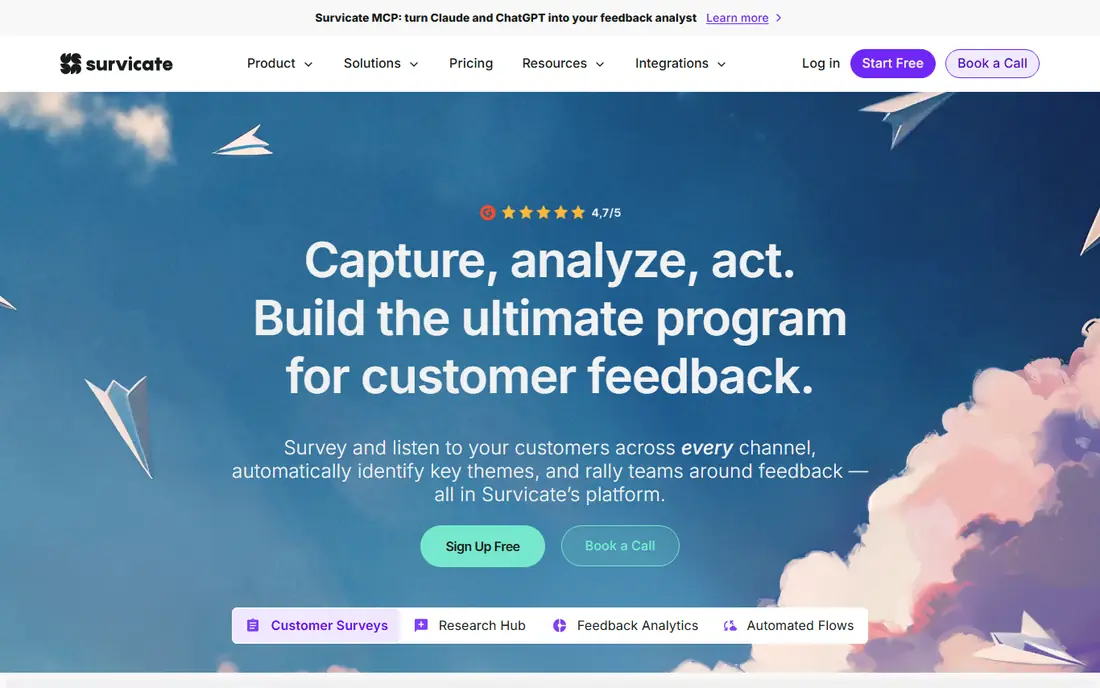
Survicate fits teams that want feedback wherever customers are, not only on the website. A survey can follow an email, appear in a product, or sit on a page, and the results feed into one view. That breadth makes it a strong Qualaroo replacement for customer experience teams.
Response limits on lower tiers need attention. A high traffic site or a large email list can hit the cap sooner than expected, so check the current response allowance against a typical month. For mid size teams, Survicate gives a good balance of reach, analysis and price.
- Surveys run on website, email, mobile and product
- Feedback analysis groups answers by theme
- Many native integrations connect survey data to other tools
- Entry paid tiers limit responses
- Advanced analysis needs higher plans

Qualtrics is the research heavyweight in this list. When a survey needs complex logic, large samples, conjoint or detailed segmentation, Qualtrics handles work that simpler tools cannot. Universities, large brands and research teams use it for that reason, and its reporting depth matches the complexity.
That power comes with cost and complexity. Pricing is often quoted, and a small team may find the setup heavier than the survey itself. Pick Qualtrics when research quality and governance matter more than speed, and pick a simpler tool when a short feedback survey is the whole job.
- Deep logic, branching and question types
- Strong analysis and reporting for research teams
- Enterprise security and governance features
- Pricing is quote based for many plans
- Setup and learning time are higher than simpler survey tools
SurveyMonkey is the safe generalist. Almost any standard survey, from customer satisfaction to employee feedback, has a template to start from, and sharing is straightforward. For teams that send surveys often but do not need on site widgets or product surveys, it is a dependable core tool.
The free plan is a starting point, not a full solution, with limits on questions and responses per survey. Paid plans lift those limits and add logic, branding and analysis. Check the current free limits before relying on it for a large survey, and use a targeted tool such as Survicate for on site feedback.
- Large template library for common surveys
- Easy sharing by link, email or embed
- Analysis tools cover most general survey needs
- Free plan limits questions and responses
- Advanced logic and branding sit on paid plans
Typeform wins on respondent experience. One question at a time, clean design and smooth mobile flow help completion rates, especially for signup, lead and customer surveys where the form itself is part of the brand. Logic, scoring and integrations handle most common flows without code.
The conversational style is not ideal for every survey. A long research questionnaire can feel slow one question at a time, and response limits on lower plans need checking. For short, branded surveys where completion matters, Typeform is a strong pick.
- Conversational one question at a time design
- Strong branding and design control
- Logic and integrations cover common survey flows
- Free plan limits responses
- Long surveys can feel slow for respondents who prefer a full form view
Userpilot suits software teams that want feedback inside the app, not on a separate survey page. A survey can appear after a feature is used, after onboarding, or when a user reaches a key step, which gives answers tied to real behaviour. Onboarding guides in the same tool help teams act on what they learn.
General websites and non software businesses will get less value, because the strength is product context. Software teams should check the monthly active user pricing against their user base, and trial it on one feature flow before rolling surveys across the whole product.
- Surveys run inside the product at the right moment
- Onboarding flows and guides sit in the same tool
- Segmentation targets surveys by user behaviour
- Best value is for software products, not general websites
- Pricing is plan based and needs checking for monthly active users
Zonka Feedback is built for customer experience work. Satisfaction, effort and loyalty surveys can run across channels, and the reporting focuses on the scores CX teams report to managers. Offline and kiosk options also help businesses with physical locations, a use case many web only tools miss.
Teams that need research depth or a huge template library may prefer Qualtrics or SurveyMonkey. Teams that need a focused CX survey tool with clear scores and multi channel reach will find Zonka a practical and affordable option.
- Covers website, email, in product and offline touchpoints
- Customer experience metrics such as satisfaction and loyalty scores are built in
- Reporting is clear for CX teams
- Smaller brand presence than SurveyMonkey or Qualtrics
- Plan limits need checking for survey volume
Refiner is for teams that want short surveys at the right moment, not long questionnaires. A one or two question survey after a key action gives a high response rate and a clear signal, without interrupting the user. That focus makes it a good Qualaroo replacement for product led teams.
The narrow focus is also the limit. If the job is a 30 question research survey, Refiner is the wrong tool. Use it for micro surveys and quick product feedback, and keep a general survey tool for longer work.
- Short micro surveys fit product and website flows
- Targeting by user segment keeps surveys relevant
- Simple setup for product teams
- Not a full general survey platform
- Long questionnaires fit better in SurveyMonkey or Typeform
SurveySparrow blends a conversational survey style with a broad template set for customer and employee feedback. The chat like flow can lift completion on mobile, and the automation helps teams follow up on low scores or specific answers without manual work.
As with most tools here, response limits on lower plans matter. Check the current allowance against survey volume, and trial the conversational flow with real respondents before committing. For teams that like Typeform style surveys but want more CX templates, SurveySparrow is a solid alternative.
- Conversational survey style similar to a chat
- Templates cover customer and employee feedback
- Automation and integrations support follow up
- Free and entry plans limit responses
- Advanced features need higher tiers
How we picked these
We compared official feature and pricing pages for survey, feedback and product survey tools, and we kept only tools that collect answers from website visitors, customers or product users. We excluded pure analytics tools with no survey feature, and we used See website where pricing was quoted, bundled or unclear, rather than printing a figure we could not confirm.
How to choose a feedback tool
Match the tool to the moment you want to measure. On site tools such as Hotjar and Survicate suit website questions, in product tools such as Userpilot and Refiner suit software feedback, and general tools such as SurveyMonkey and Typeform suit emailed or linked surveys. A tool in the wrong moment will get low response rates no matter how good its features are.
Keep surveys short. A three question survey with a clear purpose beats a long survey that few people finish. Check response limits, branding and logic before buying, and test the survey on a phone, because most respondents will answer there.
Frequently asked questions
What is the closest alternative to Qualaroo?
Hotjar and Survicate are closest for on site feedback, with Hotjar adding behaviour insight and Survicate adding multi channel reach. For in product surveys, Userpilot and Refiner are closer to the product feedback use case.
Are these tools good for NPS surveys?
Yes, most tools here support Net Promoter Score style questions, along with satisfaction and effort scores. Zonka Feedback and Survicate build CX reporting around those scores, while SurveyMonkey and Typeform handle them as part of general surveys.
Do I need a separate survey tool if I already use Hotjar?
Hotjar covers short on site surveys well. A separate tool is worth it when you need email surveys, long questionnaires, complex logic, or in product targeting that Hotjar does not cover in depth.
How many questions should a website survey have?
Keep it to three or fewer questions for on site surveys, with one open question for detail. Longer surveys belong on a dedicated survey page or email, where respondents expect more time.
Can survey tools target specific visitors?
Yes, most tools here target by page, behaviour, segment or user property. Targeting keeps surveys relevant and protects response rates, because visitors only see questions that fit their journey.
Is survey data private and secure?
Reputable tools offer data controls, consent handling and security documentation, but practices differ by plan and region. Check the vendor privacy and security pages, and avoid collecting sensitive personal data in a general feedback survey.
Sources
See where you really rank - block by block
ProMapRanker scans Google Maps across a grid of your service area. Simple monthly plans from $19, white-label on every plan.
Start freeKeep reading
 zoho books alternatives
Best Zoho Books Alternatives in 2026
Compare the best zoho books alternatives for small business accounting, from QuickBooks Online and Xero to FreshBooks, Wave, and Sage in 2026, with pricing.
Read → zluri alternatives
Best Zluri Alternatives in 2026
Compare zluri alternatives for 2026, with SaaS management platforms for app discovery, spend tracking, renewals, and automation for IT, finance and procurement.
Read → zerobounce alternatives
Best ZeroBounce Alternatives in 2026
Best zerobounce alternatives for list hygiene: compare 8 email verification tools for bulk cleaning, real-time checks and catch-all handling in 2026 today.
Read →