 ProMapRanker
Best Qlik Replicate Alternatives in 2026

Key takeaways
- Fivetran is the easiest managed swap for warehouse ingestion, with a free tier up to 500,000 monthly active rows.
- Airbyte and Debezium suit engineering teams that want control and lower software cost, but they add operational work.
- Stitch is the simplest scheduled replication option, while Striim, Artie, and GoldenGate suit real-time or high-volume database replication.
- Price by rows, events, or credits, not by headline plan, because deletes, reloads, and frequent updates change the bill fast.
Quick comparison
| Pick | Great for | Pricing starts at | Free tier | |
|---|---|---|---|---|
 Fivetran | Managed warehouse ingestion | Free | Yes | Visit |
 Airbyte | Open source ELT with cloud option | Free | Yes | Visit |
 Hevo Data | No-code ELT for smaller teams | See website | Yes | Visit |
 Stitch | Simple scheduled replication | $100 per month | No | Visit |
 Oracle GoldenGate | High-performance database replication | See website | No | Visit |
 AWS Database Migration Service | Cloud database migration and replication | See website | Free trial | Visit |
 Striim | Real-time streaming replication | See website | Free trial | Visit |
 Artie | Managed real-time database replication | $500 per month | Yes | Visit |
 Debezium | Open source change data capture | Free | Yes | Visit |
The best qlik replicate alternatives
Qlik Replicate is known for log-based change data capture across many databases and targets. The alternatives below split into managed ingestion, real-time replication, and open source capture, so choose by freshness needs and team skill.
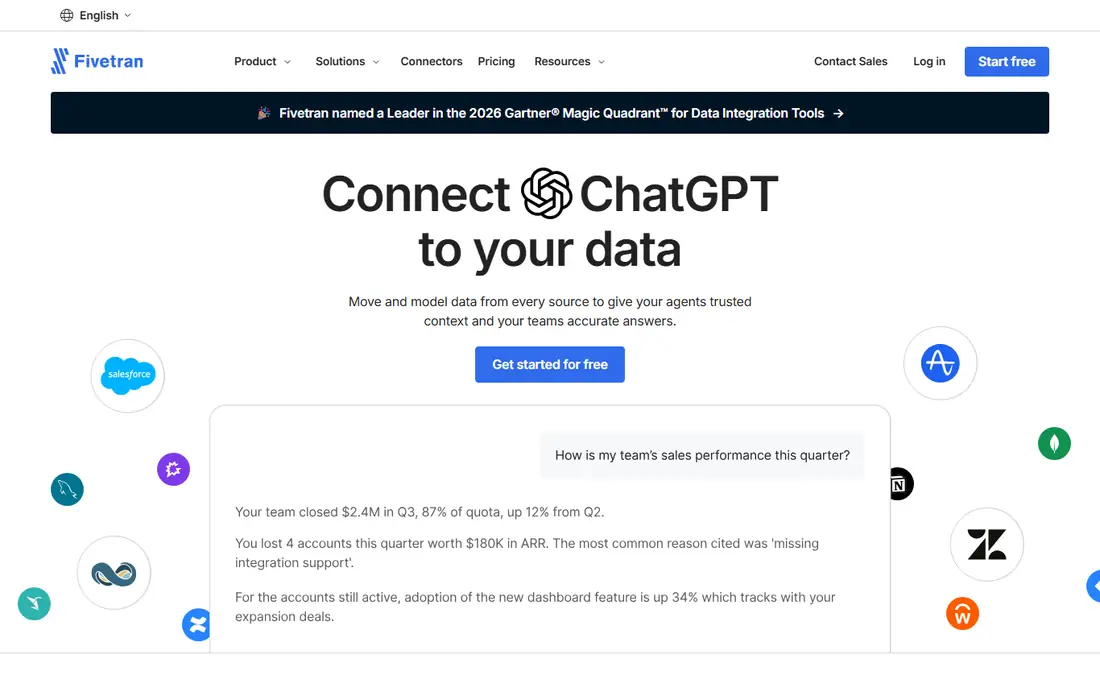
Fivetran is the simplest managed replacement for teams whose main job is getting data into a warehouse reliably. Connectors are maintained by Fivetran, schema changes are handled automatically, and setup is low-code for standard sources. The free tier covers small volumes, which lets a team prove value before committing to usage pricing.
The cost model needs careful modeling. Pricing follows monthly active rows per connection, and deletes, reloads, and frequently updated tables can push that count up. Fivetran also does not transform data in the pipeline, so teams usually pair it with dbt or warehouse models. For straightforward, managed ingestion, it is the least operational burden on this list.
- Large managed connector catalog
- Automated schema handling
- Free tier up to 500,000 monthly active rows
- Ingestion only, so transformation needs a separate tool
- Per-row pricing can rise steeply at high volume
Airbyte appeals to engineering teams that want control over connectors and deployment. The open source core is free to self-host, and teams can build custom connectors when a standard one does not fit. Airbyte Cloud removes infrastructure work, with Standard and Plus tiers for smaller teams and capacity plans for larger use.
Self-hosting is not free in practice. Someone must run, upgrade, and monitor the platform, and that labor cost should be counted beside the zero software price. Cloud pricing by credits also needs a trial with real volumes. For teams with engineering capacity, Airbyte offers flexibility that closed managed tools do not.
- Open source core you can self-host
- Large connector catalog
- Cloud plans for teams that do not want to run infrastructure
- Self-hosting adds maintenance work
- Cloud credit pricing can be hard to forecast at scale
Hevo Data is a good fit for teams that want pipelines without writing code. Sources connect through a visual interface, schemas map automatically, and data can flow near real time into warehouses. The free tier supports small workloads, which helps startups and small data teams start without a sales call.
Event pricing is the detail to watch. Every record write can count as an event, so tables that update often will cost more than a simple row count suggests. Hevo also includes reverse ETL features on some plans, which may help teams that push warehouse data back into business tools. For no-code teams with moderate volume, Hevo is a practical choice.
- No-code pipelines with automatic schema mapping
- Near-real-time options
- Free tier up to 1 million events per month
- Event-based pricing means frequent updates multiply cost
- Larger volumes move to custom pricing
Stitch is the simplest tool here for scheduled warehouse loads. Teams pick sources and destinations, set a schedule, and let Stitch move data on a row-based plan starting at $100 per month. The Singer-based design also makes it approachable for teams that already know that ecosystem.
Do not buy Stitch expecting a full data platform. It does not transform data, back up sources, or offer the same real-time CDC depth as Qlik Replicate. Its future is also closely tied to Qlik, since Stitch is part of the Qlik family, so teams leaving Qlik for independence should weigh that point. For simple, scheduled replication, Stitch is easy to run.
- Simple setup for scheduled loads
- Built on the Singer standard
- Clear row-based tiers
- Replication only, with no transformation
- Product direction is tied to Qlik Talend Cloud
Oracle GoldenGate is the specialist pick when replication performance is the whole job. It supports log-based capture, low-latency movement, and active-active topologies across heterogeneous databases, with particularly deep Oracle support. Large enterprises with demanding freshness and availability needs often test GoldenGate first.
Commercial complexity is the main drawback. Licensing, support, and Oracle ecosystem costs can be hard to compare with simple SaaS pricing, and GoldenGate does not cover general ETL or data quality work. Teams that are not Oracle-heavy should compare it with Striim or Artie before committing. For Oracle-centered replication, it is a strong contender.
- Strong real-time CDC and active-active replication
- Deep Oracle database support
- Proven at very large scale
- Licensing and pricing complexity
- Narrower scope than a full integration platform
AWS Database Migration Service
Great for: Cloud database migration and replication
AWS Database Migration Service, often called AWS DMS, helps move databases into AWS and keep them in sync. It supports full loads and change data capture, and it fits teams already running on AWS. Pricing follows the replication instances and storage used, rather than a flat SaaS tier, which can suit variable workloads.
AWS skill is required. DMS is a service to operate, not a fully managed pipeline product, so teams must handle task design, monitoring, error handling, and schema change rules. For cloud migrations and AWS-centered replication, DMS is a cost-effective and flexible option. For a hands-off SaaS pipeline, Fivetran or Hevo will feel simpler.
- Native AWS integration for migration and ongoing replication
- Pay-as-you-go infrastructure
- Broad source and target support
- Requires AWS skill to run well
- Monitoring and tuning fall to your team
Striim is built for data that must move now, not on an hourly schedule. It captures changes, streams them to warehouses, lakes, or operational systems, and can transform data in flight. That makes it useful for teams that need both analytics and live operational feeds from the same pipeline.
Enterprise scope brings enterprise effort. Pricing is quote-based, and setup, monitoring, and tuning need data engineering skill. Small teams with simple batch loads will find Fivetran or Stitch easier. For real-time replication at scale, Striim is one of the most capable tools on this list.
- Real-time CDC with streaming and transformation options
- Strong for operational and analytics use together
- Cloud and on-premises deployment
- Enterprise pricing and setup effort
- Smaller teams may find it heavier than needed
Artie takes the managed route to real-time replication. The team runs the pipeline end to end, including capture, buffering, merging, and monitoring, so data teams do not provision replication servers. Schema changes are detected and applied automatically, and backfills run beside live CDC without stopping the stream.
The trade-off is scope and entry price. Artie focuses on database-to-warehouse and lakehouse replication, not hundreds of SaaS connectors, and the Growth tier starts at $500 per month. A free tier up to 1 million rows helps with testing. For teams that want Qlik-style CDC without running servers, Artie is a focused, modern option.
- Fully managed CDC with sub-minute freshness on supported pipelines
- Automatic schema evolution
- Free tier up to 1 million rows
- Destination range is narrower than large ELT catalogs
- Growth pricing starts at $500 per month
Debezium is the open source foundation behind many CDC pipelines. It captures row-level changes from databases using log-based methods and streams them through Kafka, where downstream systems can consume them. The software itself is free, and connectors cover major databases.
Operational responsibility is the full price. Your team must run Kafka or a streaming platform, manage connectors, handle schema changes, and recover from failures without losing changes. That work suits platform teams that already run streaming infrastructure. For teams that want a product rather than a project, a managed tool will be a better fit.
- Free open source log-based CDC
- Works with Kafka and streaming platforms
- Strong community and connector range
- You run and maintain the whole pipeline
- Schema, offsets, and failure handling are your responsibility
How we picked these
We compared official feature pages, pricing pages, documentation, and public reviews for data replication and CDC tools that exist and work in October 2026. We kept tools that replicate database changes, load data into warehouses, or both, and we wrote See website where pricing is quote-based, instance-based, or not published in a comparable form. We did not claim hands-on testing, and we focused on freshness, connector range, and operational burden.
How to compare replication costs fairly
Run the same workload on paper before you buy. Count source tables, rows changed per month, deletes, reloads, and update frequency, then apply each vendor meter, whether that is rows, events, credits, or instances. A tool that looks cheap for a nightly load can become expensive for a table that updates every minute.
Also test schema changes, failure recovery, and backfill behavior. A pipeline that stops on a column change or loses changes during an outage will cost more in engineering time than a higher monthly fee. Ask vendors how they handle deletes, schema evolution, and exactly-once delivery, and get those answers in writing for your main sources.
Frequently asked questions
Is Fivetran a direct Qlik Replicate replacement?
Fivetran replaces the warehouse ingestion part well, with managed connectors and automated schema handling. It is less direct for real-time, bidirectional, or mainframe replication, where Striim, GoldenGate, or Artie may fit better.
What is the cheapest way to start with CDC?
Debezium and Airbyte self-hosted have no software license cost, but they require engineering time and infrastructure. Fivetran and Artie offer free tiers for small volumes, which can be cheaper once labor is counted.
Do I need real-time replication or is batch enough?
Batch or scheduled replication is enough for daily reports and many analytics jobs. Real-time CDC matters for live dashboards, operational alerts, and systems that must react to a database change within minutes.
How does Stitch differ from Fivetran?
Stitch focuses on simple scheduled replication with row-based tiers, while Fivetran offers a larger managed connector catalog and automated schema handling. Stitch is simpler, while Fivetran is broader for managed ingestion.
Can I replicate between databases, not just to a warehouse?
Yes, GoldenGate, Striim, AWS DMS, and Debezium support database-to-database replication use cases, depending on sources and targets. Check each tool for your exact source and target pair before you commit.
Sources
See where you really rank - block by block
ProMapRanker scans Google Maps across a grid of your service area. Simple monthly plans from $19, white-label on every plan.
Start freeKeep reading
 zoho books alternatives
Best Zoho Books Alternatives in 2026
Compare the best zoho books alternatives for small business accounting, from QuickBooks Online and Xero to FreshBooks, Wave, and Sage in 2026, with pricing.
Read → zluri alternatives
Best Zluri Alternatives in 2026
Compare zluri alternatives for 2026, with SaaS management platforms for app discovery, spend tracking, renewals, and automation for IT, finance and procurement.
Read → zerobounce alternatives
Best ZeroBounce Alternatives in 2026
Best zerobounce alternatives for list hygiene: compare 8 email verification tools for bulk cleaning, real-time checks and catch-all handling in 2026 today.
Read →