 ProMapRanker
Best Proxyium Alternatives in 2026


Enterprise scraping and compliance · Pricing starts at: $8 per GB
Key takeaways
- Legitimate providers range from a free browser proxy for simple checks to enterprise networks for large jobs.
- Pay-as-you-go pricing suits uneven volume, while monthly plans suit steady, predictable work.
- Residential proxies are harder to detect than datacenter proxies, but they cost more per gigabyte.
- Use proxies only for lawful purposes, respect site terms, and never route sensitive accounts through a free proxy.
Quick comparison
| Pick | Great for | Pricing starts at | Free tier | |
|---|---|---|---|---|
| Bright Data | Enterprise scraping and compliance | $8 per GB | Free trial | Visit |
 Oxylabs | High-volume data pipelines | See website | Free trial | Visit |
 Decodo | Best value all-rounder | $4 per GB | Free trial | Visit |
 IPRoyal | Non-expiring traffic for intermittent jobs | $1.75 per GB | Free trial | Visit |
 SOAX | Precise geo and mobile targeting | $90 per month | Free trial | Visit |
 Webshare | Free start for developers | Free | Yes | Visit |
 Rayobyte | US-heavy datacenter workloads | $3.50 per GB | Free trial | Visit |
 CroxyProxy | Free web proxy in a browser | Free | Yes | Visit |
The best proxyium alternatives
Proxies have lawful uses, such as price monitoring, SEO checks, ad verification, and accessing your own content from another location, and they also have abusive uses. The services here are legitimate providers with published terms, and they should be used only in line with those terms and the law. Do not use a proxy to bypass security controls, harass anyone, break into accounts, scrape data you have no right to use, or hide wrongdoing. If a job needs you to hide what you are doing from the site owner, stop and check whether the job itself is lawful first.
Bright Data is the enterprise pick, with a very large network, residential, datacenter, mobile, and ISP proxies, and a compliance posture that larger buyers can show to a legal team. Managed scraping tools sit beside the raw proxies, so a team can buy data collection, not just IP addresses. For a company where audit trails matter, that breadth is the point.
The price reflects that position, and access starts with verification checks that slow down a casual signup. Smaller users will find cheaper options that do the same basic job. Choose Bright Data when compliance, scale, and support matter more than the lowest price per gigabyte.
- Largest network and strong compliance tooling
- Many proxy types
- Managed scraping tools
- High entry price
- KYC checks before full access

Oxylabs is built for teams running high-volume data pipelines, with a large residential network and APIs for search results and web scraping beside the proxies themselves. That combination suits price monitoring, SEO tracking, and market research at scale, where reliability matters more than a bargain rate. Support for enterprise accounts is a real part of the offer.
Small users face the same barrier as with other enterprise providers: pricing that assumes volume, and some features that need a sales conversation. If your job is a few hundred requests a day, a smaller provider will be cheaper and faster to start. Pick Oxylabs when volume, uptime, and API tooling justify the spend.
- Large residential network
- Strong SERP and scraping APIs
- Enterprise support
- Entry pricing is high for small users
- Some features need sales contact
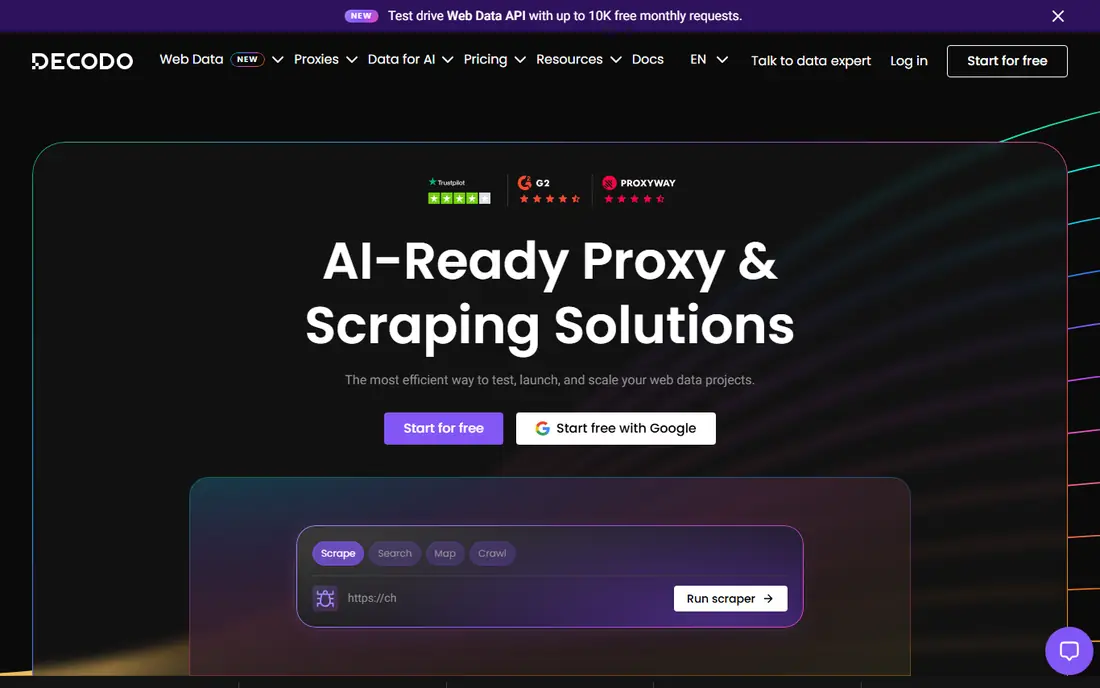
Decodo, formerly Smartproxy, is the mainstream value choice for teams that want reliable residential proxies without an enterprise process. It offers residential, datacenter, mobile, and ISP proxies, a simple dashboard, and a short free trial to test before paying. For many mid-market jobs, that combination is enough.
The network is smaller than the largest providers, and support depth depends on the plan, so a very large or unusual job may still need an enterprise vendor. For everyday scraping, SEO checks, and price monitoring at a fair price, Decodo is a sensible default. Test it on your actual targets before committing to a larger volume.
- Good balance of price and reliability
- Many proxy types
- Simple self-serve signup
- Smaller network than the largest providers
- Support depth varies by plan
IPRoyal suits jobs that run in bursts, because pay-as-you-go traffic does not expire, so a quiet month does not waste money you already spent. Pricing at volume is low, and the location range covers the common needs for SEO, ad verification, and market checks. For freelancers and small teams, that flexibility matters.
The tooling around the proxies is lighter than what enterprise platforms offer, so teams that need managed scraping or deep analytics will need to build more themselves. Trial terms also vary, so read the current offer before you rely on it. Pick IPRoyal when your volume is uneven and you hate paying for traffic you never use.
- Traffic that does not expire on pay-as-you-go plans
- Low volume pricing
- Many locations
- Tooling is lighter than enterprise platforms
- Trial terms vary
SOAX is the pick when location precision matters, such as checking how a site, an ad, or a price appears in a specific city or on a specific mobile carrier. Targeting can go down to city and ISP level, which is more detail than many cheaper providers offer. The dashboard makes that targeting easy to set without API work.
The monthly entry price is higher than a pure pay-as-you-go start, and the trial is a low-cost paid trial rather than a free one. For a team that needs precise geo checks every week, the price is justified by the accuracy. For a casual job, a cheaper pay-as-you-go provider will do.
- Granular city and carrier targeting
- Clean dashboard
- Mobile proxies for app checks
- Monthly entry price is higher than pay-as-you-go rivals
- Trial is paid
Webshare is the easiest way to start, because its free plan gives you datacenter proxies to prototype with, without a card. Developers use it to test code, check a site from another location, or learn how proxies work before spending anything. Paid plans add residential proxies and higher limits when a project grows.
The free plan covers datacenter proxies only, which some sites detect more easily than residential ones, so it is a prototype tool, not a production solution for protected targets. Residential access is paid, as elsewhere. Start free, prove the code works, and upgrade only when the target or the volume demands it.
- Permanent free plan with datacenter proxies
- Cheap paid plans
- Simple API
- Free plan is datacenter only
- Residential proxies are paid
Rayobyte is known for US-heavy datacenter work, with a sourcing approach that emphasises consent and compliance. Teams that run SEO checks, price monitoring, or data collection mainly in the United States will find the coverage and the straightforward plans a good fit. The company has a long history in the proxy market, which helps with trust.
Residential pricing at low volume is higher than the cheapest rivals, and the feature set is narrower than a full data platform. Rayobyte suits a team that wants dependable datacenter proxies with a clear compliance story, rather than the cheapest possible gigabyte. Check the current plan for your exact proxy type before buying.
- Strong US datacenter coverage
- Ethics-focused sourcing
- Straightforward plans
- Residential pricing is higher at low volume
- Smaller feature set than suites
CroxyProxy is the closest free web proxy on this list to a simple browser tool: open the site, enter a page address, and browse through the proxy without installing anything. It suits a quick check of a page from another location, or a single site that is otherwise hard to reach. The basic version is free, which makes it easy to try.
The limits are real. A free web proxy is slower than a paid proxy service, and it is not built for large scraping jobs, automation, or high-volume work. It also routes your traffic through a third party, so do not use it for banking, email, or any sensitive account. Use CroxyProxy for simple browsing checks, and a paid provider for serious work.
- No install or setup
- Works in any browser
- Free basic version
- Slower than paid proxies
- Not suited to large scraping jobs
How we picked these
We compared official feature pages, pricing pages, app store listings, privacy policies, and public reviews for each option. We kept only tools that are still offered and maintained in October 2026 and that fit the topic without stretching the definition. Where a price could not be confirmed from the vendor, we wrote See website rather than guessing. We did not claim hands-on testing that did not happen, and we weighed one concrete strength against one honest weakness for every product.
How to choose a proxy without getting blocked or breaking rules
Start with the job and the target. A simple page check needs only a free web proxy or a small datacenter plan, while large-scale price monitoring needs residential proxies and careful rate limits. Check whether the provider allows your exact use in its terms, and whether the target site permits automated access. Respect robots rules and rate limits, because hammering a site is both rude and a fast way to get blocked.
Test on a small scale first. Buy the smallest package or use the free tier, run your real job for a few days, and measure success rate, speed, and blocks. Also check where your data goes: a provider with clear sourcing and KYC checks is a better sign than an anonymous service with no terms. Never send passwords, banking, or email through a free proxy, and never use a proxy to access an account that is not yours.
Frequently asked questions
Are proxies legal?
Proxies themselves are legal tools in most countries, and they are used for lawful work such as price monitoring, SEO checks, and ad verification. What matters is how you use them. Using a proxy to break into accounts, bypass security, harass people, or take data you have no right to use can be unlawful, even if the proxy itself is legal.
What is the difference between residential and datacenter proxies?
Residential proxies use IP addresses from home internet providers, so they look like ordinary users and are harder for sites to detect. Datacenter proxies come from servers, so they are faster and cheaper but easier for sites to identify and block. Choose residential for protected targets and datacenter for simple, high-speed jobs.
Can I use a free proxy for sensitive accounts?
No, you should not. A free proxy routes your traffic through a third party, and a dishonest operator could see unencrypted traffic or inject content. Use free proxies only for simple, non-sensitive browsing checks, and keep banking, email, and work accounts on your normal connection or a trusted VPN.
How much do proxies cost?
Prices vary by type and volume. Datacenter proxies can start at a few cents per IP or a few dollars a month, while residential proxies are usually priced per gigabyte, from under two dollars at volume to eight dollars or more at entry level. Test with the smallest package first, because the cheapest gigabyte is wasted if the success rate is low.
Do I need a proxy or a VPN?
A VPN routes all of your traffic through one location for privacy, while a proxy usually routes specific requests and can rotate locations for data collection. For personal privacy, a VPN is usually simpler. For SEO checks, price monitoring, or testing from many locations, a proxy service with location targeting is the better tool.
Sources
See where you really rank - block by block
ProMapRanker scans Google Maps across a grid of your service area. Simple monthly plans from $19, white-label on every plan.
Start freeKeep reading
 zoho books alternatives
Best Zoho Books Alternatives in 2026
Compare the best zoho books alternatives for small business accounting, from QuickBooks Online and Xero to FreshBooks, Wave, and Sage in 2026, with pricing.
Read → zluri alternatives
Best Zluri Alternatives in 2026
Compare zluri alternatives for 2026, with SaaS management platforms for app discovery, spend tracking, renewals, and automation for IT, finance and procurement.
Read → zerobounce alternatives
Best ZeroBounce Alternatives in 2026
Best zerobounce alternatives for list hygiene: compare 8 email verification tools for bulk cleaning, real-time checks and catch-all handling in 2026 today.
Read →