 ProMapRanker
Best Perfecto Alternatives in 2026


Broadest device and browser coverage · Pricing starts at: $39 per month
Key takeaways
- BrowserStack and Sauce Labs are the broadest replacements, with real devices, browsers, and automation in one platform.
- TestMu AI suits price-conscious teams that want real-device testing plus AI-assisted authoring.
- Kobiton suits mobile-first teams that want a clear minute-based plan for real devices.
- TestingBot and pCloudy suit teams that need European hosting or on-premises options.
- HeadSpin, AWS Device Farm, and Firebase Test Lab suit performance, AWS, or Android-first workflows.
Quick comparison
| Pick | Great for | Pricing starts at | Free tier | |
|---|---|---|---|---|
| BrowserStack | Broadest device and browser coverage | $39 per month | Free trial | Visit |
 Sauce Labs | Enterprise cross-browser and mobile testing | $39 per month | Free trial | Visit |
 TestMu AI | Price-conscious real-device testing | $15 per month | Yes | Visit |
 Kobiton | Mobile-first real-device testing | $83 per month | Free trial | Visit |
 TestingBot | European-hosted browser and device testing | See website | Free trial | Visit |
 pCloudy | Real-device testing with on-premises options | See website | Free trial | Visit |
 HeadSpin | Performance testing on real devices and networks | $49 per month | Free trial | Visit |
 AWS Device Farm | AWS-native real-device testing | See website | Free trial | Visit |
 Firebase Test Lab | Android-first Google cloud testing | See website | Free trial | Visit |
The best Perfecto alternatives
Perfecto is an enterprise real-device cloud for mobile and web testing, with a focus on secure and compliant testing in regulated industries. The tools below cover that same job with different strengths, from broad device coverage to performance analysis and cloud-native testing. The right pick depends on your frameworks, device needs, and parallel test volume.
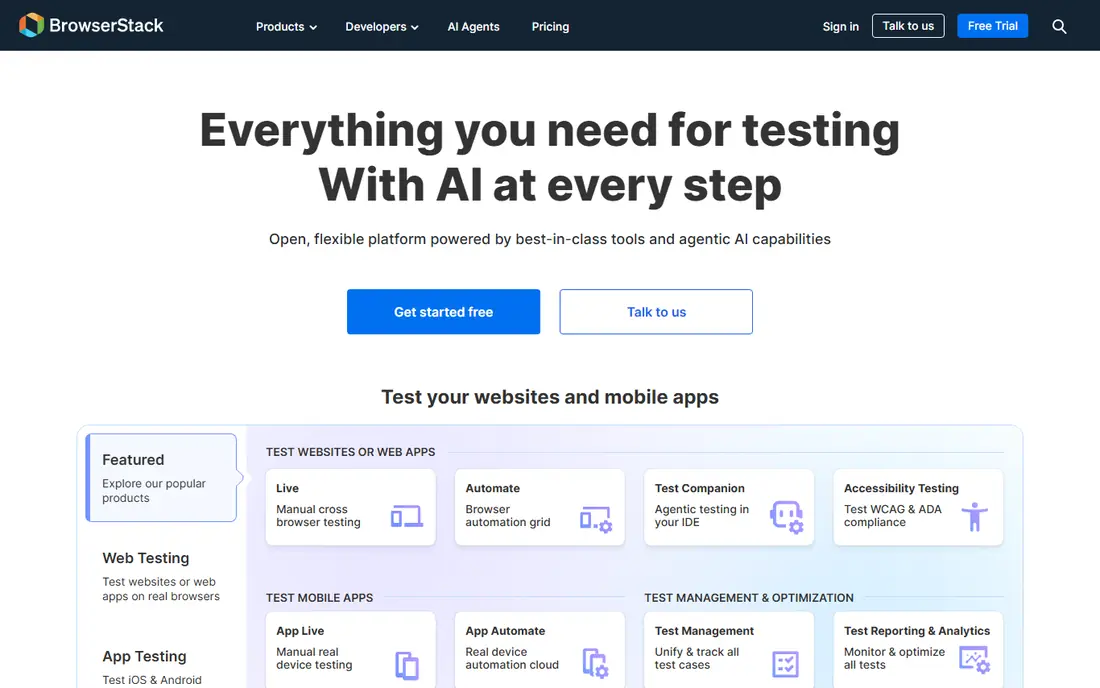
BrowserStack is the broadest swap for Perfecto, because it covers manual and automated testing on real devices and desktop browsers in one platform. Its Live product suits manual checks, while Automate suits Selenium and Appium suites, and its integrations cover common CI tools. That breadth helps a team that tests web and mobile together.
The pricing catch is product split. The $39 per month figure covers Live Desktop and Mobile for manual testing, while automated real-device testing sits on higher Automate plans. A team should price the exact product, parallels, and minutes it needs, rather than comparing entry prices across vendors.
For most teams leaving Perfecto, BrowserStack is the first trial to run. It covers the widest range of devices and browsers, and its trial shows quickly whether coverage and speed match your suite.
- Large real-device and browser range
- Live and Automate products
- Strong CI integrations
- Automation plans cost more than manual plans
- Pricing varies by product and parallels
Sauce Labs is a close enterprise peer to Perfecto, with live testing, virtual device clouds, and a real device cloud for mobile apps. Its pricing is parallel-based, which makes it easier to model cost for a team that knows how many tests run at once. Debugging tools, including video and logs, help a team find why a test failed without rerunning the whole suite.
The entry price needs context. Live Testing starts at $39 per month, while Virtual Device Cloud and Real Device Cloud automation cost more, with real-device automation around $199 per month per parallel on annual billing in recent comparisons. A team should price its automation needs separately from manual testing.
We recommend Sauce Labs for enterprise teams that want a mature cloud with clear parallels and strong CI support. Smaller teams may find TestMu AI or TestingBot cheaper for the same manual coverage.
- Real and virtual device clouds
- Clear parallel-based pricing
- Strong CI and debugging tools
- Real-device automation costs more than entry plans
- AI features sit on enterprise plans

TestMu AI, formerly LambdaTest, suits a team that wants real-device coverage without enterprise pricing. Its entry plan covers virtual live testing at $15 per month, with real-device manual testing and automation on higher plans. AI-assisted authoring helps a team create tests faster, and HyperExecute speeds up test runs for larger suites.
The main caution is product pricing. A team that compares only the $15 entry price will understate the cost of real-device automation, which sits on higher plans. Check the plan that matches your device type, parallels, and minutes before budgeting.
For a price-conscious team, TestMu AI offers strong value. It covers browsers and real devices, adds AI help for authoring, and keeps the entry cost low for manual testing.
- Low entry price
- Real devices plus browsers
- AI-assisted test authoring and HyperExecute orchestration
- Real-device automation costs more than the entry plan
- Pricing varies by product
Kobiton is built for mobile teams first, with a real-device cloud for manual and automated Appium testing. Its plans start around $83 per month with included minutes, which gives a mobile team a clear starting point for budgeting. That mobile focus helps a team that tests apps daily and needs real hardware behavior, not just emulators.
The limits are browser scope and minute costs. Kobiton does not match BrowserStack or Sauce Labs on desktop browser coverage, so a web-heavy team will need another tool. High-volume automation can also consume minutes quickly, so a team should model its monthly test minutes before choosing a tier.
We recommend Kobiton for mobile-first teams that want a simple real-device plan. Web-heavy teams should shortlist BrowserStack or Sauce Labs instead.
- Mobile-focused real-device cloud
- Minute-based plans
- Manual and automated Appium support
- Desktop browser coverage is thinner than BrowserStack
- Minutes can add cost at high volume
TestingBot suits a team that needs European hosting for data or compliance reasons, with manual and automated testing on browsers and real devices. Its per-parallel pricing is clear, which helps a small team model cost for one or two parallels without enterprise sales. It also offers programs for open source projects, which helps small public projects.
The trade-off is scale. Device coverage is smaller than BrowserStack or Sauce Labs, so a team that needs rare devices or large parallel counts should check availability first. Pricing in euros on some plans also needs conversion for US budgeting, so we list it as See website here.
For a European-focused or compliance-conscious small team, TestingBot is a practical choice. Larger teams with broad device needs should compare the bigger clouds first.
- European-hosted cloud
- Manual and automated testing
- Clear per-parallel pricing
- Device coverage is smaller than large clouds
- Pricing is in euros on some plans
pCloudy offers a real-device cloud with thousands of devices, plus on-premises and private cloud options for teams that cannot use a public cloud alone. That deployment flexibility is its main advantage over public-only clouds, especially for regulated or air-gapped needs. Its automation features also help teams that want AI assistance for test creation and maintenance.
The main drawback is price transparency. Pricing is quoted rather than published as a simple starting price, so a team needs a sales conversation to budget. A small team may also find the platform more enterprise-oriented than a simple manual testing tool.
We recommend pCloudy for teams that need private or on-premises device testing. For a standard public cloud need, BrowserStack or Sauce Labs will usually be simpler to price and start.
- Large real-device range
- On-premises and private cloud options
- AI-assisted automation features
- Pricing is quoted
- Interface and support vary by plan
HeadSpin suits a team that cares about how an app feels on real networks, not just whether it passes a functional test. It runs tests on real devices in many locations, with performance, video, and network data that help diagnose slow screens and failed calls. That insight matters for apps where user experience depends on network conditions.
The entry plan at $49 per month covers a limited Lite tier, while on-premises and air-gapped options sit on higher custom-priced plans. A team should check which performance features and locations are included on its tier, because the full platform costs more than the entry figure.
For a performance-focused mobile team, HeadSpin is a strong Perfecto alternative. For basic functional testing, a broader cloud may offer more device coverage for less money.
- Real-device testing with performance and network insight
- Global device locations
- On-premises options on higher plans
- Entry plan is limited
- Full performance and private options cost more
AWS Device Farm suits a team already running on AWS, because it offers real-device testing inside the same cloud and billing account. Teams can run Appium, Espresso, and XCTest suites on real devices, with pay-as-you-go minutes for testing without a monthly device cloud subscription. That model fits bursty testing or a team that already uses AWS CodePipeline and related tools.
The limits are depth and tooling. Device range and debugging features are thinner than dedicated clouds such as BrowserStack or Sauce Labs, and usage-based pricing can vary month to month with test volume. A team that tests daily at high volume should model minutes carefully.
We recommend AWS Device Farm for AWS-native teams with intermittent device testing needs. For daily, high-volume testing, a dedicated cloud with parallel pricing may be more predictable.
- Real devices in AWS
- Pay-as-you-go minutes
- Integrates with AWS CI workflows
- Device range and debugging tools are thinner than dedicated clouds
- Pricing is usage-based
Firebase Test Lab suits an Android-first team that already uses Firebase or Android Studio. It runs automated tests on real and virtual devices in Google Cloud, with results linked to crash and performance data in Firebase. That integration helps an Android team move from a failed test to a fix without switching tools.
The trade-off is scope. Firebase Test Lab is Android-first, with iOS support more limited than a dedicated mobile cloud, and device coverage is narrower than BrowserStack or Sauce Labs. A team that needs broad iOS device coverage or complex web testing will need another tool.
For an Android team in the Google stack, Firebase Test Lab is a practical and low-friction choice. For a cross-platform team, start with a dedicated device cloud instead.
- Google cloud testing for Android and iOS
- Integrates with Firebase and Android Studio
- Free daily quota on some plans
- Android-first focus
- Device and framework coverage is narrower than dedicated clouds
How we picked these
We compared official feature pages, pricing pages, and public reviews, and we kept only tools that still offer real-device or browser testing clouds in October 2026. We checked device coverage, framework support, parallels, minutes, hosting options, and pricing models, and we noted where entry prices cover manual testing only. We did not claim hands-on testing.
How to choose a testing cloud
Start with your frameworks and device list. List the exact frameworks, such as Appium, Selenium, Espresso, or XCTest, and the exact devices and OS versions your users actually run. A cloud that lacks a key device or framework will fail the trial regardless of price, so that list should come before any demo.
Next, price parallels and minutes, not just the entry plan. Manual testing, virtual devices, and real-device automation are priced differently on most clouds, and a team that runs many tests in parallel will pay far more than the entry figure. Model a typical CI day, including peak parallels, then ask for that total in writing.
Finally, test debugging and CI integration with a real failing test. Run a suite, break a test on purpose, and check how quickly the team can find the cause from video, logs, and screenshots. A cloud with fast debugging saves more time than a slightly cheaper cloud with slow failure analysis, and that saving repeats on every run.
Frequently asked questions
What is the best Perfecto alternative?
BrowserStack and Sauce Labs are the broadest alternatives, because both cover real devices, browsers, and automation at enterprise scale. TestMu AI is the best value pick for smaller teams, while Kobiton suits mobile-first teams. Choose by device coverage, parallels, and whether web testing matters as much as mobile.
Is BrowserStack cheaper than Perfecto?
For manual and small-scale testing, BrowserStack entry plans are usually cheaper and published, while Perfecto pricing is quoted per enterprise account. For large-scale automation, the comparison depends on parallels, minutes, and device needs, so both should be quoted on the same workload before deciding.
Can I test on real devices without a paid cloud?
Yes, for limited use. Firebase Test Lab offers a free daily quota on some plans, and TestMu AI offers a free tier for virtual testing. Real-device testing at scale usually needs a paid plan, because device time and maintenance cost the vendor. A free tier is a good trial, but not a long-term home for a large suite.
Which tool is best for Android app testing?
Firebase Test Lab suits Android-first teams in the Google stack, while Kobiton, BrowserStack, Sauce Labs, and TestMu AI suit cross-platform Android and iOS testing. Choose Firebase Test Lab for Android-only work with Firebase integration, and a dedicated cloud for broad device coverage across both platforms.
Do these clouds support Appium and Selenium?
Yes, the dedicated clouds here support Appium for mobile and Selenium for web, with framework versions and CI plugins that vary by vendor. Check the exact framework versions and parallel limits on your plan, because older or newer versions can affect suite compatibility. A trial run with your real suite is the safest check.
How do I migrate tests from Perfecto?
Keep your existing Appium or Selenium tests where possible, because most clouds support the same frameworks, and change only the cloud configuration, capabilities, and CI steps. Run the suite on the new cloud in parallel with Perfecto, compare results and timing, and switch traffic only after a full release cycle has passed cleanly on the new platform.
Sources
See where you really rank - block by block
ProMapRanker scans Google Maps across a grid of your service area. Simple monthly plans from $19, white-label on every plan.
Start freeKeep reading
 zoho books alternatives
Best Zoho Books Alternatives in 2026
Compare the best zoho books alternatives for small business accounting, from QuickBooks Online and Xero to FreshBooks, Wave, and Sage in 2026, with pricing.
Read → zluri alternatives
Best Zluri Alternatives in 2026
Compare zluri alternatives for 2026, with SaaS management platforms for app discovery, spend tracking, renewals, and automation for IT, finance and procurement.
Read → zerobounce alternatives
Best ZeroBounce Alternatives in 2026
Best zerobounce alternatives for list hygiene: compare 8 email verification tools for bulk cleaning, real-time checks and catch-all handling in 2026 today.
Read →