 ProMapRanker
Hevo Data Alternatives: 8 Tools Compared


managed ELT with the broadest connector catalog · Pricing starts at: Usage based from $500 per month
Key takeaways
- Stitch is the cheapest managed entry point at $100 a month for 5 million rows, while Hevo itself starts at $265 a month on annual billing.
- Airbyte Cloud starts at $20 a month and the open-source core is free to self-host, which suits teams with engineering time.
- Fivetran offers a free plan to 500,000 monthly active rows, then bills on usage from about $500 a month, with a $5 base charge per connection.
- Integrate.io is the fixed-fee option at $1,999 a month for unlimited volume, which suits teams that want a predictable bill.
- Stitch is now part of Qlik and is being folded into Qlik Talend Cloud, so check the roadmap before you commit to a long contract.
Quick comparison
| Pick | Great for | Pricing starts at | Free tier | |
|---|---|---|---|---|
| Fivetran | managed ELT with the broadest connector catalog | Usage based from $500 per month | Yes (free to 500,000 MAR) | Visit |
 Airbyte | open-source ELT with a large connector catalog | $20 per month (Cloud Standard) | Yes (open source, free to self-host) | Visit |
 Stitch | simple, cheap extract-and-load | $100 per month (Standard) | Yes (free tier, 5 million rows a month) | Visit |
 Integrate.io | fixed-fee ETL with unlimited volume | $1,999 per month | Free trial (14 days) | Visit |
 Talend | enterprise data integration and governance | quote only | Free trial (14 days) | Visit |
 Matillion | cloud-native ELT for Snowflake and Databricks | quote only | Free trial (14 days) | Visit |
 Rivery | ELT, CDC and reverse ETL in one platform | quote only | Free trial (14 days) | Visit |
 Skyvia | no-code integration with a real free plan | $79 per month (billed annually) | Yes (free plan) | Visit |
The best hevo data alternatives
Fivetran is the managed ELT standard that Hevo buyers most often compare against. It moves data from more than 700 sources, including databases, SaaS apps and files, into a warehouse or lake with automated schema handling and re-sync detection. Pricing is based on monthly active rows, which means you pay for distinct rows inserted, updated or deleted in a month, and since 2026 each standard connection carries a $5 monthly base charge. The free plan covers 500,000 monthly active rows, plus 5,000 model runs a month for transformations, and usage-based plans start from about $500 a month.
The merger with dbt Labs closed in June 2026, which tightened the link between loading and transformation, since Fivetran now bundles model runs and activation features on the same platform. The main drawback is cost predictability: a high-churn table can push monthly active rows far above the forecast, and enterprise contracts commonly land between $2,000 and $10,000 a month at scale. For a team that wants the widest connector catalog and the least pipeline maintenance, Fivetran is the safest managed choice, and the free plan is a real way to test it.
- 700-plus managed connectors with reliable syncs
- Strong dbt integration after the 2026 merger
- MAR billing is hard to predict
- Costs climb fast at scale
Airbyte is the open-source route out of Hevo. The core is free to self-host with 700-plus connectors, and Airbyte Cloud starts at $20 a month on the Standard plan, with Plus at $189 a month for 40 credits and Pro and Enterprise Flex quoted by capacity. Cloud billing is credit-based, at about $2.50 per credit, so a small analytics stack with three to five sources and modest volume can run from $0 to $300 a month. Transformations run through dbt or SQL in the warehouse, and the community connector catalog is the largest open-source set available.
The trade-off is operations. Self-hosting is free software, not a free service: production-grade infrastructure typically runs $500 to $3,000 a month, plus 20 to 40 engineering hours a month for upgrades, connector issues and pipeline maintenance. Cloud removes that work but adds credit metering, so a team must watch volume or the bill climbs. For a team with engineers that wants control over its stack and no vendor lock-in, Airbyte is the best fit, and the open-source core means the pipelines stay yours.
- Open-source core with 700-plus connectors
- Self-hosting is free
- Production self-hosting needs engineering time
- Cloud credits add up at volume
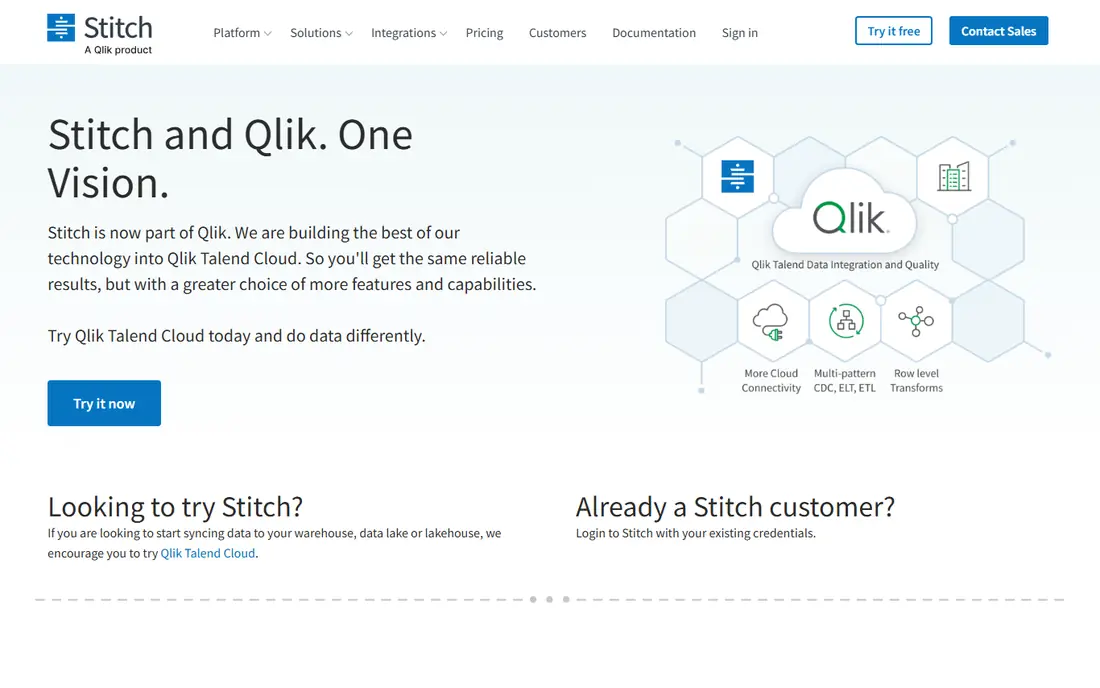
Stitch is the simplest and cheapest managed loader on this list. Standard costs $100 a month for 5 million rows, with Advanced at $1,500 a month and Premium at $3,000 a month, both billed annually, and a free tier covers 5 million rows a month with a 14-day trial. The pricing model is row tiers: a flat monthly fee for a row allowance, stepping up in tiers, which is the most predictable of the usage models as long as you stay inside your tier. Setup is fast, with a short list of connectors that covers the common SaaS sources and databases.
The limits are scope and future. Stitch has around 130 to 140 connectors, far fewer than Fivetran or Airbyte, and its Singer-based taps are not all actively maintained. The strategic point matters more: Stitch is now part of Qlik and is being folded into Qlik Talend Cloud, so a buyer should check the roadmap and the support terms before signing a long contract. For a small analytics team loading a handful of SaaS sources into one warehouse, Stitch is still the cheapest managed start, and the $100 entry price is easy to approve.
- Simple row-tier pricing
- Cheapest managed entry point
- Limited connector catalog
- Being folded into Qlik Talend Cloud
Integrate.io is the fixed-fee option for teams that hate usage billing. One plan at $1,999 a month covers unlimited data volume, pipelines and connectors, with 220-plus in-pipeline transformations, 60-second change data capture and reverse ETL on the same plan. There are no row counts to forecast and no per-connection charges, so the monthly bill is the same whether you sync one source or fifty. A 14-day trial lets a team test the pipeline builder before committing, and the platform covers ETL, ELT, CDC and reverse ETL without add-ons.
The drawback is the entry price. At $1,999 a month, Integrate.io costs far more than Stitch at $100 or Airbyte Cloud at $20, so it only makes sense once volume is high enough that usage-based tools would cost more. There is no free tier, so a small team cannot start cheap and grow into it. For a mid-market team moving serious volume that wants one predictable invoice and deep transformation features, Integrate.io is a strong pick, and the fixed fee removes the monthly row-count anxiety.
- Fixed fee with unlimited volume
- 220-plus in-pipeline transformations
- High entry price for small teams
- No free tier
Talend is the enterprise data platform that covers integration, data quality, governance and application integration in one suite. Talend Cloud connects hundreds of sources to cloud warehouses and lakes, with data quality checks, masking, profiling and lineage built in, which suits regulated industries that need audit trails on every pipeline. A free trial covers the entry products, and the platform is sold by quote, shaped around connectors, users and deployment needs. Talend also owns Stitch, which it is folding into Qlik Talend Cloud, so the two products share a roadmap.
The limits are price and weight. There are no published prices, so every engagement starts with a sales process, and the platform is heavier than a small team needs for simple loading. Deployment and configuration take real effort, and the full value only shows when a team uses the governance and quality features alongside integration. For a large company that needs integration plus data quality and governance in one vendor, Talend is a strong pick, but a small team loading five sources will find it too much.
- Broad data integration and governance suite
- Strong enterprise controls
- Quote-only pricing
- Heavyweight for small teams
Matillion is a cloud-native ELT platform built for teams that already run Snowflake, Databricks, BigQuery or Redshift. Its visual pipeline designer lets data engineers build transformations without writing SQL for every step, and the platform pushes compute into the warehouse, so processing scales with the warehouse rather than a separate engine. A free trial covers the entry products, and pricing is quoted per deployment, shaped around users, pipelines and warehouse size. Matillion also covers data productivity features such as orchestration, scheduling and monitoring in the same console.
The trade-off is focus. Matillion is built for cloud warehouses, so a team that still runs on-premises databases or needs broad SaaS-to-SaaS syncing will find gaps, and the quote-only pricing means a buyer cannot compare it with Stitch or Airbyte without a sales conversation. The visual designer is a strength for teams that want less code, but heavy SQL users may find it slower than writing transformations by hand. For a Snowflake or Databricks shop that wants ELT designed for its warehouse, Matillion is a natural fit.
- Cloud-native ELT built for Snowflake and Databricks
- Visual pipeline designer
- Quote-only pricing
- Focused on cloud warehouses only
Rivery is a data integration platform that covers ELT, change data capture and reverse ETL in one product, so a team can load data into the warehouse and push enriched data back to SaaS tools without a second vendor. Pricing is credit-based, with credits consumed by sync volume, and a 14-day trial lets a team test the pipeline builder before committing. The platform includes data orchestration, workflow automation and monitoring, and it suits teams that want a single tool for the full data flow rather than a loader plus a separate reverse ETL product.
The limits are price transparency and catalog size. Rivery does not publish plan prices, so a buyer needs a sales conversation to compare it with Fivetran or Airbyte, and the connector catalog is smaller than the 700-plus sets at the top of this list. Credit-based billing also needs monitoring, since a busy month can burn credits faster than forecast. For a mid-market team that wants ELT and reverse ETL together and will pay for a managed service, Rivery is a strong pick, and the all-in-one design removes a vendor from the stack.
- ELT, CDC and reverse ETL in one platform
- Credit-based pricing
- Quote-only pricing
- Smaller connector catalog than Fivetran
Skyvia is a no-code data integration platform for teams that want to move data without writing code. It covers backup, replication, data import and query building through a visual interface, with connectors for common SaaS apps, databases and cloud storage. The free plan includes real connectors and a usable record allowance, and the entry plan costs $79 a month billed annually, with higher tiers adding more records and features. Setup is fast, with templates for common flows such as Salesforce to Snowflake or HubSpot to BigQuery.
The limits are depth and scale. Skyvia has fewer advanced transformation features than Fivetran or Matillion, so complex pipelines may need workarounds, and credit limits on the lower tiers cap how much data a team can move each month. The connector catalog is solid for common sources but thinner than the 700-plus sets at the top of this list. For a small team that wants a no-code tool with a real free plan and a low entry price, Skyvia is a good start, and the free plan is a genuine way to test it.
- Free plan with real connectors
- Simple no-code interface
- Fewer advanced transformation features
- Credit limits on lower tiers
How we chose
We compared vendor pricing pages, product documentation and plan feature lists, and we checked prices in November 2026. Every price in this guide comes from the vendor's own pricing page, and where a vendor publishes no price we say quote only instead of repeating a number from a third party. We favoured tools with a real data loading product, published entry prices or a clear trial, and a connector catalog a buyer can check today. We did not claim hands-on testing, and we did not count review scores as test results. Pick by volume: under 5 million rows a month, start with Stitch or Airbyte; from 5 to 100 million, Airbyte Cloud or Fivetran cover most needs; above 100 million, Fivetran or Integrate.io are the realistic choices.
What to check before you buy
Check how the vendor counts billable volume before you sign, because monthly active rows, rows replicated and credits measure different things, and the same pipeline can cost very different amounts across vendors. Confirm which connectors are included at your tier, since some catalogs gate premium sources behind higher plans, and confirm sync frequency, since 15-minute syncs and 1-minute syncs sit on different tiers. Ask about the free tier limits and what happens when you cross them, and test the trial with a real source and a real table, not a demo dataset.
| Monthly volume | First pick | Why | Monthly cost | | Under 5 million rows | Stitch | $100 flat for 5 million rows | $100 | | 5 to 100 million rows | Airbyte Cloud | Credits scale with volume | $20 to about $500 | | Over 100 million rows | Fivetran or Integrate.io | Managed reliability or fixed fee | $500 to $1,999 |
Frequently asked questions
What is Hevo Data used for?
Hevo Data is a managed data integration platform that moves data from SaaS apps, databases and files into a cloud warehouse or lake, with automated schema handling and near-real-time sync. Teams use it to build analytics pipelines without writing code for each source. Hevo starts at $265 a month on annual billing, and the tools in this guide cover the same job with different pricing models and connector catalogs.
What is the cheapest Hevo Data alternative?
Stitch is the cheapest managed entry point at $100 a month for 5 million rows, with a free tier for the same volume. Airbyte Cloud starts at $20 a month and the open-source core is free to self-host, though hosting and maintenance cost real money. Fivetran is free to 500,000 monthly active rows. The cheapest choice depends on volume, since usage-based tools can pass a flat-fee tool once rows climb.
What is the difference between ETL and ELT?
ETL extracts data, transforms it, then loads it into the target, which suits strict schemas and heavy cleaning before loading. ELT extracts and loads raw data first, then transforms it inside the warehouse, which suits cloud warehouses with cheap compute and fast iteration. Most tools on this list do ELT, and some also cover ETL, CDC and reverse ETL, so check the model that matches your warehouse.
How much does data integration cost per month?
Entry prices in this guide run from $20 a month at Airbyte Cloud to $1,999 at Integrate.io, with Stitch at $100 and Skyvia at $79. Fivetran is free to 500,000 monthly active rows and usage-based from about $500 a month. Talend, Matillion and Rivery are quote only. At scale, enterprise contracts commonly land between $2,000 and $10,000 a month, so forecast volume before you commit.
Can I migrate my Hevo pipelines to another tool?
Yes, you can rebuild Hevo pipelines in another tool, but there is no one-click export in most cases. Map each source, table and sync schedule, then recreate the connections and transformations in the new platform and run both in parallel until the numbers match. Check whether the new tool supports the same sources and sync frequency, and budget a week or two for testing, since schema handling and CDC behaviour differ across vendors.
Sources
See where you really rank - block by block
ProMapRanker scans Google Maps across a grid of your service area. Simple monthly plans from $19, white-label on every plan.
Start freeKeep reading
 Grid My Business alternatives
Best Grid My Business Alternatives for Local SEO
Compare the best Grid My Business alternatives for geo-grid rank tracking, with real starting prices, free plans, grid sizes and credit limits to help you pick.
Read → Grade.us vs Birdeye
: Review Tools Compared
Grade.us vs Birdeye compared on price, review funnels, white label and reporting. See which review platform fits an agency or a local brand, updated for 2026.
Read → Grade.us alternatives
Best Grade.us Alternatives for Review Management
Compare the best Grade.us alternatives for review requests, monitoring and replies, with vendor prices, free trials and real limits, to pick the right fit.
Read →