 ProMapRanker
Best Folloze Alternatives in 2026


Full account-based marketing suites · Pricing starts at: See website
Key takeaways
- Full suites cover intent, advertising, and measurement, but they need staff time and quote-based budgets.
- Focused tools launch faster and cost less in effort, though they cover only one part of an account program.
- Content-led tools reward teams with a strong library, while website tools reward teams with real account traffic.
- Start from the gap in your current program, not from the longest feature list, and confirm pricing before shortlisting.
Quick comparison
| Pick | Great for | Pricing starts at | Free tier | |
|---|---|---|---|---|
| Demandbase | Full account-based marketing suites | See website | No | Visit |
 6sense | Predictive intent and account identification | See website | No | Visit |
 Terminus | Account-based advertising and engagement | See website | No | Visit |
 PathFactory | Content journeys and engagement analytics | See website | No | Visit |
 Uberflip | Personalised content hubs for accounts | See website | No | Visit |
 Mutiny | Website personalisation without heavy code | See website | No | Visit |
 RollWorks | Mid-market account advertising | See website | No | Visit |
 Turtl | Interactive personalised documents | See website | No | Visit |
The best folloze alternatives
If you used a personalised content tool to reach target accounts, the options here split into two groups: full suites that cover intent and advertising, and focused tools that do one job well. Full suites suit larger teams with dedicated staff. Focused tools suit teams that know exactly which gap they need to close, such as website personalisation or document tracking.
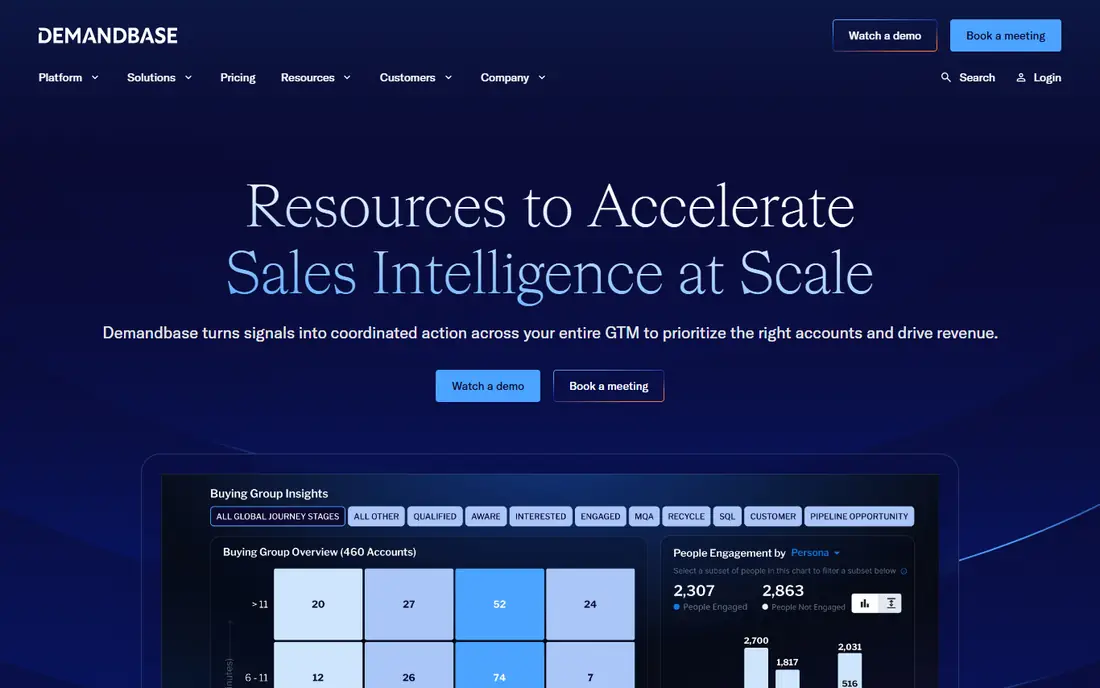
Demandbase is the closest thing to a complete account-based marketing suite on this list, covering account identification, advertising, intent signals, and measurement in one place. Large B2B teams use it to run coordinated plays across sales and marketing, with account lists shared between both sides. That breadth is the point: fewer handoffs between separate tools.
The cost of that breadth is complexity and price. Pricing is quote-based, and getting value from the platform usually needs someone who owns it day to day. Smaller teams may find they pay for modules they never fully use. Choose Demandbase when the account program is a core motion, not a side experiment.
- Broad intent, advertising, and measurement in one platform
- Strong enterprise integrations
- Mature account targeting
- Quote-based pricing
- Implementation needs dedicated staff time

6sense is built around a simple promise: spot the accounts most likely to buy before your competitors do. It combines intent signals with predictive scoring, then helps teams route those accounts into advertising, sales alerts, and personalised experiences. For a team with a clear ideal customer profile, that focus can sharpen where time and ad spend go.
The trade-off is that a predictive model is only as good as the data and the follow-up behind it. Pricing is quote-based, and a full rollout takes planning and staff time. Teams that buy it for the dashboard alone, without a plan for who acts on each signal, tend to get less from it than teams that build plays around the scores.
- Strong predictive account scoring
- Large intent signal set
- Useful orchestration workflows
- Quote-based pricing
- Setup can take weeks for a full rollout

Terminus focuses on the advertising and engagement side of account-based marketing, helping teams reach target accounts across display and social channels and see how those accounts respond. That narrower focus can be a strength for a team that already has intent data elsewhere and mainly needs reliable activation. Reporting keeps the conversation on account engagement rather than raw clicks.
The limit is scope. Terminus does not try to be the whole revenue platform, so teams that want deep predictive modelling or a full content personalisation engine will need other tools beside it. Pricing is also quote-based, so budget talks happen with sales. Pick it when ads and engagement are the gap you need to close.
- Multi-channel account advertising
- Clear engagement reporting
- Practical for mid-market teams
- Pricing is quote-based
- Predictive depth is lighter than full suites
PathFactory turns a pile of content into guided journeys, so a buyer sees the next relevant asset instead of a generic resource page. Marketers can build tracks for an account or a persona, then watch which assets hold attention and which get skipped. That data helps content teams stop guessing about what actually moves a deal forward.
The catch is that the tool rewards teams that already publish well. With a thin library, journeys feel short and repetitive, and the analytics have less to say. Pricing is quote-based, and the setup work is real. It fits best when content is already a serious investment and you want to learn from how buyers use it.
- Content tracks that guide buyers
- Detailed content engagement data
- Useful for content-led teams
- Needs a solid content library to shine
- Setup rewards planning
Uberflip builds branded content hubs that sales teams can share with a specific account, so a prospect sees a curated set of relevant assets rather than a homepage. That personal touch can make a follow-up email feel considered instead of generic, and reps can see which items were opened. It works well for teams that already create case studies, guides, and videos.
Like other content tools, it needs a steady supply of good material to stay fresh, and pricing is quote-based. A hub with three old PDFs will not impress anyone, no matter how clean the design looks. Choose Uberflip when your content library is strong and your sales team will actually share the hubs it creates.
- Branded content destinations
- Account-level personalisation
- Strong for sales enablement
- Quote-based pricing
- Content volume matters for best results
Mutiny personalises your website for the visitor in front of you, swapping headlines, proof points, and calls to action based on account or segment. That makes it a practical pick for teams whose website already gets meaningful traffic from target accounts. Experiments let you test which version converts better instead of debating it in a meeting.
The focus is the website, so it will not replace an advertising platform or a content hub on its own. Pricing is quote-based, and results depend on traffic volume: a site with few visits will take longer to learn from. Pick Mutiny when the website is a real part of the buying journey and you want to improve it account by account.
- Personalises site pages for target accounts
- Faster to launch than a full suite
- Clear experiment tools
- Best for website-led motions
- Quote-based pricing
RollWorks aims at the middle of the market: teams that want account-based advertising without an enterprise contract or a long implementation. It offers account targeting, display advertising, and reporting in a package that is easier to start with than the largest suites. HubSpot users in particular will find the connection straightforward.
The compromise is depth. Reporting and predictive features are lighter than what the enterprise platforms offer, and larger teams may outgrow it as their program gets more complex. Pricing is quote-based, so confirm the full cost including media before you judge it. It is a sensible step for a team testing account-based advertising for the first time.
- More accessible entry point than enterprise suites
- Account advertising with useful targeting
- HubSpot friendly
- Reporting is lighter than full suites
- Predictive features are modest
Turtl turns static PDFs into interactive documents that can be personalised for an account and measured page by page. A sales team can see which sections a prospect actually read, which is far more useful than knowing a file was downloaded. The reading experience is clean on mobile and desktop, which matters when a busy buyer opens it on a phone.
The scope is deliberately narrow. Turtl is a document tool, not an advertising platform or an intent engine, so it works best beside other tools rather than instead of them. Pricing is quote-based. Choose it when proposals, pitch decks, and account documents are where your deals are won or lost.
- Documents that track reader attention
- Personalisation tokens for accounts
- Clean reader experience
- Narrower than a full ABM suite
- Document-led use case only
How we picked these
We compared official feature pages, pricing pages, app store listings, privacy policies, and public reviews for each option. We kept only tools that are still offered and maintained in October 2026 and that fit the topic without stretching the definition. Where a price could not be confirmed from the vendor, we wrote See website rather than guessing. We did not claim hands-on testing that did not happen, and we weighed one concrete strength against one honest weakness for every product.
How to choose without overbuying
Write down the one job you need done first. If the problem is that target accounts never see your ads, an advertising platform is the answer. If the problem is that buyers land on a generic site, website personalisation is the answer. If the problem is that nobody reads your proposals, a document tool is the answer. Buying a suite to solve one of those jobs usually wastes money and time.
Ask each vendor for a concrete trial plan, not just a demo. Who will own the tool, what does week one look like, and which metric will tell you it worked after 90 days. Also check the integrations you actually use, such as your CRM and marketing automation platform, because a tool that cannot share account data with sales will sit unused. Confirm the full contract cost, including media, onboarding, and any data add-ons, before you sign.
Frequently asked questions
What is account-based marketing software?
Account-based marketing software helps B2B teams focus on a defined list of target accounts instead of broad audiences. It can identify accounts showing interest, serve them ads, personalise content and websites, and report engagement at the account level. Sales and marketing share the same account list, so follow-up is coordinated.
Do I need a full suite or a focused tool?
A full suite suits a larger team running account-based marketing as a core motion, with staff to manage intent, ads, and measurement together. A focused tool suits a team with one clear gap, such as website personalisation or content hubs. Start focused if you are testing the motion, and move to a suite when the program outgrows single tools.
Why is pricing mostly quote-based?
Most of these platforms price by account volume, data, modules, and contract length, so vendors ask for a sales conversation before quoting. That makes budgeting harder, but it also means you should ask for the full first-year cost, including onboarding and media, rather than comparing headline platform fees alone.
How long does it take to see results?
Focused tools can show early signals within weeks, such as website conversion changes or document read data. Full suites often take one to three months to implement and another quarter to show pipeline effects. Set a 90-day check-in with a clear metric, such as meetings booked from target accounts.
Can small teams use these tools?
Yes, but the pick matters. Focused tools and mid-market advertising platforms are easier for small teams to run, while enterprise suites need more staff. If no one on your team can own the tool for a few hours each week, choose the simplest option that solves your main gap.
Sources
See where you really rank - block by block
ProMapRanker scans Google Maps across a grid of your service area. Simple monthly plans from $19, white-label on every plan.
Start freeKeep reading
 zoho books alternatives
Best Zoho Books Alternatives in 2026
Compare the best zoho books alternatives for small business accounting, from QuickBooks Online and Xero to FreshBooks, Wave, and Sage in 2026, with pricing.
Read → zluri alternatives
Best Zluri Alternatives in 2026
Compare zluri alternatives for 2026, with SaaS management platforms for app discovery, spend tracking, renewals, and automation for IT, finance and procurement.
Read → zerobounce alternatives
Best ZeroBounce Alternatives in 2026
Best zerobounce alternatives for list hygiene: compare 8 email verification tools for bulk cleaning, real-time checks and catch-all handling in 2026 today.
Read →