 ProMapRanker
Best Exploding Topics Alternatives in 2026

Key takeaways
- Google Trends is the best free starting point, but it shows relative interest rather than absolute search volume.
- Glimpse adds absolute volumes and forecasts on top of Google Trends data, which helps teams validate a keyword they already have.
- Trend Hunter and TrendWatching are better for cultural and consumer insight, while Semrush and BuzzSumo are stronger for traffic and content angles.
- Cheap trend tools work well for discovery, but a rising chart alone does not prove a business case, so pair trends with demand and competition checks.
Quick comparison
| Pick | Great for | Pricing starts at | Free tier | |
|---|---|---|---|---|
 Glimpse | Deep Google Trends analysis | See website | Yes | Visit |
 Google Trends | Free interest checks | Free | Yes | Visit |
 Trend Hunter | Consumer innovation inspiration | $199 per month | No | Visit |
 Treendly | Budget trend tracking | €99 per year | Yes | Visit |
 Rising Trends | Founder trend discovery | $97 per year | Yes | Visit |
 BuzzSumo | Viral content research | $199 per month | Free trial | Visit |
 TrendWatching | Strategic consumer reports | $990 per year | Yes | Visit |
 Semrush | Traffic and market trends | $139.95 per month | Free trial | Visit |
 Pinterest Trends | Visual and shopping trends | Free | Yes | Visit |
The best exploding topics alternatives
We compared official feature pages, pricing pages, and public reviews for tools that surface rising topics, search interest, and consumer shifts. Each option below fits a different part of trend research, from quick validation to long form reports.
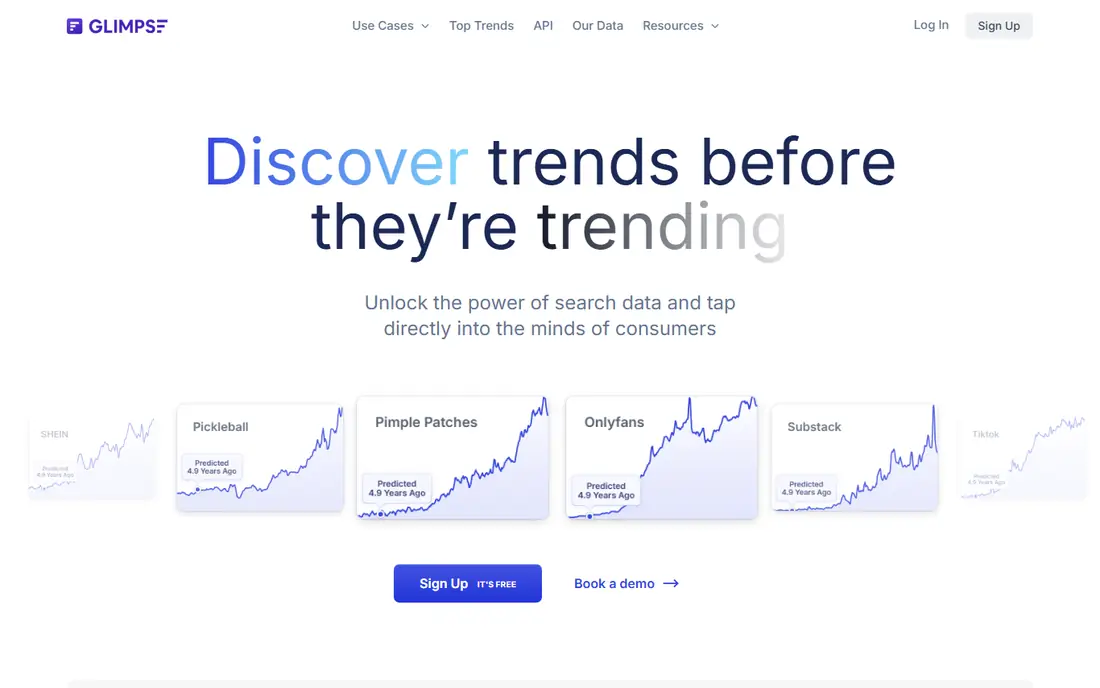
Glimpse is the tool to try when you already have a keyword and want to know whether it is worth pursuing. It builds on Google Trends data and adds absolute volume estimates, a forecast, and related search data, which makes a rising line easier to judge in business terms. The Chrome extension also brings that extra data into Google Trends itself, so researchers do not need to switch tools for every check.
The catch is pricing transparency. Paid plans are shown after sign-up rather than on a public pricing page, and third party coverage has reported different figures over time, so we list the price as See website. The free plan covers a limited number of lookups per month, which is enough for occasional validation but not for heavy daily research.
- Adds absolute search volume to Google Trends
- Forecasts and channel breakdowns
- Chrome extension for in-browser checks
- Paid pricing is shown inside the app rather than on a public page
- Free plan is limited to a small number of monthly lookups
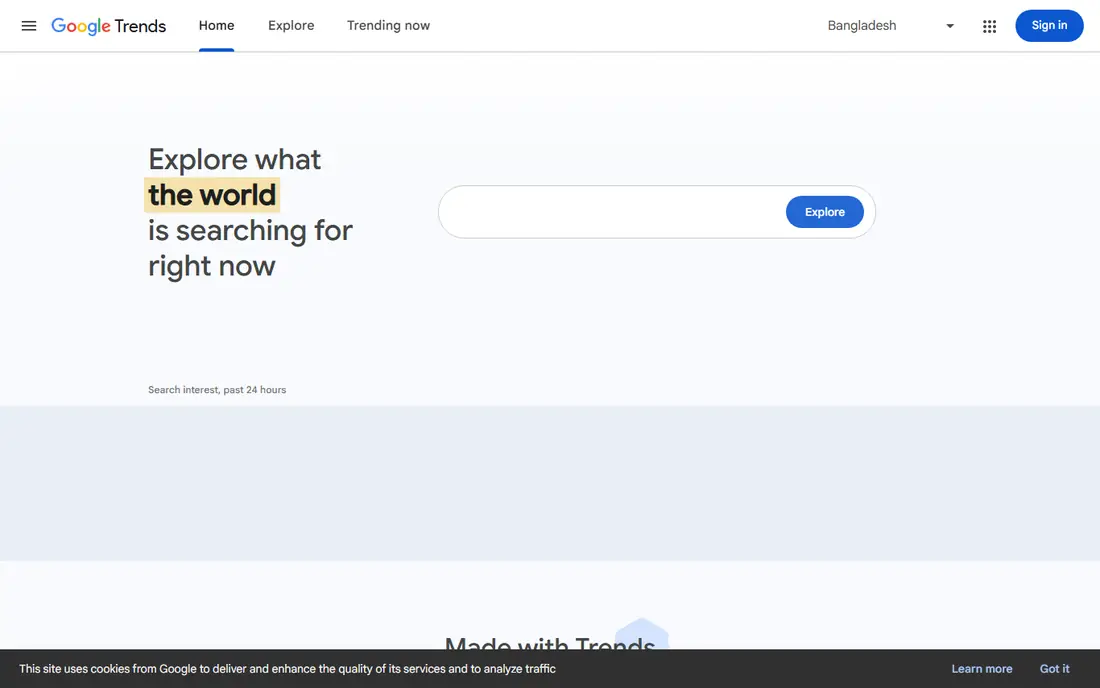
Google Trends remains the first check for most trend questions because it costs nothing and covers almost any term. You can compare up to five topics, break interest down by region and time period, and see related queries that point to nearby demand. For a quick sense check before spending money, nothing else matches its speed.
The limit is interpretation. A score of 100 means peak interest for that term in that period, not a fixed number of searches, so two unrelated terms cannot be compared by score alone. It also does not hand you a curated list of new trends, which is where paid tools earn their keep.
- Free for any keyword
- Regional and time based comparisons
- Related queries and topics included
- Shows relative interest on a 0 to 100 scale, not absolute volume
- No curated feed of emerging topics
Trend Hunter takes a very different approach from search data tools, because its value is in examples rather than charts. Its archive covers products, campaigns, and ideas across many consumer categories, with written context on why each example matters. Product teams use it to spark ideas and to see how a theme plays out across fashion, food, tech, and home goods.
The drawback is price and measurement. The paid plan starts at $199 per month per user when billed annually, which is hard to justify for a solo founder, and its popularity measures do not translate directly into search volume. Use it for inspiration and context, then validate demand with search or traffic data.
- Large archive of visual innovation examples
- Trend reports by category
- Useful for product and marketing teams
- Paid plan is expensive for solo users
- Popularity scores are qualitative rather than absolute search volumes
Treendly is built for people who want to watch a handful of trends without paying a monthly enterprise fee. The free plan lets you monitor a small number of trends, and the paid plan is priced annually at a level most small teams can test without a long approval process. Country level tracking is a practical bonus for sellers who care about one market at a time.
The trade-off is depth. Treendly does not match Semrush for traffic analysis or Trend Hunter for rich innovation examples, so it works best as a discovery and monitoring layer. Pair it with Google Trends or a keyword tool when you need to size a market before investing.
- Low annual cost
- Lets users monitor specific trends by country
- Simple interface for ongoing tracking
- Smaller feature set than larger platforms
- Less depth on traffic and content data
Rising Trends is aimed squarely at founders, e-commerce sellers, and content creators looking for their next idea. Each trend listing pairs a short write-up with search volume and growth context, which helps readers move from a catchy idea to a quick demand check. The free weekly newsletter also makes it easy to sample the product before paying.
The limit is scale. It is a curated service rather than a full market intelligence platform, so coverage is thinner in niche business to business categories. Treat it as a strong idea source, then confirm any shortlisted trend with search, traffic, or marketplace data.
- Curated trends with search volume and growth data
- Free weekly newsletter
- Low annual price
- Smaller database than the largest platforms
- Trend write-ups vary in depth by category
BuzzSumo answers a different question from most tools here, namely what content is actually getting shared and linked to right now. That makes it valuable for content teams, PR teams, and anyone whose trend bet depends on social and media attention rather than search alone. Its monitoring alerts also catch spikes as they happen, which is useful for news driven topics.
The catch is cost and fit. At $199 per month, it is a serious commitment for a solo creator, and it will not replace a search volume tool for sizing demand. Choose it when content performance is the signal you care about most, not as a general replacement for trend discovery.
- Shows which content and topics earn engagement
- Media monitoring and influencer discovery
- Strong for PR and content teams
- High starting price
- Trend angle is content led rather than search led
TrendWatching is the most strategy oriented option in this list. Its reports explain the consumer shift behind a trend, with examples and implications for brands, rather than just charting a keyword. That depth helps strategy, brand, and innovation teams explain a trend to stakeholders and decide whether it fits their market.
The downside is pace and price. Reports arrive on a publishing schedule rather than as a live feed, and the paid plan starts at $990 per year, so it suits teams that buy research rather than individuals browsing for ideas. The free Seeker plan is a sensible way to test whether the writing style fits your work.
- Thoughtful consumer trend analysis
- Free Seeker plan for sampling
- Useful for strategy and brand work
- Annual price is high for small teams
- Reports are periodic rather than a live trend feed
Semrush is the pick when a trend question is really a market question. Its traffic and market tools show how sites and categories are growing, which complements search interest with actual visits and competitor movement. That combination helps teams separate a topic that is merely talked about from one that is driving real traffic.
The weakness is focus. Semrush is a large SEO and marketing platform, so trend discovery sits inside a much bigger toolset, and some market features require higher tiers. Solo users who only need trend ideas may find it more than they need, while marketing teams will get more value from the full suite.
- Market and traffic data alongside keyword trends
- Competitor comparison
- Broad SEO and content toolset
- Trend discovery is one part of a large platform
- Full market toolkit pricing is higher than the base plan
Pinterest Trends is a free and often overlooked source for visual and shopping demand. It shows how search terms perform on Pinterest over time, which is valuable for home, fashion, food, beauty, and craft categories where discovery is visual. Seasonal spikes also stand out clearly, which helps with planning content and inventory.
The limit is audience. Pinterest data describes Pinterest users, not the whole web, so a flat line there does not prove a topic is dead elsewhere. Use it as a complement to Google Trends for visual categories, not as a standalone market measure.
- Free search and shopping trend data from Pinterest
- Seasonal patterns are easy to spot
- Useful for visual products
- Data only reflects Pinterest users
- Less useful for business to business or non visual topics
How we picked these
We compared official feature pages, pricing pages, and public reviews for tools that surface emerging topics in a way a reader can act on. We favored tools that are live in October 2026, that show a real data source or editorial method, and that cover different needs, including free validation, curated discovery, content signals, and strategic reports. We left out tools that only republish another platform without adding data or analysis.
How to use trend tools without chasing noise
Start with a question, not a chart, and write down what would count as proof before you search. A rising keyword is a lead, so check search volume where available, look at related queries, and see whether traffic, sales, or content engagement supports the same story. If only one signal rises while the others stay flat, treat the idea as unproven and keep watching it.
Set a shortlist and a review date rather than collecting trends endlessly. Track a small number of topics for a few weeks, note what changes, and drop ideas that do not grow or that lack a clear buyer. That discipline matters more than the tool you choose, because every platform can surface interesting topics that never become viable products.
Frequently asked questions
Is there a free alternative to Exploding Topics?
Yes, Google Trends is free and covers the core job of checking interest over time for any keyword. Treendly and Rising Trends also offer free tiers or a free newsletter, while Glimpse offers a limited free plan for deeper checks.
Which tool is best for validating a keyword I already have?
Glimpse is the strongest fit here, because it adds absolute volume estimates and forecasts to Google Trends data. Google Trends alone can show direction, but it cannot tell you how many searches a term actually receives.
Are trend tools enough to choose a business idea?
No, a trend tool is only the first step. Check competition, pricing, margins, and whether buyers actually pay for a solution in that category before you invest time or money in a product.
How often should I check trends?
Weekly checks suit most founders, with daily alerts only for news driven or seasonal topics. Checking too often creates noise, while checking monthly can miss a short window for seasonal products.
Do paid trend tools guarantee early discovery?
No tool can guarantee that a trend will keep growing, and curated lists reflect editorial choices as well as data. Use several signals, set a decision date, and be ready to drop an idea that stops growing.
Sources
See where you really rank - block by block
ProMapRanker scans Google Maps across a grid of your service area. Simple monthly plans from $19, white-label on every plan.
Start freeKeep reading
 zoho books alternatives
Best Zoho Books Alternatives in 2026
Compare the best zoho books alternatives for small business accounting, from QuickBooks Online and Xero to FreshBooks, Wave, and Sage in 2026, with pricing.
Read → zluri alternatives
Best Zluri Alternatives in 2026
Compare zluri alternatives for 2026, with SaaS management platforms for app discovery, spend tracking, renewals, and automation for IT, finance and procurement.
Read → zerobounce alternatives
Best ZeroBounce Alternatives in 2026
Best zerobounce alternatives for list hygiene: compare 8 email verification tools for bulk cleaning, real-time checks and catch-all handling in 2026 today.
Read →