 ProMapRanker
Best Vocabulary Apps in 2026: 9 Apps Compared

Deep English vocabulary learning · Pricing starts at: See website
Key takeaways
- Vocabulary.com is our top pick for deep English word learning, thanks to adaptive practice and clear example sentences.
- Anki is the best free long-term tool for learners who want full control over spaced repetition and custom decks.
- Quizlet is the easiest choice for school and exam cramming, with huge sets of ready-made flashcards.
- Magoosh Vocabulary Builder is the most focused option for GRE and SAT test prep, with curated high-value words.
- Memrise and WordUp suit learners who remember words better through video, images and real-world examples.
Quick comparison
| Pick | Great for | Pricing starts at | Free tier | |
|---|---|---|---|---|
| Vocabulary.com | Deep English vocabulary learning | See website | Yes | Visit |
 Anki | Custom spaced repetition | Free | Yes | Visit |
 Quizlet | Ready-made study sets | Free | Yes | Visit |
 Magoosh Vocabulary Builder | GRE and SAT test prep | Free | Yes | Visit |
 Memrise | Video and language context | Free | Yes | Visit |
 WordUp | Daily English words with examples | Free | Yes | Visit |
 Elevate | Brain training with vocabulary games | See website | Yes | Visit |
 Drops | Visual short-session learning | Free | Yes | Visit |
 Merriam-Webster Dictionary | Dictionary with word games | Free | Yes | Visit |
The best vocabulary apps
Vocabulary apps work in different ways: some teach words in context, some drill flashcards, and some use games and video. We compared official app pages, app store listings and current pricing summaries, and we kept only apps that operate in October 2026. The best choice depends on your goal: learning English, preparing for a test, or building words for work and writing.
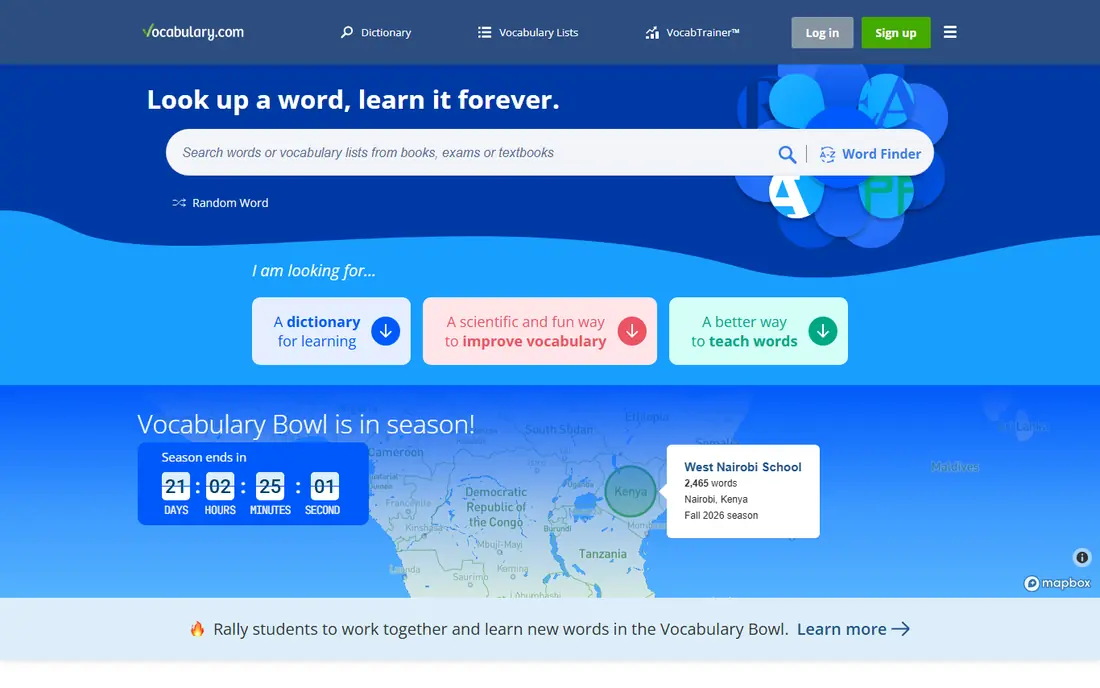
Vocabulary.com is our top pick for learners who want to truly understand English words, not just memorize a definition for a test. Its adaptive trainer asks questions in varied formats, gives example sentences, and repeats words you miss until they stick. Definitions are written in plain language, with notes on usage and word origins that help you use a word correctly in writing.
The free access is useful for looking up words and trying practice, but the full adaptive trainer sits behind a paid plan, so check the current price before you commit. If you are a student, teacher or professional who wants depth in English, Vocabulary.com is worth that cost. If you want a quick game, a lighter app may suit you better.
- Adaptive practice adjusts to your level
- Human-written definitions and examples
- Tracks progress and weak words
- Full trainer features need a paid plan
- Less suited to non-English languages
- Interface is study focused, not game focused
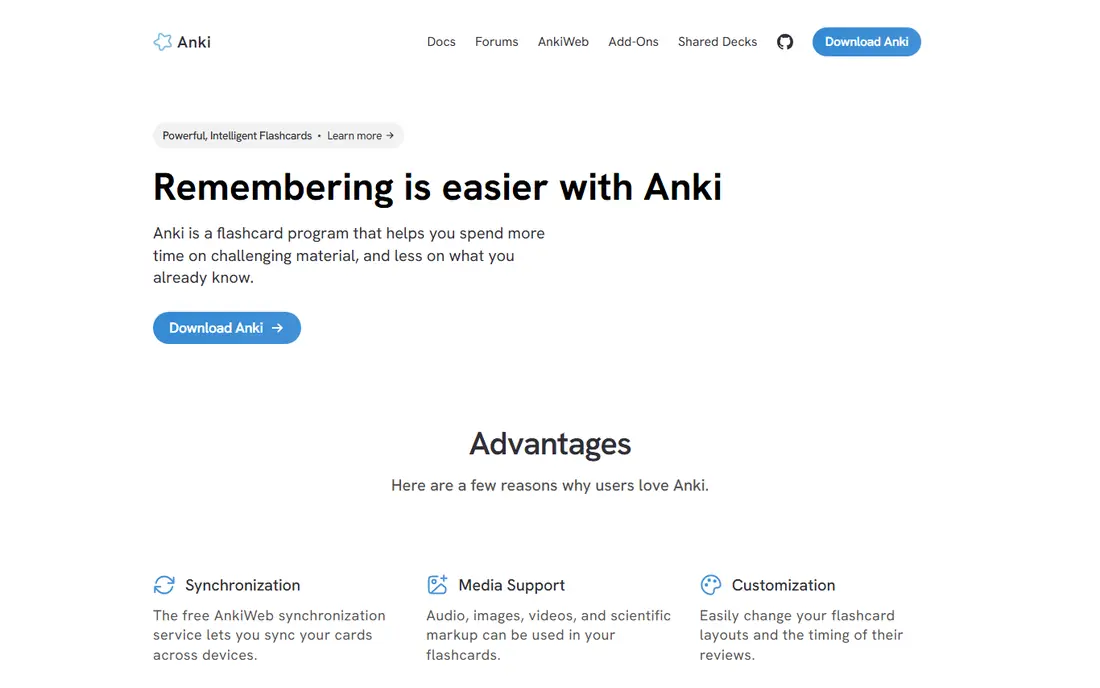
Anki is the best long-term vocabulary tool for learners who do not mind setup work. Its spaced repetition system schedules each card at the right interval, so words return just before you would forget them. You can build your own decks, add images and audio, or download shared decks for English, test prep or another language.
The plain interface and learning curve are the trade-offs. Anki will not entertain you with games, and a new user needs an hour to learn how decks, cards and review settings work. Once that setup is done, though, few apps match Anki for retention over months, and the desktop and Android versions are free.
- Free on desktop and Android
- Powerful spaced repetition
- Huge library of shared decks
- Fully customizable cards
- IOS app is a paid one-time purchase
- Setup takes time
- Interface feels plain compared with game apps
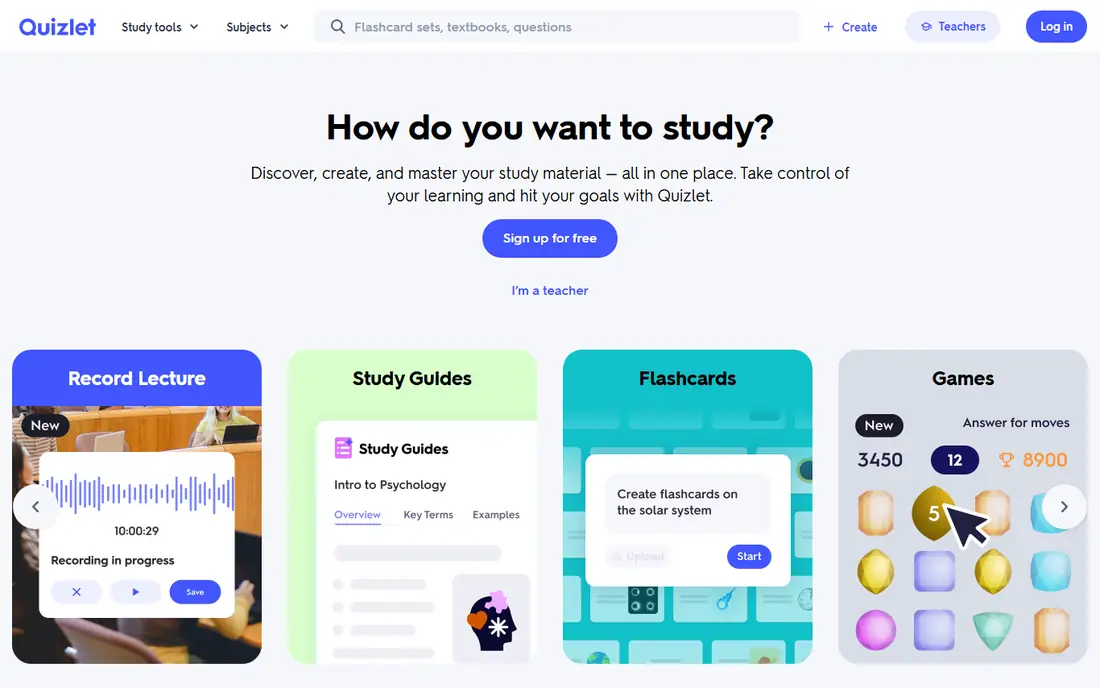
Quizlet is the easiest app for school study and exam cramming, because you rarely need to build a set from scratch. Search for a textbook, exam or topic, and you will usually find a set made by a teacher or another student. Study modes let you flip cards, take practice tests, play a matching game or work through a guided Learn path.
Quality control is the catch. User-made sets can contain errors, so check a set against a trusted source before you rely on it for an exam. The free plan covers basic study well, while the paid plan adds stronger spaced repetition and removes ads. For group study and quick revision, Quizlet is hard to beat.
- Huge library of ready-made sets
- Multiple study modes including Learn and Match
- Easy sharing for classes and study groups
- Full spaced repetition needs a paid plan
- Quality varies across user-made sets
- Ads appear on the free plan
Magoosh Vocabulary Builder is the most focused app in this list for test prep. Instead of teaching every English word, it drills the high-value words that appear most often on the GRE, SAT and similar exams, with short multiple-choice questions and clear explanations. That focus helps when study time is short and the exam date is close.
General learners should look elsewhere. Magoosh will not build broad everyday English or workplace vocabulary in the same way Vocabulary.com does, and full Magoosh prep courses cost more than the free builder app. For a test taker, though, that narrow focus is exactly the point.
- Curated words for GRE, SAT and similar tests
- Short multiple-choice drills
- Clear explanations for each word
- Narrow focus on test words
- Related Magoosh courses are paid
- Less useful for general English learning
Memrise teaches vocabulary through short video clips of native speakers, spaced review and game-like practice, which suits learners who remember words better when they hear and see them used. It covers many languages, and the free plan includes official courses for a core set of languages, with device sync and review plans. That context helps with pronunciation and real conversation.
Academic English is not its strongest area. If your goal is GRE words or professional writing vocabulary, Vocabulary.com or Anki will serve you better. Memrise shines for language learners who want practical words they can actually say, and for building a daily habit with short sessions.
- Native-speaker video clips
- Spaced review and gamified practice
- Wide range of languages
- Paid plan needed for full features
- English academic vocabulary is not the main focus
- Course availability varies by language
WordUp is a good daily habit app for English learners, especially those learning English as a second language. It presents words with video examples, images and example sentences, and its knowledge map shows which words you already know and which need work. Short daily sessions fit easily into a commute or a break, and the app feels more modern than a plain flashcard deck.
Advanced learners may outgrow it. WordUp is stronger for everyday and intermediate English than for graduate test vocabulary, and the most useful features sit behind a paid plan. Start with the free plan, set a daily goal you can keep, and move to a deeper tool if you need academic depth.
- Daily words with video and image examples
- Knowledge map tracks words you know
- Good for English as a second language learners
- Advanced features need a paid plan
- Content depth varies by level
- Less suited to advanced test prep
Elevate is the pick for learners who want vocabulary practice inside a broader brain training routine. Its games cover vocabulary, reading comprehension, writing and processing speed, and daily workouts adapt to your performance. Sessions are short and polished, which makes it easy to practise every day without feeling like you are doing homework.
Depth is the limit. Elevate will not teach GRE word lists or build a custom deck for your profession, and full access needs a paid subscription, so check the current price on its site. If you want a fun daily workout that includes words, Elevate is a good choice. If you want deep word study, pair it with Vocabulary.com or Anki.
- Polished games for vocabulary, reading and speed
- Personalized daily workouts
- Short sessions build a habit
- Full access needs a subscription
- Vocabulary is one part of a broader brain training app
- Less depth than a dedicated vocabulary tool
Drops uses bright visuals and quick swipe games to teach words in five-minute sessions, which makes it one of the least intimidating apps in this list. It is best for beginners learning vocabulary in a new language, where pictures and repetition help words stick. The design is clean, the pace is gentle, and it works well for learners who have struggled with text-heavy apps.
The five-minute free limit is the catch, since longer practice needs a paid plan, and Drops focuses on basic vocabulary rather than advanced English. Use it as a warm-up or a first step into a new language, then move to Memrise or Anki when you need sentences, grammar and deeper word knowledge.
- Visual, game-like word learning
- Very short daily sessions
- Good for beginners in a new language
- Free sessions are time limited each day
- Focus is on nouns and basic words
- Less suited to advanced English study
Merriam-Webster Dictionary is the reference app every vocabulary learner should have on their phone, even if it is not a full course. Its definitions are trusted, its Word of the Day builds a gentle daily habit, and its word games and quizzes give light practice. Audio pronunciations and example sentences help you use a word correctly, not just recognize it.
It will not plan your learning or schedule spaced reviews the way Anki does, so treat it as a companion, not a curriculum. Look up words you meet in reading, save favorites, play the daily quiz, and let a dedicated app handle structured practice. That combination works well for readers and writers.
- Trusted dictionary definitions
- Word of the Day and word games
- Audio pronunciations and example sentences
- Not a structured learning course
- Full features and ad removal need a paid plan
- Vocabulary games are lighter than dedicated apps
How we picked these
We compared official app pages, app store listings and current pricing summaries for vocabulary apps that operate in October 2026. We kept only apps that truly teach vocabulary, and we mixed dictionary tools, flashcard systems, test prep apps and game-based learners so different goals are covered. Where pricing varies by platform or plan, we wrote See website rather than publishing a single figure that could mislead you.
What to check before you choose
Start with your goal: everyday English, a test, a new language or professional writing. Then pick the method that fits how you learn: context and examples, flashcards and spaced repetition, video and speaking, or short games. Try the free plan for a week and check whether you actually open the app daily, since the best app is the one you keep using.
Also check platform and cost. Some apps charge on iOS but not on Android, and some limit free sessions each day. If you study with a class or a tutor, check whether the app lets you share sets or track progress. Finally, pair an app with reading: words learned in books and articles stick better than words learned only in drills.
Frequently asked questions
What is the best free vocabulary app?
Anki is the best free long-term choice on desktop and Android, thanks to spaced repetition and custom decks. Quizlet and Vocabulary.com also offer useful free plans, while Drops and Memrise give a good free start for language learners.
What is the best app for vocabulary building?
Vocabulary.com is our top pick for deep English vocabulary, while Anki is best for long-term retention with custom decks. Quizlet is better for quick school study, and WordUp suits daily English learners who like video examples.
What is the best app to learn English vocabulary?
WordUp and Memrise are strong for English as a second language learners, thanks to video, images and real examples. Vocabulary.com adds depth for advanced learners, and Anki lets you build decks from words you meet in reading and class.
What is the best vocabulary builder app for GRE or SAT prep?
Magoosh Vocabulary Builder is the most focused choice, with curated test words and short drills. Pair it with Vocabulary.com for deeper understanding and Anki for spaced review of words you keep missing.
Can a vocabulary app replace reading?
No. Apps are excellent for review and for learning new words, but reading books, news and articles shows you how words work in real sentences. Use an app for daily practice, and add new words from your reading into a deck for review.
Sources
See where you really rank - block by block
ProMapRanker scans Google Maps across a grid of your service area. Simple monthly plans from $19, white-label on every plan.
Start freeKeep reading
 steamunlocked alternatives
Best SteamUnlocked Alternatives in 2026
Looking for steamunlocked alternatives? These 8 legal game stores and subscriptions offer licensed PC games, sales, and cloud play without piracy risks.
Read → mangools alternatives
Best Mangools Alternatives in 2026
Looking for mangools alternatives? We compare 8 SEO tools for keyword research, rank tracking, and site audits, from Semrush and Ahrefs to Keysearch today.
Read → lemlist alternatives
Best Lemlist Alternatives in 2026
Looking for lemlist alternatives? We compare 9 cold email and outreach tools for 2026, covering pricing, deliverability, inboxes, and multichannel steps.
Read →