 ProMapRanker
Best Software for Church Accounting in 2026

Key takeaways
- Aplos from $79 per month is the clearest cloud choice for churches that need true fund accounting without enterprise complexity.
- PowerChurch Plus at $445 one-time suits churches that prefer a desktop purchase and built-in clergy payroll.
- ChurchTrac from $29 per month is the budget all-in-one pick for small churches that also need membership and giving tools.
- QuickBooks Online can work for churches, but fund accounting needs careful class tracking rather than native fund ledgers.
- Payroll decides many choices, since clergy housing allowance and dual tax status need handling that general tools may not cover.
Quick comparison
| Pick | Great for | Pricing starts at | Free tier | |
|---|---|---|---|---|
 Aplos | Cloud fund accounting | $79 per month | Free trial | Visit |
 PowerChurch Plus | One-time purchase value | $445 one-time | No | Visit |
 ChurchTrac | Budget all-in-one | $29 per month | Free plan | Visit |
 Realm by ACS Technologies | Large church ecosystems | See website | No | Visit |
 QuickBooks Online | General accounting with wide support | $38 per month | Free trial | Visit |
 IconCMO | Modular church accounting | $35 per month | Free trial | Visit |
 ChMeetings | Giving plus church administration | $25 per month | Free plan | Visit |
 Church Windows | Long-standing church accounting | See website | No | Visit |
 FellowshipOne | Multi-campus churches | See website | No | Visit |
The best software for church accounting
Church accounting differs from business accounting because gifts are often restricted to a fund, such as a building fund or missions fund, and must stay separate from general operating money. The tools below handle fund accounting, donor statements, and church reporting in different ways. We favor purpose-built church tools where fund separation matters, and we note where a general tool needs workarounds.
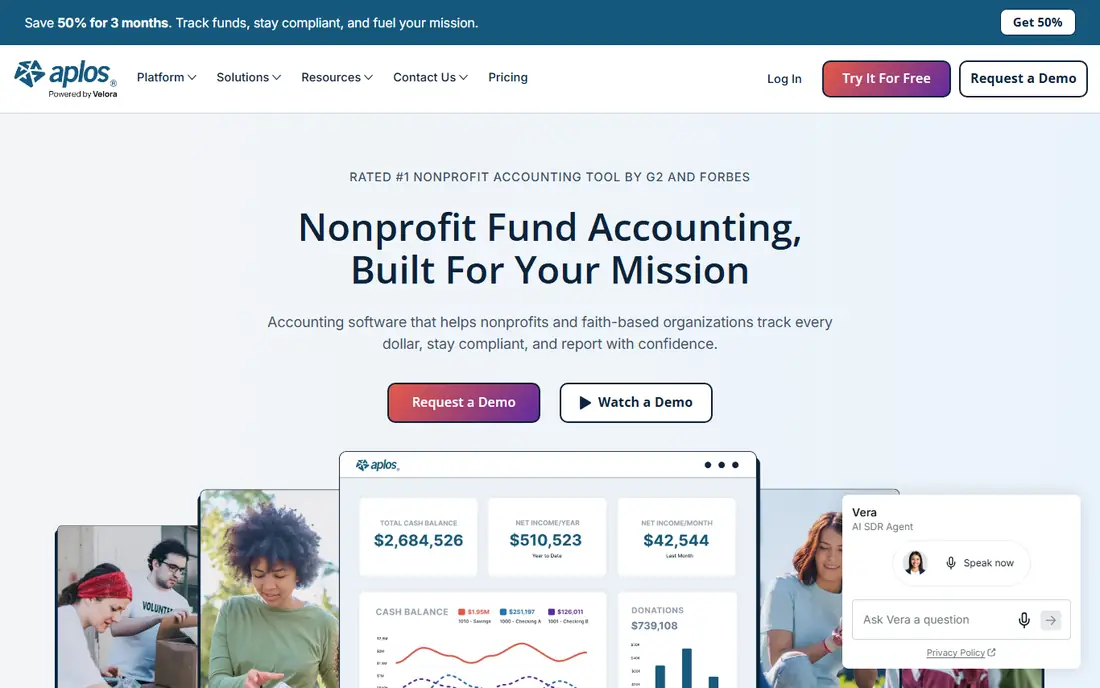
Aplos is built for churches and nonprofits, so fund accounting works the way churches actually operate. Restricted funds, contributions, donor management, and fund-based financial statements are native, not added through tags or workarounds. That clarity helps a volunteer treasurer show a board exactly where building, missions, and general funds stand.
Plans run Lite at $79, Core at $129, and Advanced at $229 per month, with fund budgeting on Advanced. Payroll runs through a Gusto partnership rather than natively, which means churches need a second service for clergy payroll. For a church that wants proper fund accounting in the cloud without hiring an accountant to run it, Aplos is our pick for most people.
- True fund accounting built in
- Donor tracking and statements
- Friendly for volunteer treasurers
- Payroll runs through a partner
- Advanced budgeting needs higher tiers
- Price rises with tiers
PowerChurch Plus has served churches for many years, combining fund accounting, membership, contributions, and payroll in one desktop program. The desktop license costs $445 one-time, and an online version starts at $47 per month for two concurrent users. Built-in payroll with housing allowance tracking is a real advantage for churches with ordained staff.
The trade-off is a desktop-first experience that feels older than cloud tools such as Aplos. Churches that want remote access for several staff members will pay for the online plan. For a budget-conscious church with a stable office computer and clergy payroll needs, PowerChurch Plus offers strong value.
- One-time desktop price
- Built-in payroll with housing allowance
- Membership and contributions included
- Desktop-first design
- Online plan costs extra
- Interface feels dated
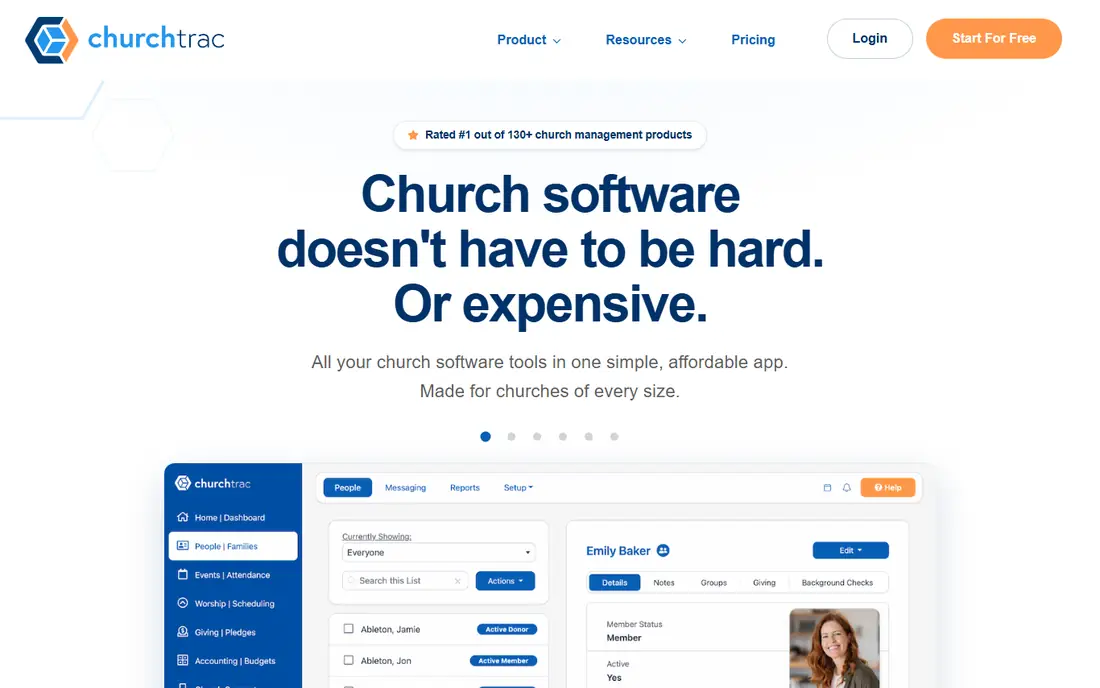
ChurchTrac combines church management, giving, and accounting from $29 per month, which makes it attractive for small churches that cannot pay for several separate tools. Fund accounting is included on its plans, and donor records sit beside giving and attendance data. That single database reduces double entry for a small staff or volunteer team.
ChurchTrac does not include native payroll, so churches track payroll entered from a separate system. Reporting is also lighter than Aplos or Realm for complex fund structures. For a small church that needs accounting, membership, and giving in one affordable package, ChurchTrac is a practical choice.
- Low starting price
- Accounting plus membership and giving
- Simple for small churches
- Payroll is not built in
- Reporting depth is lighter
- Accounting setup help costs extra
Realm by ACS Technologies combines church administration, giving, groups, and accounting in one platform, with multi-campus administration on higher plans. Giving batches can post directly into the ledger, which reduces manual entry and reconciliation work. Churches already using ACS products will find the shared database familiar.
Pricing is by quote, and accounting is an add-on rather than part of every plan, so buyers need a clear quote for the full package. Setup for a large or multi-campus church takes planning. For mid-sized to large churches that want ministry and finance in one system, Realm is a strong contender.
- Combined ministry, giving, and accounting
- Multi-campus support
- Strong ACS ecosystem
- Pricing by quote
- Accounting is an add-on
- Setup can be complex
QuickBooks Online is the most widely supported general accounting tool in the US, which means most accountants and bookkeepers already know it. Invoicing, expenses, bank feeds, payroll add-ons, and reporting are polished, and integrations cover giving platforms, payment processors, and payroll services. A church with a QuickBooks-savvy bookkeeper can run its books reliably.
The catch is fund accounting. QuickBooks approximates funds with class or location tracking, which works for simple restrictions but needs discipline as funds grow. It also lacks native donor contribution statements, so churches often pair it with a giving tool. For churches with simple fund needs and a bookkeeper who knows QuickBooks, it remains a workable option.
- Widest accountant support
- Huge integration library
- Familiar interface
- Fund accounting needs class workarounds
- No native donor statements
- Payroll is an add-on
IconCMO sells church software in modules, so a church can buy accounting from $35 per month and add membership, donations, and payroll as needed. That modular approach helps churches that only need accounting now and want to add other tools later. Fund accounting is a core strength, and the system handles church-specific reporting.
Module pricing means the total can rise as features are added, so buyers should price the full set they need. The interface is practical rather than polished, and payroll comes as an add-on service. For churches that want to buy only what they need and expand over time, IconCMO is a flexible option.
- Modular pricing
- Fund accounting focus
- Membership and donation modules
- Modules add cost
- Interface is functional rather than modern
- Payroll is an add-on
ChMeetings combines church administration, giving, and basic accounting from $25 per month for 250 people, with a free plan for smaller needs. Giving flows into administration and accounting views, which helps small churches track donations without a separate giving platform. The interface is straightforward for staff who are not accountants.
Accounting depth is lighter than Aplos or PowerChurch, so churches with many restricted funds or complex budgets may outgrow it. Payroll is not built in. For a small church that needs giving and administration first, with accounting as a supporting tool, ChMeetings offers good value.
- Low starting price
- Giving linked to administration
- Free plan available
- Accounting features are basic
- Payroll is not built in
- Fund reporting is lighter
Church Windows is a long-standing church software package covering fund accounting, payroll, membership, contributions, and scheduling. Its reporting depth suits mid-sized to large churches that need detailed fund and department reports for boards and finance committees. Payroll and membership in the same system reduce separate tools for many churches.
Pricing is custom, so buyers need a quote tied to modules and users. The product heritage is desktop-oriented, and churches used to modern cloud interfaces may find it less polished. For churches that value deep reporting and an established church-specific vendor, Church Windows remains a credible choice.
- Deep church reporting
- Fund accounting and payroll
- Membership included
- Pricing by quote
- Desktop heritage
- Newer cloud tools feel more modern
FellowshipOne Finance suits large and multi-campus churches that need multi-site accounting integrated with church management. Budgeting, fund tracking, and campus-level reporting help central finance teams oversee several locations from one system. Integration with the FellowshipOne church management platform keeps giving, membership, and finance data connected.
Pricing is by quote, and the platform is built for larger organizations, so small churches will likely find it more than they need. Implementation for a multi-campus church also takes planning. For a large church network that needs consolidated finance across campuses, FellowshipOne is worth a quote.
- Multi-site accounting
- Integrated church management
- Budgeting tools
- Pricing by quote
- Best for larger churches
- Smaller churches may find it heavy
How we picked these
We compared official product and pricing pages, fund accounting features, giving and payroll handling, and recent church accounting comparisons. We favored tools with native fund accounting, donor statements, and a live product in October 2026. We excluded giving-only tools with no ledger, and we marked quote-based tools as See website rather than guessing a price.
What to check before you choose
Start by listing your funds and how restricted gifts must be reported. If a donor gives to a building fund, your software should keep that money separate, prevent it from paying general expenses, and show it separately on fund statements. Test that flow with a real example in a trial or demo, not just a feature list.
Next, settle payroll. Ask how clergy housing allowance, dual tax status, and year-end reporting are handled, and whether payroll is native, partnered, or separate. Finally, check who will actually run the books. A volunteer treasurer needs a simpler interface than a CPA, and a multi-campus church needs permissions and consolidation that a small-church tool may not offer.
Frequently asked questions
What is the best church accounting software?
Aplos is our pick for most churches that need true cloud fund accounting, from $79 per month. PowerChurch Plus suits churches that prefer a one-time purchase, and ChurchTrac suits small churches on a budget. The best choice depends on fund complexity, payroll needs, and who runs the books.
What is the best church accounting software for small churches?
ChurchTrac from $29 per month and ChMeetings from $25 per month offer the lowest entry prices with giving and administration included. Aplos from $79 per month is better if fund accounting depth matters more than the lowest price. Small churches should test donor statements and fund reports before choosing.
Does QuickBooks work for church accounting?
Yes, with limits. QuickBooks Online works for churches with simple fund needs, using class tracking to approximate funds. It lacks native fund ledgers and donor statements, so churches with many restricted funds usually do better with Aplos, PowerChurch, or Realm. A QuickBooks-savvy bookkeeper narrows the gap.
What is fund accounting for churches?
Fund accounting tracks money by purpose, so restricted gifts stay separate from general operating money. A building fund, missions fund, and general fund each get their own balances and statements. That separation helps boards and donors see that restricted gifts were used as intended.
Do churches need payroll software for clergy?
Often yes, because clergy pay has special rules for housing allowance and tax status. PowerChurch includes payroll with housing allowance tracking, while Aplos pairs with Gusto for payroll. Confirm how your chosen tool handles clergy pay before you rely on it for year-end reporting.
Sources
See where you really rank - block by block
ProMapRanker scans Google Maps across a grid of your service area. Simple monthly plans from $19, white-label on every plan.
Start freeKeep reading
 zoho books alternatives
Best Zoho Books Alternatives in 2026
Compare the best zoho books alternatives for small business accounting, from QuickBooks Online and Xero to FreshBooks, Wave, and Sage in 2026, with pricing.
Read → zluri alternatives
Best Zluri Alternatives in 2026
Compare zluri alternatives for 2026, with SaaS management platforms for app discovery, spend tracking, renewals, and automation for IT, finance and procurement.
Read → zerobounce alternatives
Best ZeroBounce Alternatives in 2026
Best zerobounce alternatives for list hygiene: compare 8 email verification tools for bulk cleaning, real-time checks and catch-all handling in 2026 today.
Read →