 ProMapRanker
Best Relationship Apps in 2026

Key takeaways
- Paired is our pick for most couples because daily questions and exercises build a short, shared habit that both partners can actually keep up.
- Lasting suits couples who want a structured, multi-week program rather than a quick daily prompt.
- Gottman Card Decks is the best free starting point, with conversation decks based on published relationship research.
- Between, Lovewick, and Flamme cover shared memories, milestones, and date ideas for couples who want more than questions.
- Therapy and coaching apps can support a relationship, but they are not a substitute for professional help when conflict is serious or ongoing.
Quick comparison
| Pick | Great for | Pricing starts at | Free tier | |
|---|---|---|---|---|
 Paired | Daily questions and exercises | See website | Yes | Visit |
 Lasting | Structured relationship program | See website | Yes | Visit |
 Gottman Card Decks | Free conversation decks | Free | Yes | Visit |
 Between | Private shared space | Free | Yes | Visit |
 Lovewick | Milestones and date ideas | Free | Yes | Visit |
 Flamme | Daily notes and goals | Free | Yes | Visit |
 Relish | Coaching with a human coach | See website | No | Visit |
 Honeydue | Shared money for couples | Free | Yes | Visit |
The best relationship apps
Relationship apps do different jobs: some prompt a daily conversation, some plan dates and track milestones, and some offer coaching or shared finances. The best app for a couple depends on what feels hard right now, whether that is finding time to talk, planning together, or handling money without arguments. We compared official feature pages and app store listings for eight apps that couples use in 2026. A note on safety: if conflict involves coercion, control, or harm, an app is not the right tool, and professional support is the safer step.
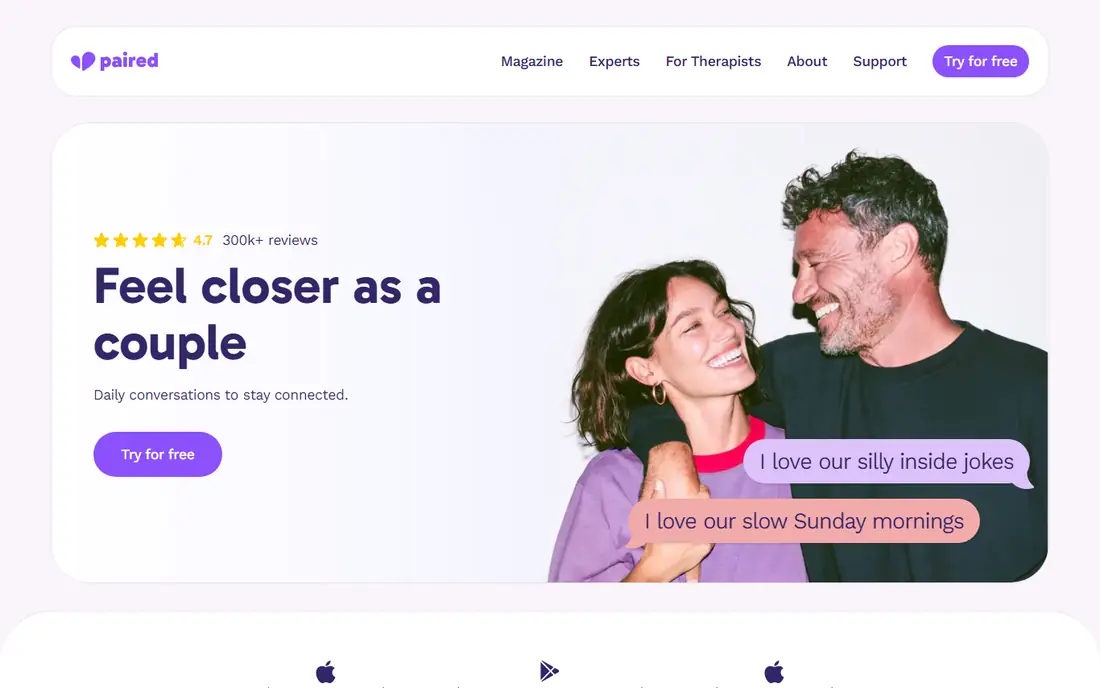
Paired is the easiest relationship app to stick with. Each day brings a question, quiz, or short exercise for both partners, and the app tracks progress over time. The content is designed with therapists and researchers, and the daily time commitment is small, which matters because a habit that takes five minutes is more likely to survive a busy week than a program that takes thirty.
The limit is depth. Paired maintains a relationship that is already working, but it does not fix entrenched conflict, and it is not a substitute for professional help. If your relationship is generally healthy and you want more intentional conversation, Paired is our first pick. If you need structured work on a specific issue, look at Lasting or Relish instead.
- Short daily habit
- Questions designed with therapists and researchers
- One subscription covers both partners
- Light on deep programs for serious issues
- Full features need a paid plan
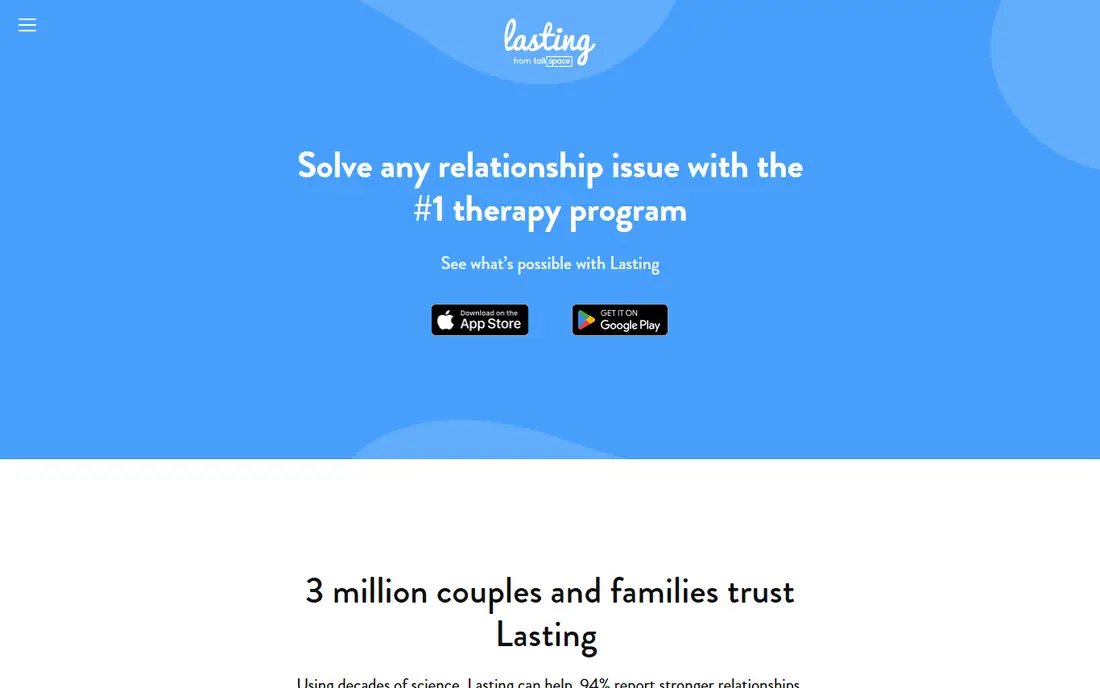
Lasting suits couples who want a program, not just a prompt. It offers guided sessions across topics such as communication, trust, intimacy, and conflict, and it builds a sequence that unfolds over weeks. That structure helps couples who want to work through a topic in order, rather than picking a random question each day.
The trade is time. Sessions take longer than Paired's daily questions, so both partners need to agree to the commitment. If you try Lasting and the sessions feel like homework, switch to a lighter app and revisit Lasting when you have more time. For couples who want depth and are willing to invest it, Lasting is the strongest structured option here.
- Multi-week guided programs
- Covers many topics
- Therapist-led sessions in the app
- Takes more time per session than Paired
- Full access needs a paid plan
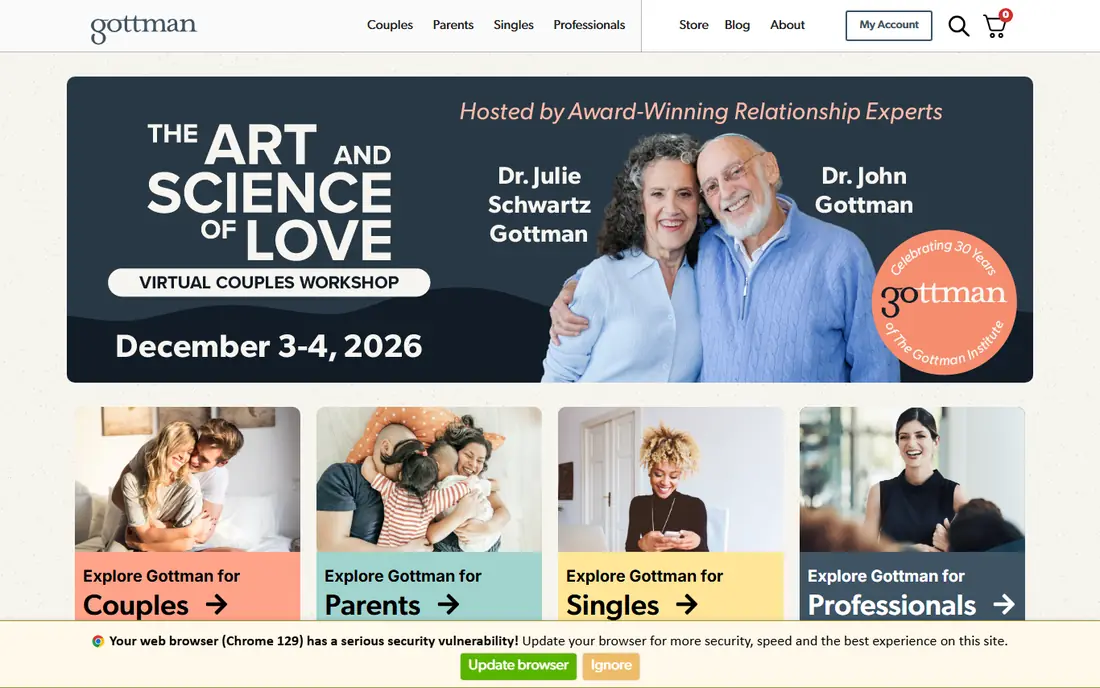
Gottman Card Decks is the best free place to start. The app offers digital card decks with questions and prompts for date nights, intimacy, and rebuilding trust, based on work from the Gottman Institute. There is no subscription wall for the core decks, and the prompts are open-ended enough to lead to real conversation rather than a quiz answer.
It does not track progress, assign exercises, or offer coaching, so couples who want structure will outgrow it. Use it as a low-risk test: if a few evenings with the decks lead to better talks, you will know a paid app is worth trying. If the decks sit unused, a fancier app is unlikely to fix that.
- Free to use
- Decks based on Gottman Institute research
- Good for date nights
- No tracking or coaching features
- Decks are prompts, not a program
Between is a private space for two people, rather than a coaching app. It combines messaging, shared photos, a shared calendar, and a memory box where couples can save important moments. For long-distance couples, that private space feels more intimate than a general messaging app, because everything you share lives in one place built for two.
It does not offer the guided programs of Lasting or the daily exercises of Paired, so couples who want prompts will need another app. If your main need is a shared home for messages, photos, and plans, Between does that job cleanly. Pair it with a question app if you also want conversation prompts.
- Private messaging and shared photos
- Shared calendar
- Memory box for special moments
- Fewer guided exercises than Paired or Lasting
- Some features need a paid plan
Lovewick mixes tracking, prompts, and planning in one app. It tracks milestones and anniversaries, sends reminders for dates and special days, and offers date ideas and daily questions to keep conversation going. That mix suits couples who like a bit of structure but do not want a full coaching program.
Date ideas will not all fit your city or budget, so treat that section as inspiration rather than a plan. The milestone tracking and reminders are the most practical features, because they help couples mark the moments that are easy to forget in a busy year. Lovewick is a good middle ground between a pure question app and a pure calendar app.
- Milestone tracking and reminders
- Many date ideas
- Daily questions for couples
- Date ideas vary by location
- Full features need a paid plan
Flamme is built around small daily gestures. Couples can share love notes, set check-in reminders, take on habit challenges, and track shared goals, with expert advice available in the app. The tone is warm and light, which suits couples who want connection without a heavy program.
Because Flamme is smaller than Paired, its community and content library are less extensive, and some features sit behind a paid plan. If daily notes and shared goals appeal to you more than quizzes, Flamme is worth trying. Start with the free tier and see whether both partners open it daily before you pay.
- Daily love notes and check-ins
- Shared goals and habit challenges
- Expert advice in the app
- Smaller user base than Paired
- Some features need a paid plan
Relish is the closest thing in this list to working with a coach. It pairs couples with a human coach, builds a personalized plan, and lets you message the coach between sessions. That human element matters when a couple wants feedback on their specific situation, rather than generic exercises.
The cost is higher than a question app, and coach fit matters, so a first coach who does not click should not end the experiment. Relish is also not a substitute for licensed therapy, and couples facing serious or ongoing conflict should seek professional help directly. For couples who want guided support with a human touch, Relish is the strongest option here.
- Access to a human relationship coach
- Personalized plan
- Messaging with a coach between sessions
- Subscription cost is higher than question apps
- Coach fit varies by person
Honeydue solves a different relationship problem: money. It lets couples track shared spending, set budgets, and get bill reminders, while keeping individual accounts private where you want them. Money arguments are common, and a shared view of spending can lower the tension around who paid for what.
It is not a coaching or conversation app, so it will not improve communication on its own. Use Honeydue alongside a question or coaching app if money and conversation are both on your list. For couples who mainly argue about spending, Honeydue may do more good than any prompt app.
- Joint budgeting with privacy controls
- Bill reminders
- Shared and individual accounts in one view
- Not a relationship coaching app
- Bank connections vary by institution
How we picked these
We compared official feature pages and app store listings for relationship apps that are available to US couples in 2026, and we favored apps with a clear purpose, a free tier or trial where possible, and a realistic daily time commitment. We included question apps, a structured program, a free deck app, shared-space apps, a coaching app, and a money app, because couples come to this category with different needs. We did not claim hands-on testing, and we flagged where a paid plan is needed for full access. Therapy and coaching apps in this guide are not a substitute for professional help.
How to choose a relationship app
Start with one problem, not with a list of features. If conversation feels flat, pick a question app. If you keep missing dates and milestones, pick a tracking app. If money causes most arguments, pick Honeydue. One clear job makes it easier for both partners to agree to try the app.
Agree on time before you download
Most couples apps fail because one partner uses them and the other does not. Agree on a time budget first, such as five minutes a day or one session a week, and pick an app that fits that budget. A light app used daily beats a deep program opened twice and abandoned.
Try free tiers first
Start with a free tier or trial, and give the app two weeks of real use before you pay. Check whether both partners open it, whether the prompts lead to conversation, and whether the features match your life. If only one partner is engaged, talk about that before you spend money on a subscription.
Know when to seek professional help
Apps build habits and prompt conversation, but they do not treat serious conflict, trust breakdowns, or harmful patterns. If arguments repeat, if one partner shuts down, or if safety is a concern, seek a licensed therapist or a trusted support service directly. An app can support that work, but it cannot replace it.
Frequently asked questions
What are the best apps for couples?
Paired is the best all-round pick for daily connection, Lasting suits structured programs, and Gottman Card Decks is the best free start. Between, Lovewick, and Flamme add shared space, milestones, and daily notes.
What is the best couples app for daily questions?
Paired is the best choice for daily questions and short exercises, because one subscription covers both partners and the time commitment is small. Agape is a lighter alternative with one question a day.
What is the best relationship app for couples who want therapy tools?
Lasting offers structured, therapist-led programs, and Relish adds a human coach. Neither is a substitute for licensed therapy, and couples with serious conflict should seek professional help directly.
What is the best couple app for long-distance relationships?
Between gives long-distance couples a private shared space for messages, photos, and plans, while Paired adds a daily shared prompt. Many long-distance couples use both: one for space, one for conversation.
Are relationship apps free?
Many have free tiers, including Paired, Gottman Card Decks, Between, Lovewick, Flamme, and Honeydue. Full programs, coaching, and extra features usually need a paid subscription, so check the price in your region before you subscribe.
Do couples apps really work?
Apps can help when both partners use them regularly and the relationship is generally healthy, because they build a habit of talking. They work less well for serious conflict, where professional support is the better step.
Sources
See where you really rank - block by block
ProMapRanker scans Google Maps across a grid of your service area. Simple monthly plans from $19, white-label on every plan.
Start freeKeep reading
 zeffy payment processor stripe alternatives
Zeffy and Stripe Alternatives for Nonprofits in 2026
Explore zeffy payment processor stripe alternatives for nonprofits. We compare 8 fundraising platforms on fees, donor tools, and nonprofit focus. Check fees.
Read → workday alternatives
Workday Alternatives in 2026
Workday alternatives compared: we review 8 HR and payroll platforms that replace Workday, with pricing, strengths and honest limits for each team size.
Read → what's the best weather app
What's the Best Weather App in 2026
Wondering what's the best weather app? We compare 10 free and paid apps for forecasts, radar, alerts, and Colorado mountain weather for everyday and storm use.
Read →