 ProMapRanker
Best POD Companies in 2026

Key takeaways
- Print on demand means no inventory, but margins depend on base cost, shipping, and returns, not just the monthly plan price.
- Printful suits brands that prioritize quality and branding, while Printify suits sellers who want provider choice and lower base costs.
- Gelato suits sellers with customers in several countries, since local production can cut shipping time and cost.
- Order samples before launch, since print quality, fabric, and color vary by product and facility even within one company.
Quick comparison
| Pick | Great for | Pricing starts at | Free tier | |
|---|---|---|---|---|
 Printful | Quality and branding | Free | Yes | Visit |
 Printify | Provider choice and low base cost | Free | Yes | Visit |
 Gelato | Global local production | Free | Yes | Visit |
 SPOD | Simple fast apparel fulfillment | Free | Yes | Visit |
 CustomCat | Low-cost US apparel | Free | Yes | Visit |
 Gooten | Managed fulfillment at volume | Free | Yes | Visit |
 AOP+ | All-over-print products | Free | Yes | Visit |
 Prodigi | Art prints and photography | Free | Yes | Visit |
 Apliiq | Premium apparel and labels | Free | Yes | Visit |
 teelaunch | Gifts and home decor | Free | Yes | Visit |
The best POD companies
Print on demand, often shortened to POD, lets a seller offer custom products without holding stock, since each item is printed and shipped after an order arrives. The companies below are live fulfillment providers in October 2026, and we compared their official product catalogs, pricing pages, app store listings, and public seller reviews. Marketplace sellers such as Redbubble and TeePublic are a different model, so this list focuses on fulfillment companies that connect to your own store.
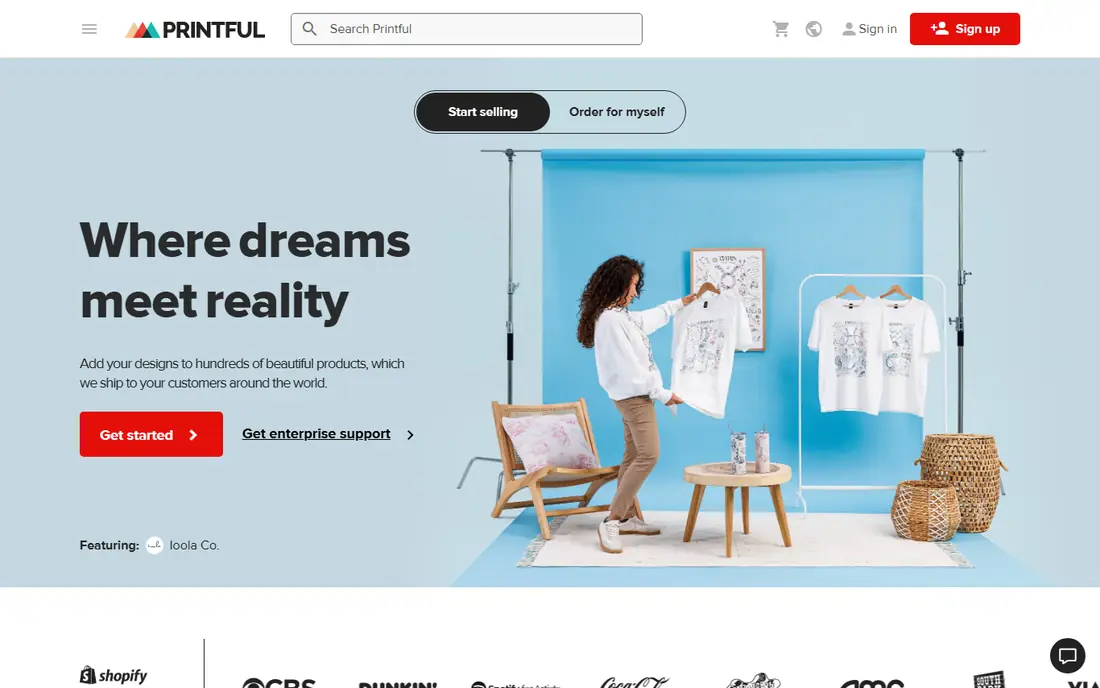
Printful is the most consistent quality-first pick among POD fulfillment companies, because it prints in its own facilities rather than passing every order to an outside shop. That control shows in branding too, with custom labels, packaging inserts, and a strong mockup generator that helps a store look like a real brand rather than a template shop. Its catalog covers apparel, accessories, drinkware, wall art, and more, with deep Shopify and other store integrations.
The trade-off is price. Printful is not the cheapest on every item, and sellers who compete mainly on price may find better margins at Printify or CustomCat. The Growth plan, at $24.99 per month and free once a store passes $12,000 in yearly sales in public comparisons, adds discounts that help at volume. For a brand-led store, though, the quality and branding edge is worth the premium.
- In-house production for more consistent quality
- Strong branding options including labels and packaging
- Growth plan at $24.99 per month with discounts
- Higher base costs than some rivals on certain products
- Branding options vary by product and facility
Printify suits sellers who want choice and low base costs above all else. Its catalog runs to more than a thousand products across dozens of print providers, and its provider comparison tools let a seller weigh price, location, and production time for the same design. That range helps sellers who sell many product types, or who want a provider near their main customers to cut shipping time.
The honest limit is consistency. Since providers differ, two orders of the same design can print slightly differently, and a seller must test providers rather than assume uniform quality. The free plan is a fair start, and the Premium tier adds discounts for sellers with volume. Sellers who order samples and lock in a reliable provider for each bestseller will get the most from Printify.
- Very large catalog with many print providers to compare
- Competitive base costs on many items
- Free plan with a paid Premium tier for discounts
- Quality can vary by provider, so samples matter more
- More supplier decisions to manage than an in-house printer
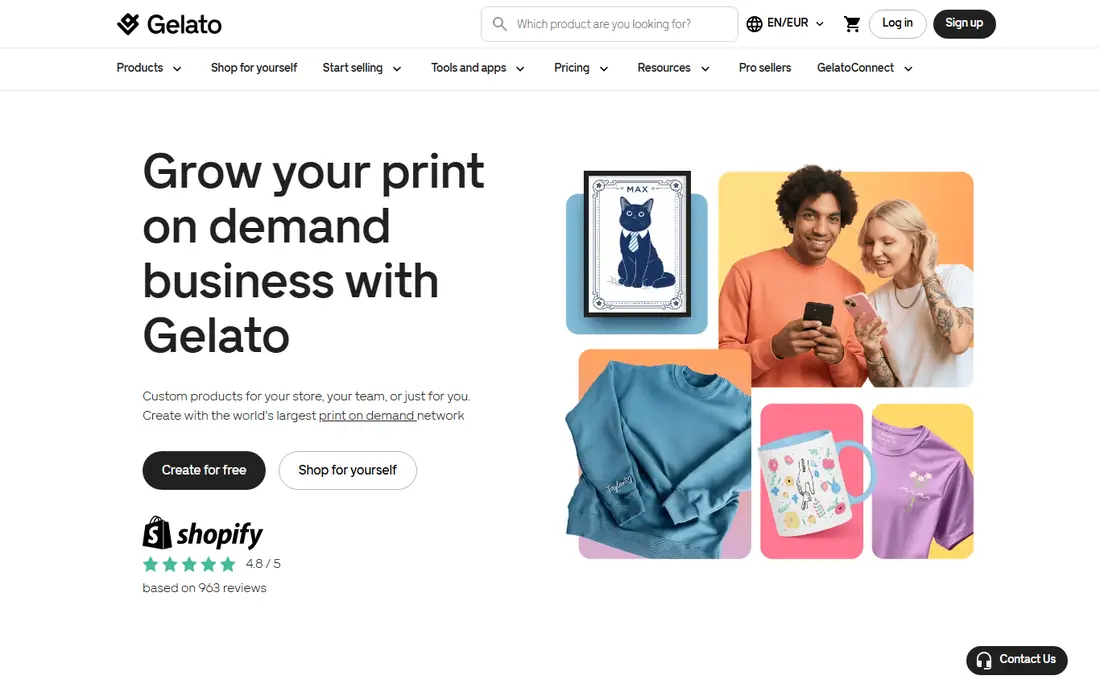
Gelato is the strongest pick for sellers whose customers live in several countries. Its network of local production hubs means an order in Europe, North America, or Asia-Pacific can often be printed near the buyer, rather than shipped across an ocean. That can shorten delivery, lower shipping cost, and reduce customs friction, which matters for wall art and apparel where shipping can erase margin.
The catch is that local production depends on the product and destination, so not every order will be local. Sellers should test delivery times to their main markets and confirm which products are produced locally. For a store with a truly global audience, Gelato still offers the clearest international advantage on this list.
- Local production in many countries, which can cut delivery time and shipping cost
- Strong wall art and apparel range
- Paid Plus tier for discounts
- Local production is not guaranteed for every product and destination
- Paid tier pricing varies in public comparisons, so check the current plan page
SPOD, the print-on-demand arm of Spreadshirt, suits sellers who want apparel fulfillment without a monthly fee or a complex setup. Its production is known for speed, with fast turnaround on apparel orders, and its catalog covers the core tees, hoodies, and accessories that most new stores need. The free account and simple workflow make it a low-risk first POD provider.
The limit is range and branding. Sellers who want home decor, drinkware variety, or deep custom packaging will find Printful or Gelato stronger, and SPOD branding is more limited. For a straightforward apparel store that values speed and simplicity, SPOD is a clean and honest pick.
- No monthly fee and simple setup
- Fast apparel production, often cited at 48 hours
- Clean integration with Shopify and other stores
- Narrower catalog than Printful or Printify
- Branding options are more limited
CustomCat suits US-focused apparel sellers who care about base cost and volume. Its US production keeps domestic shipping simpler, and its PRO tier, described at $30 per month in public comparisons, adds discounts for sellers with steady order volume. The catalog centers on apparel and customizable merchandise, which covers most standard POD stores.
The drawback is international reach and breadth. Orders outside the US need separate costing and may take longer, and sellers who want wall art, drinkware variety, or deep branding may prefer another provider. For a US apparel store chasing margin, CustomCat is a strong value pick.
- Competitive US apparel costs, especially at volume
- Free Lite access with a PRO tier at $30 per month in public comparisons
- Large apparel catalog
- International orders need separate costing
- Branding and product range are narrower than Printful
Gooten suits brands that want managed fulfillment without managing each printer themselves. Its network handles production and shipping across a wide merchandise range, and its API options help larger stores automate orders. With no membership fee, a brand can test Gooten alongside another provider without a monthly commitment.
The trade-off is control. Sellers who want to pick a specific printer for each product, as Printify allows, may find Gooten less transparent, since the network manages fulfillment. Brands that value a managed service and steady volume will not mind, but sellers who obsess over a single product's print quality should sample carefully.
- No membership fees
- Managed network of print partners
- API and integration options for larger brands
- Less control over individual printers than Printify
- Product range and branding need a per-product check
AOP+ is the specialist pick for all-over-print products, where a design covers the whole garment rather than a chest print. Its catalog leans into all-over-print tees, hoodies, leggings, and accessories, which suits streetwear and bold-design stores that standard POD providers serve less well. Paid plans from $11.99 per month in public comparisons add discounts and features for regular sellers.
The limit is breadth. A store that also wants mugs, posters, and phone cases in one place may need a second provider, since AOP+ centers on all-over-print. For a design-led apparel brand, though, that specialization is the point, and samples will show whether the print quality matches the design ambition.
- Strong all-over-print focus for apparel and accessories
- Paid plans from $11.99 per month in public comparisons
- Branding options for sellers
- All-over-print specialization means a narrower general catalog
- Shipping and production times vary by product
Prodigi suits artists, photographers, and print sellers who care about paper, color, and framing more than tee prices. Its catalog covers fine-art prints, posters, canvas, and framed work, with a global production network that serves buyers in several countries. That focus makes it a natural partner for a photography or illustration store, where print quality decides repeat sales.
The drawback is general POD breadth. A store that also wants a wide apparel range will find Printful or Printify stronger, and the Pro plan costs more than a basic tier. For art-led sellers, though, Prodigi offers a print quality and framing range that general providers do not match.
- Strong fine-art print and framing range for artists and photographers
- Global production network
- Pro plan for volume sellers
- Pro plan pricing is higher than basic POD tiers in public comparisons
- Apparel range is narrower than general POD providers
Apliiq suits clothing brands that want to feel like a label, not a POD store. Its private labels, embroidery, custom packaging, and product sourcing help a brand present premium apparel, and its Los Angeles production keeps US fulfillment tight. No minimum orders mean a small brand can test a design without bulk stock, which is rare for private-label work.
The honest limits are cost and label stock. The VIP tier costs more than basic POD plans, and woven labels may need upfront stock, which adds a small inventory commitment. Brands that prioritize a premium unboxing and label story will find Apliiq worth it, while price-led sellers should stay with Printify or CustomCat.
- Premium apparel with private labels, embroidery, and custom packaging
- US production in Los Angeles
- No minimum orders
- VIP plan at $39.99 per month in public comparisons
- Woven labels need upfront stock in some cases
teelaunch suits gift and home decor sellers who want POD without a monthly fee. Its range covers drinkware, wall art, laser-engraved crafts, and apparel, which fits Etsy and Shopify stores selling personalized gifts. Free installation and no subscription make it easy to add as a second provider for gift products.
The drawback is shipping logic. Mixed carts with products from different facilities can ship separately, which can raise the total shipping cost for a multi-item order. Sellers should test a mixed order, set shipping prices to cover split shipments, and use teelaunch mainly for the gift categories where it is strongest.
- Free installation with no subscription
- Gifts, drinkware, wall art, and laser crafts range
- Good fit for Etsy and Shopify gift stores
- Mixed carts can ship separately, which affects shipping cost
- Catalog depth varies by category
How we picked these
We compared official product catalogs, pricing pages, app store listings, and public seller reviews for POD fulfillment companies that are live in October 2026. We kept companies that connect to a seller's own store, offer real production and shipping, and have a free entry option. We marked pricing as Free where account access is free, since product and shipping charges still apply per order, and we noted paid tiers only where public comparisons were consistent.
How to choose the right POD company
The right POD company depends on your products, your customers, and how much branding matters to your store.
Start with your bestsellers, not the catalog size
List the five products you expect to sell most, then check base cost, shipping cost, and delivery time for each one at each provider. A provider with a huge catalog but high costs on your bestsellers will lose to a narrower provider that prices those items well. Order samples of those five products before launch.
Check shipping, returns, and quality control
Confirm who handles returns, misprints, and damaged orders, and how quickly replacements ship. Check whether branding, packaging inserts, and packing slips can carry your store name, since unbranded parcels hurt repeat sales. A provider with clear quality checks and a fair reprint policy is worth a slightly higher base cost.
Price for margin, not just for sales
Set retail prices from base cost plus shipping plus fees, with room for discounts and returns. A product that sells well but loses money after shipping is worse than a slower product with a healthy margin. Reprice after your first samples, since real shipping costs often differ from the catalog estimate.
Frequently asked questions
What is the best POD company for beginners?
Printful and Printify are the safest beginner picks, since both offer free accounts, large catalogs, and strong store integrations. Printful suits beginners who prioritize quality and branding, while Printify suits beginners who want lower base costs and provider choice. Start with one provider, order samples, and add a second provider only when a product need arises.
What is the best POD company for international sellers?
Gelato suits sellers with customers in several countries, thanks to local production hubs that can cut delivery time and shipping cost. Printify also helps through provider choice near your main markets, while Prodigi suits international art print sellers. Test delivery times to your top three markets before committing to one provider.
How much does print on demand cost to start?
Account access is free at every company on this list, so the startup cost is mainly samples, store fees, and design time. Product and shipping charges apply per order, and paid tiers such as Printful Growth at $24.99 per month add discounts at volume. Budget for samples first, since they prevent costly quality surprises after launch.
Do POD companies handle shipping and returns?
Yes, fulfillment companies print, pack, and ship each order, and most handle misprints and damaged items under their own policies. Return handling for size or change-of-mind returns varies by provider and by store policy, so confirm the process before launch. Your store still owns customer service, so set clear shipping and return wording on your site.
Can I use more than one POD company at once?
Yes, many sellers use one provider for apparel, another for art prints, and a third for gifts, since no single company leads every category. That mix improves quality and margin, but it can split shipments when a customer orders across providers. Keep the mix simple at first, and check how each provider handles multi-item carts.
Sources
See where you really rank - block by block
ProMapRanker scans Google Maps across a grid of your service area. Simple monthly plans from $19, white-label on every plan.
Start freeKeep reading
 zoho books alternatives
Best Zoho Books Alternatives in 2026
Compare the best zoho books alternatives for small business accounting, from QuickBooks Online and Xero to FreshBooks, Wave, and Sage in 2026, with pricing.
Read → zluri alternatives
Best Zluri Alternatives in 2026
Compare zluri alternatives for 2026, with SaaS management platforms for app discovery, spend tracking, renewals, and automation for IT, finance and procurement.
Read → zerobounce alternatives
Best ZeroBounce Alternatives in 2026
Best zerobounce alternatives for list hygiene: compare 8 email verification tools for bulk cleaning, real-time checks and catch-all handling in 2026 today.
Read →