 ProMapRanker
Best Platforms for AI Visibility Metrics in 2026

Key takeaways
- Profound is our pick for large brands that need broad engine coverage, governance, and deep citation analysis.
- Peec AI is best for marketing teams that want prompt-level analytics and clear competitive comparisons across AI answers.
- Otterly.AI is the best low-cost starting point, with entry monitoring across major engines for a modest monthly fee.
- Scrunch AI suits teams that also care how AI crawlers read and use their site content, not just how often a brand is mentioned.
- Prompt counts, engine counts, and credit limits decide the real cost, so compare those limits rather than headline prices alone.
Quick comparison
| Pick | Great for | Pricing starts at | Free tier | |
|---|---|---|---|---|
 Profound | Large brands and enterprises | See website | Free trial | Visit |
 Peec AI | Prompt-level analytics | See website | Free trial | Visit |
 Otterly.AI | Low-cost monitoring | $29 per month | Free trial | Visit |
 Scrunch AI | Crawler and content analysis | See website | Free trial | Visit |
 AthenaHQ | Broad engine coverage on credits | See website | Yes | Visit |
 Semrush AI Visibility Toolkit | Existing Semrush users | See website | No | Visit |
 Ahrefs Brand Radar | Existing Ahrefs users | See website | No | Visit |
 Rankscale | Budget multi-engine tracking | See website | Free trial | Visit |
The best platforms for AI visibility metrics
AI visibility metrics measure how often a brand appears, is cited, or is recommended in answers from ChatGPT, Perplexity, Gemini, Google AI Overviews, and similar systems. These eight platforms track those answers, compare brands with rivals, and show which prompts drive visibility.
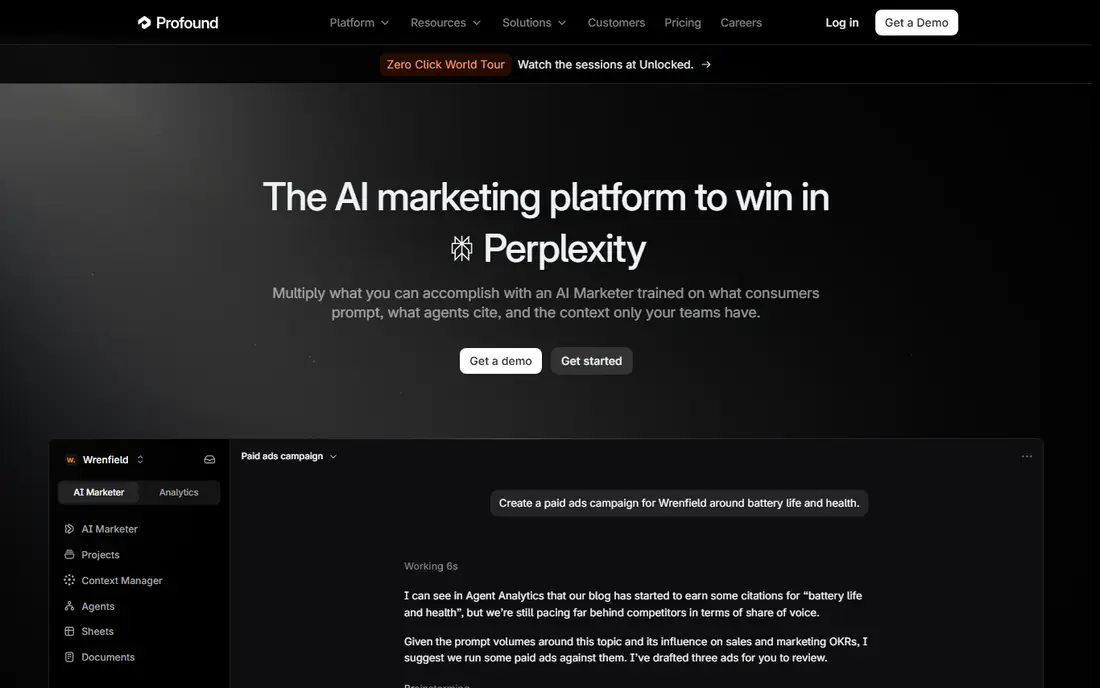
Profound is the most complete AI visibility platform on this list for large brands. It tracks visibility across major answer engines, analyzes citations and sources, and shows prompt volume alongside brand mentions. Higher tiers add broader engine coverage, integrations with analytics and content systems, and tools that turn tracking data into optimization work. For a brand that needs to report AI visibility to leadership and manage several markets, that depth is hard to match.
The cost and complexity are the trade-offs. Paid plans for brands are custom priced, and the full value appears only when a team acts on the data each week. A small business tracking ten prompts will not use most of what Profound offers. If you run a large brand, manage an agency portfolio, or need governance and security controls, Profound is the best starting point. If you need a simple monthly check, start cheaper and upgrade later.
- Broad engine coverage on higher tiers
- Citation and prompt volume analysis
- Agency workspaces and governance features
- Enterprise pricing is custom and can be costly
- Smaller teams may not need the full depth
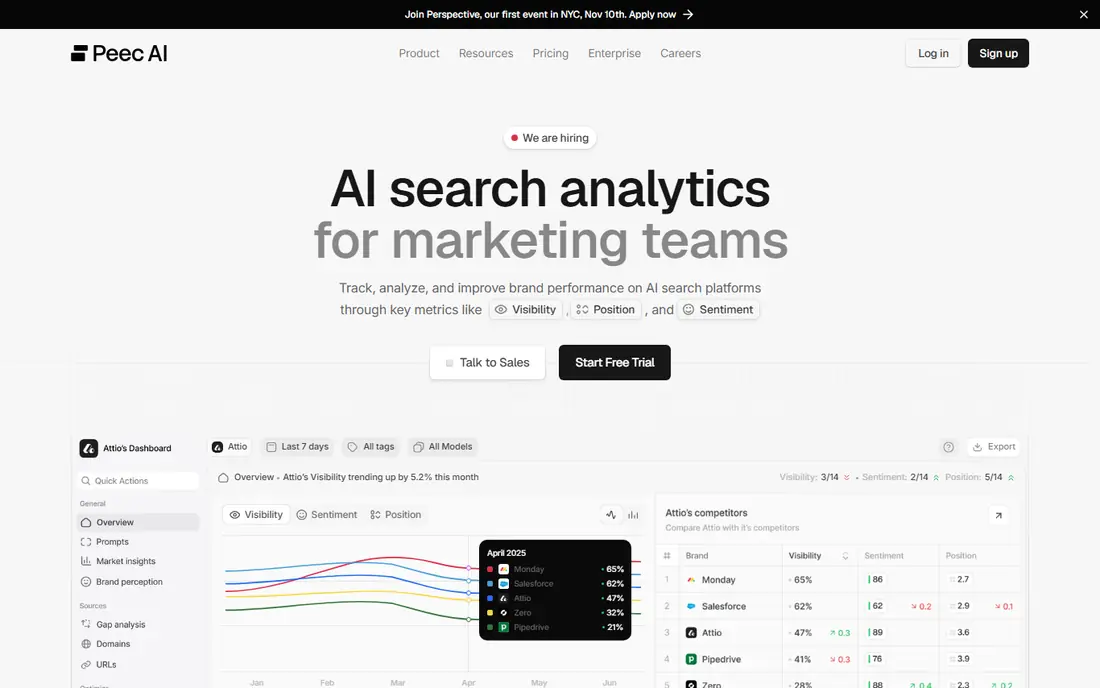
Peec AI is built around prompts, which is how AI visibility actually works. You track the questions buyers ask, see which brands appear in answers, and compare your share of mentions with rivals. Reports are readable for non-technical stakeholders, and unlimited users on many plans make it easy to share results across marketing, product, and leadership teams. Agencies also benefit from project-based workspaces and shared credit pools.
Entry plans limit prompt counts, so a team tracking hundreds of questions will need a higher tier. Engine choice also varies by plan, so confirm that the engines your buyers use are included before you commit. For most marketing teams, Peec AI strikes a good balance between depth and usability. It shows what changed, why it may have changed, and which prompts deserve content work next.
- Clear prompt-level reporting
- Competitive comparisons
- Unlimited users on many plans
- Prompt limits on entry plans can feel tight
- Some engines sit on higher tiers
Otterly.AI is the best first step into AI visibility metrics. The entry plan covers major surfaces including ChatGPT, Google AI Overviews, Perplexity, and Copilot, with daily tracking and team access. Setup is simple, reports are easy to read, and the price is low enough for a solo marketer or small business to test whether AI tracking earns its keep. Alerts and trend views help teams notice a drop in mentions before it becomes a larger problem.
The limits are prompt counts and engine add-ons. Entry plans track a modest number of prompts, and Gemini, Claude, and Google AI Mode may cost extra depending on the plan. Larger teams will also miss deeper governance and workflow features. Even so, Otterly.AI is the right pick for a first year of AI tracking. Start here, learn which prompts matter, and move to a deeper platform only when the data shows you need it.
- Low entry price
- Monitoring across major engines
- Simple setup for small teams
- Entry prompt counts are modest
- Some engines are paid add-ons
- Fewer enterprise features
Scrunch AI goes beyond mention counts. It examines how AI crawlers and answer engines read your site, which pages they use, and where content gaps may hurt visibility. That technical view suits teams that own content, documentation, or product pages and want to fix the source rather than only watch scores change. Monitoring across major engines is included, with higher tiers adding broader coverage and optimization workflows.
The entry price is higher than budget trackers, and the technical reports need someone who can act on them. A small team without a content owner may find the detail overwhelming. For mid-size and larger teams with a content program, Scrunch AI is a strong pick because it connects visibility to site work. For simple brand monitoring, a cheaper tool will give you the headline numbers faster.
- Tracks how AI crawlers parse site content
- Monitoring plus optimization guidance
- Enterprise content features
- Higher entry price than budget tools
- Setup takes more effort for small teams
AthenaHQ stands out because it offers a free plan with real tracking, not just a demo. Paid plans cover a broad set of engines and use credits, where one credit generally equals one AI answer. That model suits teams that want to test many engines before committing, or that track in bursts around campaigns rather than at a steady daily rate. Agency features and optimization guidance are available on higher tiers.
Credits are also the main risk. If prompt counts rise or a team checks answers often, costs can climb faster than a flat monthly plan would. Paid entry pricing is also high for a small business, so the free plan is the best way to judge value first. For teams that want broad coverage and flexible usage, AthenaHQ is worth a trial. For teams that want a simple fixed monthly cost, compare it carefully with Otterly.AI and Peec AI.
- Free plan for trying real tracking
- Broad engine coverage on paid plans
- Credit-based flexibility
- Credit model can be hard to forecast
- Paid entry price is high for small teams
Semrush AI Visibility Toolkit adds AI tracking to a platform many SEO teams already use. It monitors prompts across major engines, shows brand visibility and citations, and sits alongside keyword rankings, site audits, and backlink data. That combination helps teams connect AI visibility with classic search work, rather than treating AI answers as a separate channel. For an existing Semrush customer, adding the toolkit is simpler than adopting a new vendor.
Pricing per domain and prompt limits are the limits. A team tracking many domains or hundreds of prompts will pay more, and the toolkit is less attractive as a standalone purchase if you do not use the rest of Semrush. If your team already lives in Semrush, this is a practical choice. If you only need AI visibility, a specialist platform may offer broader coverage for a similar price.
- AI visibility inside a full SEO suite
- Prompt tracking across major engines
- Familiar reports for SEO teams
- Priced per domain
- Prompt limits on entry tiers
- Best value only if you already use Semrush
Ahrefs Brand Radar tracks how brands appear across AI platforms and connects that data with Ahrefs search tools. It suits SEO teams that already use Ahrefs for keywords, content, and links, and want AI visibility in the same workflow. A free checker gives a first look without signup, which helps teams judge whether paid tracking is worth it. Paid plans add broader platform coverage and deeper reporting.
The main limit is the Ahrefs ecosystem. Brand Radar is most useful inside a paid Ahrefs plan, and pricing varies by how many platform indexes you need. Teams that do not use Ahrefs may find a specialist tool simpler and cheaper. If your SEO work already runs on Ahrefs, Brand Radar is a logical add-on. If not, compare it with Peec AI and Profound before you commit to a new suite.
- AI brand data alongside a large SEO index
- Free checker for a first look
- Broad engine coverage on paid plans
- Full value needs an Ahrefs subscription
- Pricing varies by platform index and plan
Rankscale is a budget-friendly option for teams that want multi-engine tracking without enterprise pricing. It covers a broad set of engines, offers dashboards for brands and agencies, and provides white-label reporting options that suit small agencies. The low entry cost makes it easy to test AI visibility alongside classic rank tracking, and the trial helps teams judge the reports before paying.
As a smaller vendor, Rankscale offers fewer enterprise integrations and governance features than Profound or Semrush. Plan limits, credits, and engine coverage also vary, so read the current pricing page carefully rather than assuming every engine is included on every plan. For small teams, freelancers, and small agencies, Rankscale is a practical low-cost pick. For large brands with strict security needs, an enterprise platform is a safer fit.
- Low-cost entry options
- Broad engine coverage
- Simple dashboards for small teams and agencies
- Smaller vendor with fewer enterprise features
- Plan limits vary and need careful checking
How we picked these
We compared official pricing pages, engine coverage, prompt and credit limits, free plans and trials, and reporting depth. We kept only platforms that track real AI answers in October 2026 and provide metrics such as mentions, citations, and share of voice, rather than tools that only estimate search rankings. We favored a mix of enterprise, mid-market, and budget options so small teams and large brands can both find a fit. Prices change often in this fast-moving category, so check the vendor site before you buy.
How to choose an AI visibility platform
The right platform depends on how many prompts you track, which engines your buyers use, and who will act on the data. The points below keep the choice practical.
Count prompts and engines first
List the questions buyers actually ask, grouped by product, comparison, and problem. Count them, then check how many prompts each plan allows and which engines are included. A cheap plan that covers only one engine will miss answers on the engines your buyers use most. A plan with too few prompts will force you to cut the questions that matter.
Decide who acts on the reports
If one marketer will check the dashboard weekly, a simple tool such as Otterly.AI or Rankscale is enough. If several teams need reports, look for unlimited users, workspaces, and scheduled reporting. If content teams must fix pages based on the data, favor a platform such as Scrunch AI that links visibility to site content. A report nobody acts on is wasted spend, whatever the price.
Test with real prompts before you commit
Use a trial or free plan with your real brand prompts, rival prompts, and top product questions. Check whether citations are clear, whether trends are stable over a week, and whether reports are easy to explain to a colleague. If the data is hard to read during a trial, it will be hard to read after you pay. Shortlist two tools, test both, and choose the one your team actually opens.
Frequently asked questions
What are the best ai visibility metrics tools?
The best ai visibility metrics tools on this list are Profound for large brands, Peec AI for prompt-level analytics, Otterly.AI for low-cost monitoring, and Scrunch AI for crawler and content analysis. AthenaHQ, Semrush, Ahrefs, and Rankscale also fit, depending on your existing tools and budget. Choose by prompt count, engine coverage, and reporting needs rather than by brand name alone.
How do AI visibility metrics differ from classic rank tracking?
Classic rank tracking measures where a page ranks in search results for a keyword. AI visibility metrics measure whether a brand appears, is cited, or is recommended in an AI-generated answer, and how often rivals appear instead. Both matter, but AI answers can cite a brand that does not rank first, and can omit a brand that ranks well. Tracking both gives a fuller view of discovery.
Which engines should an AI visibility platform track?
At minimum, track the engines your buyers use most, which for many US teams means ChatGPT, Google AI Overviews, Perplexity, and Gemini. Add Copilot, Claude, and Google AI Mode if your audience uses them or if rivals appear there. More engines are useful only if you act on the data, so favor coverage you will review over a long list you will ignore.
Is a free AI visibility tool enough for a small business?
A free plan or checker can be enough to learn whether AI answers mention your brand and which prompts matter. It is rarely enough for ongoing monitoring, rival comparisons, and trend reporting, since free plans limit prompts, engines, and history. Start free, prove value with a small prompt set, and upgrade when the data guides content or product decisions.
How often should AI visibility be checked?
Daily or weekly tracking suits most teams, since AI answers change as models and sources update. Daily checks help catch sudden drops, while weekly reviews suit content planning and reporting. Avoid checking hourly, since short-term swings can mislead. Set a weekly review habit and a monthly report to leadership, and act on trends rather than single-day changes.
Sources
See where you really rank - block by block
ProMapRanker scans Google Maps across a grid of your service area. Simple monthly plans from $19, white-label on every plan.
Start freeKeep reading
 steamunlocked alternatives
Best SteamUnlocked Alternatives in 2026
Looking for steamunlocked alternatives? These 8 legal game stores and subscriptions offer licensed PC games, sales, and cloud play without piracy risks.
Read → mangools alternatives
Best Mangools Alternatives in 2026
Looking for mangools alternatives? We compare 8 SEO tools for keyword research, rank tracking, and site audits, from Semrush and Ahrefs to Keysearch today.
Read → lemlist alternatives
Best Lemlist Alternatives in 2026
Looking for lemlist alternatives? We compare 9 cold email and outreach tools for 2026, covering pricing, deliverability, inboxes, and multichannel steps.
Read →