 ProMapRanker
Best Music Distribution Service in 2026

Key takeaways
- DistroKid is our pick for frequent releasers because one annual fee covers unlimited uploads and the artist keeps 100 percent of streaming royalties on its paid plans.
- CD Baby suits artists who release rarely, because a one-time fee per release avoids an annual bill, even though CD Baby keeps a 9 percent commission.
- TuneCore pairs distribution with publishing tools and included YouTube Content ID, but it keeps 20 percent of social platform earnings.
- Ditto Music is the cheapest annual option in this list at 19 dollars a year for a single artist, while RouteNote lets you start free in exchange for a revenue share.
- Always check what happens to your music if you stop paying, because some services remove releases and others leave them live.
Quick comparison
| Pick | Great for | Pricing starts at | Free tier | |
|---|---|---|---|---|
 DistroKid | Frequent releasers | $24.99 per year | No | Visit |
 TuneCore | Distribution plus publishing | $24.99 per year | No | Visit |
 CD Baby | Rare releasers | $9.99 per single | No | Visit |
 Ditto Music | Low-cost annual plans | $19 per year | No | Visit |
 UnitedMasters | Brand and sync opportunities | $19.99 per year | Yes | Visit |
 RouteNote | Starting free | Free | Yes | Visit |
 Amuse | Mobile-first artists | $23.99 per year | No | Visit |
 LANDR | Mastering plus distribution | $24 per year | No | Visit |
The best music distribution services
A music distributor puts your songs on Spotify, Apple Music, and other stores, collects royalties, and handles the metadata that keeps your catalog organized. The right service depends on how often you release, how much you earn, and whether you need publishing help. We compared official pricing pages and published terms for eight services that are active in 2026.
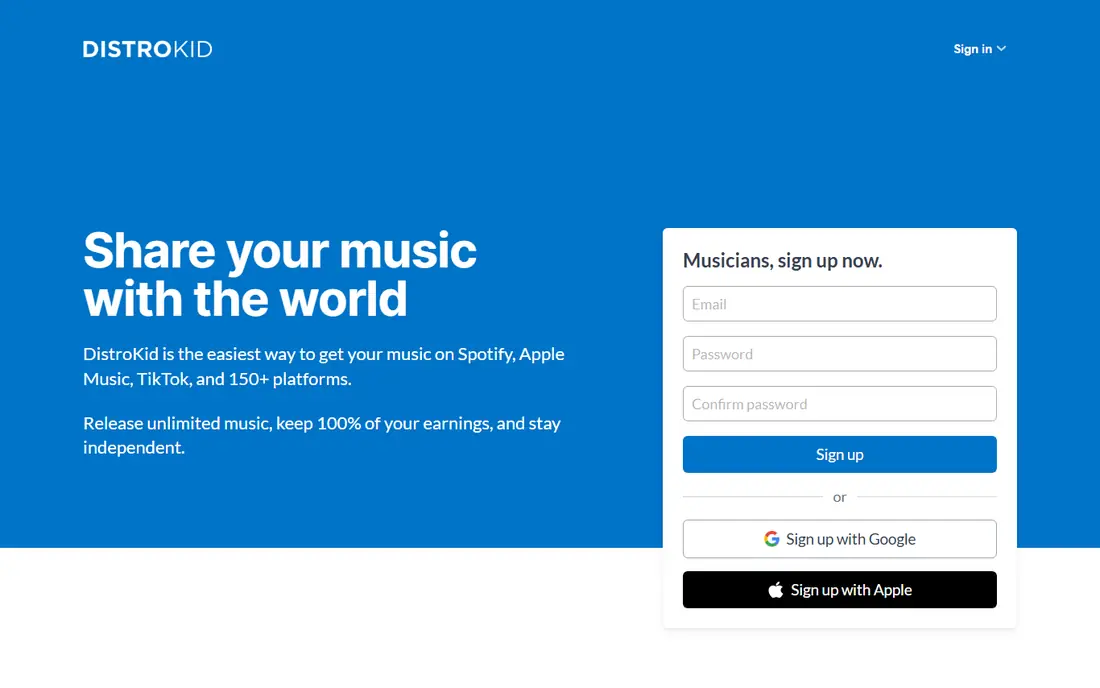
DistroKid is built for artists who release often. One annual fee covers unlimited uploads for a single artist on the Musician plan, so a song a week costs the same as a song a year. You keep 100 percent of streaming royalties, and delivery to major stores is typically quick, which helps when you are working to a release date.
The catch is the extras. Features such as YouTube Content ID and legacy protection, which keeps music live after you stop paying, are paid add-ons, and those costs add up across a large catalog. Support is mainly through a help center rather than phone help. If you release several times a year and you manage your add-ons carefully, DistroKid remains the best value in this list.
- Unlimited uploads on paid plans
- Artist keeps 100 percent of streaming royalties
- Fast store delivery
- Add-ons cost extra
- Releases can come down if the subscription lapses without a legacy option
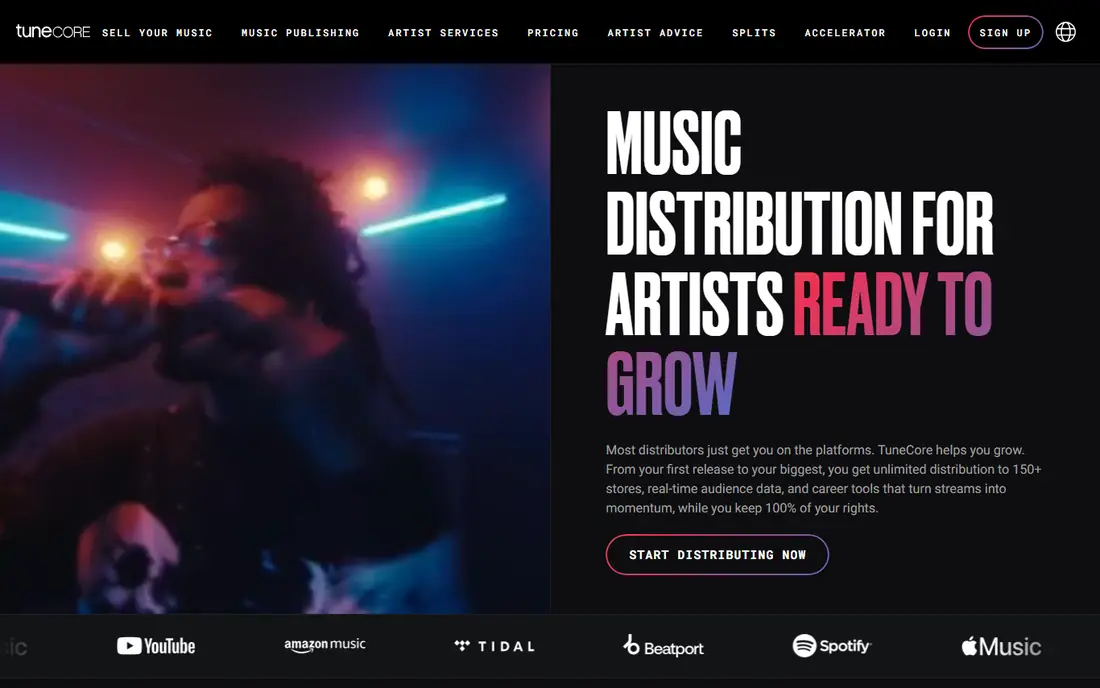
TuneCore suits artists who want distribution and publishing in one place. Its annual unlimited plans cover streaming royalties at 100 percent, and its publishing arm can help collect songwriting royalties, for a setup fee and a commission. Daily trend data and a store automator for new platforms add useful reporting for artists who track performance closely.
Watch the social split. TuneCore keeps 20 percent of earnings from TikTok, Instagram, Facebook, and YouTube monetization, even on paid plans, so artists with strong social income should run the numbers first. Releases also come down when a plan ends. If publishing help matters more to you than social earnings, TuneCore is a strong pick.
- Unlimited releases on annual plans
- Publishing administration available
- YouTube Content ID included
- Keeps 20 percent of social platform earnings
- Releases come down when a plan expires
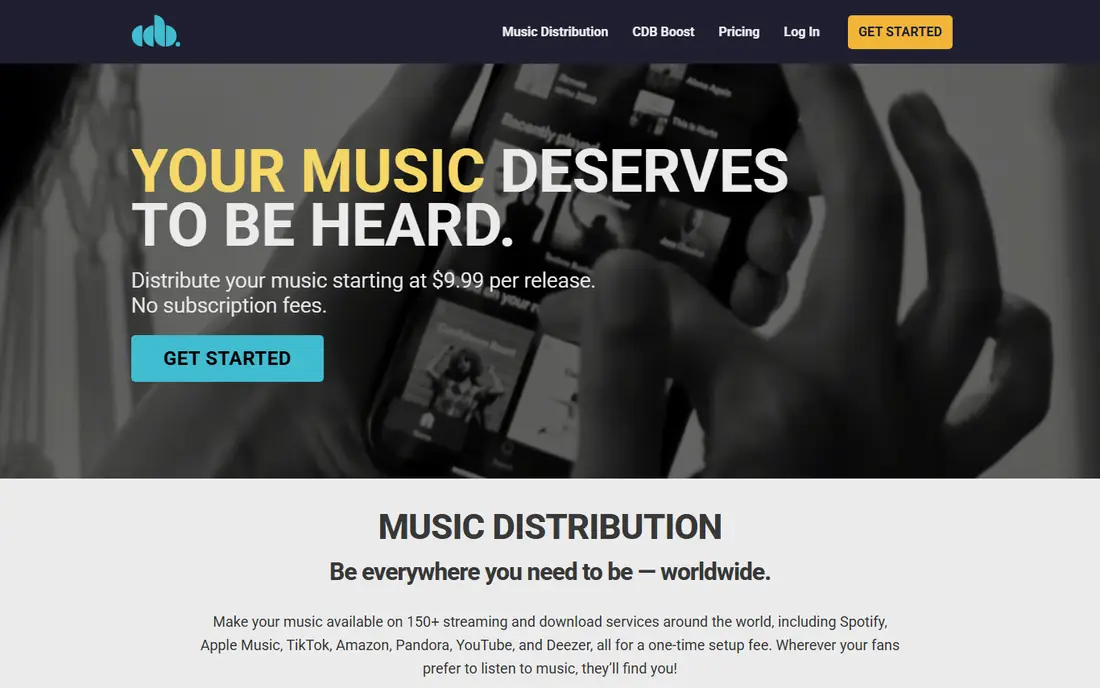
CD Baby is the best fit for artists who release once or twice a year and dislike subscriptions. You pay once per single or album, and there is no annual renewal to keep the music live. That permanence is valuable for a small catalog, and the included Content ID helps collect YouTube revenue without a separate add-on.
The trade is the 9 percent commission, which applies for as long as the release earns. For a low-earning release, the one-time fee beats years of subscription renewals. For a high-earning release, that commission can eventually cost more than an annual plan. Count your releases per year before you choose, because that number decides the math.
- One-time fee per release
- Music stays live with no annual renewal
- YouTube Content ID included in the release fee
- Keeps a permanent 9 percent commission
- Per-release fees add up for frequent releasers
Ditto Music is a straightforward budget pick. Its Starter plan costs 19 dollars a year for one artist, covers unlimited releases, and lets the artist keep 100 percent of streaming royalties. Chart registration and sync pitching are part of the appeal for artists who want a shot at playlists, radio, and placements without paying for a full label service.
It does not match TuneCore on publishing depth, and publishing and sync royalties on higher plans carry a 15 percent commission, so read the plan terms before you upgrade. For a solo artist who wants a low annual bill and a simple upload flow, Ditto is hard to beat on price alone.
- Lowest annual entry price in this list
- Artist keeps 100 percent of streaming royalties
- Chart registration included
- Publishing and sync royalties carry a commission on some plans
- Smaller toolset than TuneCore
UnitedMasters stands out for artists who want more than store delivery. Its paid plans keep 100 percent of streaming royalties, and the platform promotes brand partnerships and sync opportunities that can matter more than streaming income for some artists. The workflow is mobile friendly, which suits artists who manage releases from a phone.
The limits are real. The free tier does not support the same release options as paid plans, and brand placement is not guaranteed, since it depends on approval and fit. Treat the brand pipeline as a bonus, not a promise. If you are already building a social following and want a distributor that thinks about deals as well as stores, UnitedMasters is worth a close look.
- Brand and sync deal pipeline
- Artist keeps 100 percent on paid tiers
- App-based workflow
- Free tier has limits
- Brand deal placement depends on platform approval
RouteNote is the best way to test distribution without spending money first. Its free tier charges no upfront fee and pays 85 percent of royalties, which is a fair trade for an artist who is unsure whether a first release will earn anything. You can switch a release to Premium later for 100 percent of royalties, priced per single with an annual fee from the second year.
The downside is the same as the upside: the free tier costs you 15 percent of everything you earn, and that adds up if a song takes off. Use RouteNote to learn the process, then move to an annual unlimited plan once you are releasing regularly. For a first release, it removes the main barrier, which is cost.
- Free tier with no upfront cost
- Premium tier keeps 100 percent of royalties
- Good entry point for new artists
- Free tier pays 85 percent of royalties
- Premium is priced per release
Amuse suits artists who do most of their work on a phone and want a clean upload flow. Paid plans keep 100 percent of streaming royalties, and higher tiers add faster delivery and extra tools. Royalty advances are available to qualifying artists, which can help fund a video, a tour, or a next release.
Amuse no longer offers a free distribution tier, so it is not the cheapest way to test the waters. Content ID revenue also carries a flat fee on the entry plan, so check that term if YouTube income matters to you. If you like the mobile workflow and you release steadily, Amuse is a solid mid-priced option.
- Artist keeps 100 percent of streaming royalties on paid plans
- Fast delivery on higher tiers
- Royalty advances for qualifying artists
- No free distribution tier
- YouTube Content ID revenue carries a fee on the entry plan
LANDR is the best pick for producers who already master with LANDR or want one account for mastering and distribution. Distribution starts at 24 dollars a year, keeps 100 percent of royalties on subscriptions, and LANDR says releases stay live. Bundling mastering with distribution can save time and money for artists who master every track before release.
The limits are in the details. Content ID is curated, so tracks made with AI assistance or non-exclusive samples may not qualify, and support is email only on weekdays. If you master elsewhere, a pure distributor may be cheaper. If LANDR is already part of your workflow, the bundle makes sense.
- Distribution plus mastering, samples, and plugins in one account
- Artist keeps 100 percent on subscriptions
- Releases stay live
- Content ID is curated and some tracks are not eligible
- Support is email only on weekdays
How we picked these
We compared official pricing pages, royalty terms, and published support pages for leading distributors, and we favored services that are open to independent artists in 2026, deliver to major stores, and publish clear pricing. We looked for a mix of subscription, per-release, and free models, so artists at different release rates can compare like with like. Where terms differed by plan, we described the entry plan and flagged the exceptions.
How to choose a music distributor
Start with release frequency, because that decides the pricing model. Frequent releasers should favor an annual unlimited plan, while rare releasers should favor a one-time fee. Then check the royalty split, including social and Content ID earnings, because the headline split is not always the full split.
Read the exit terms first
Before you upload, check what happens if you stop paying. Some services remove your music, some leave it live with a commission, and some charge a one-time legacy fee per release. That clause matters most when your catalog grows, because switching distributors later is work. Pick a service whose exit terms you can live with.
Match extras to your real needs
Publishing administration, Content ID, sync pitching, and royalty splits all sound useful, but each one costs money or commission. List the extras you will actually use in the next year, and ignore the rest. A cheap plan with the right extras beats an expensive plan with a long feature list you never open.
Check store and payment details
Confirm that the distributor delivers to the stores your fans use, and check payout thresholds, payment methods, and reporting frequency on the vendor's own pages. Good reporting helps you spot a release problem early, and clear payout terms avoid surprises when royalties start to arrive.
Frequently asked questions
What is the best music distribution service overall?
DistroKid is the best overall pick for most independent artists because its annual fee covers unlimited uploads and keeps 100 percent of streaming royalties. Rare releasers should consider CD Baby instead.
What are the best music distribution platforms for new artists?
RouteNote is the best free starting point, while Ditto Music offers the cheapest annual plan in this list. Both let a new artist release without a large upfront cost.
What are the best TuneCore alternatives?
DistroKid is the closest alternative for unlimited annual releases, CD Baby suits rare releasers, and Ditto Music undercuts TuneCore on annual price. Your release rate should decide among them.
What is the best distribution service for music with no annual fee?
CD Baby charges a one-time fee per release with no annual renewal, so it is the best fit if you want to avoid subscriptions. RouteNote's free tier also avoids an upfront fee, in exchange for a revenue share.
What is the best music distribution company for keeping 100 percent of royalties?
DistroKid, TuneCore on streaming royalties, Ditto Music, UnitedMasters on paid tiers, Amuse on paid plans, and LANDR on subscriptions all keep 100 percent of streaming royalties, though social and Content ID splits can differ.
Do distributors take a cut of my royalties?
Some do and some do not. CD Baby keeps 9 percent, RouteNote's free tier pays 85 percent, and most annual plans keep 100 percent of streaming royalties while taking a share of social or publishing income. Read each plan's terms before you upload.
Sources
See where you really rank - block by block
ProMapRanker scans Google Maps across a grid of your service area. Simple monthly plans from $19, white-label on every plan.
Start freeKeep reading
 zeffy payment processor stripe alternatives
Zeffy and Stripe Alternatives for Nonprofits in 2026
Explore zeffy payment processor stripe alternatives for nonprofits. We compare 8 fundraising platforms on fees, donor tools, and nonprofit focus. Check fees.
Read → workday alternatives
Workday Alternatives in 2026
Workday alternatives compared: we review 8 HR and payroll platforms that replace Workday, with pricing, strengths and honest limits for each team size.
Read → what's the best weather app
What's the Best Weather App in 2026
Wondering what's the best weather app? We compare 10 free and paid apps for forecasts, radar, alerts, and Colorado mountain weather for everyday and storm use.
Read →