 ProMapRanker
Best Local SEO Tools for Shed Builders in 2026

Listing management across service areas · Pricing starts at: See website
Direct answer
Advice Local is my first pick for most shed builders because it puts your business listings, service areas and location data in one place, which matters when you deliver and install across several towns. It has no free plan stated, so check its pricing page. If reviews are your weak spot, look at GatherUp, and if you want to see where you rank in each town, SE Ranking is worth a look.
I put this list together from vendor documentation and public sources, and I did not run hands-on tests of any of these tools. My focus was on how each one fits the way a shed builder actually works: a workshop address, a delivery radius that covers several towns, and customers who call before they enquire online.
Key takeaways
- Shed builders compete in a wide service area, so consistent name, address and phone data across directories does more for you than most on-page tweaks.
- Review tools matter because homeowners compare builders by recent reviews and photos before they ever call.
- Local rank tracking shows which towns your Google Business Profile actually appears in, not just your website position.
- Call tracking helps you see which towns and which listings produce real phone enquiries.
- No single tool covers listings, reviews, rankings and calls well, so most shed builders end up with two or three.
Quick comparison
| Pick | Great for | Pricing starts at | Free tier | |
|---|---|---|---|---|
| Advice Local | Listing management across service areas | See website | Not stated | Visit |
 GatherUp | Review requests after a shed install | See website | Not stated | Visit |
 SE Ranking | Local rank tracking by town | See website | Free trial | Visit |
 Uberall | Multi-location and dealer networks | See website | Not stated | Visit |
 Signpost | Review requests and customer messaging | See website | Not stated | Visit |
 Nimbata | Call tracking from ads and listings | See website | Free trial | Visit |
 Trustpilot | A public review profile | See website | Free plan | Visit |
The best local SEO tools for shed builders compared
Advice Local is a listing management platform. You give it your business name, address, phone, hours and service areas, and it pushes that data to directories and data aggregators. For a shed builder, that means the address on your Google Business Profile matches what appears on Yelp, Bing, Apple Maps and the smaller local directories customers still check.
The workflow suits a business with one workshop and a wide delivery area. You set your core address as the workshop, then define the towns and counties you serve, so listings stay consistent whether a customer is two miles away or forty. When you move premises or add a second yard, you update it once and the changes flow out, which saves the slow job of chasing each directory by hand.
The limit is scope. Advice Local does listings, not reviews or rankings, so you still need a review tool and a rank tracker. If you only ever work in one small town and your listings are already clean, the value is lower.
- Manages business listings from one dashboard
- supports service-area businesses
- handles directory data cleanup
- Pricing needs a quote
- not a review or rank tracking tool
GatherUp is a review management and customer feedback tool. You connect it to your customer list or job system, and it sends invitations asking for a review after a job is finished. For shed builders, the natural trigger is the day after installation, when the customer has seen the finished building and is still pleased.
The useful part for this trade is that it can ask for private feedback first. If someone is unhappy about a delivery delay or a damaged panel, you hear about it before it becomes a public review. That is a fair process as long as you never stop a customer from posting publicly, and you should not filter or gate reviews. GatherUp also shows which review sites produce the most responses, so you can point customers to the profile that matters.
Skip it if you install only a handful of sheds a month. At low volume, a simple email asking for a review, sent from your own inbox, does the same job.
- Sends review invitations by email and SMS
- routes feedback before it goes public
- tracks review volume over time
- Needs a steady flow of completed jobs
- setup takes some thought
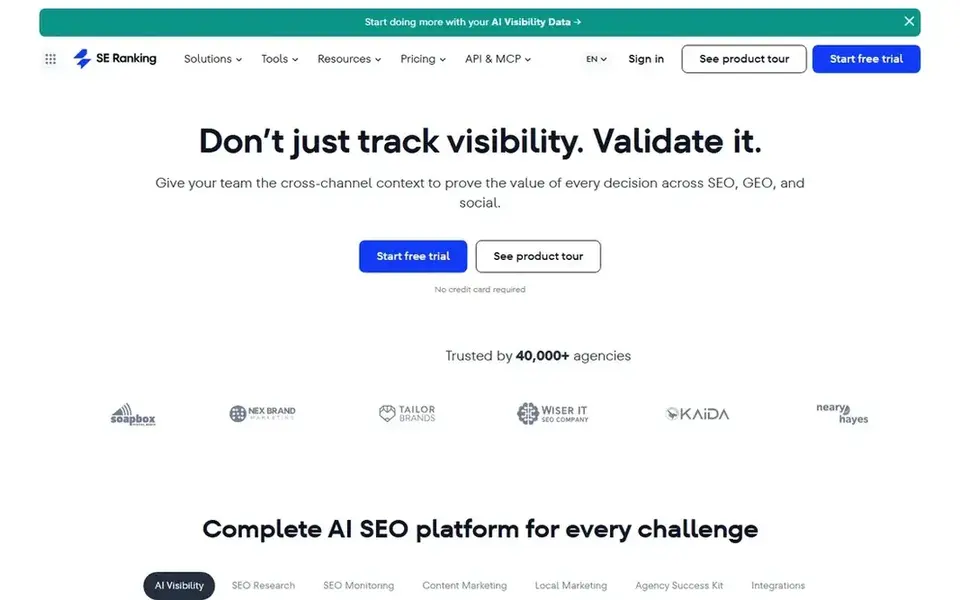
SE Ranking is an SEO platform with a local rank tracking module. You add your keywords, set the locations you care about, and it checks where you appear in search results for each one. For a shed builder, the keywords are practical: "garden sheds [town]", "shed installation [town]", "bespoke shed builder near me".
The location setting is what makes it useful here. A shed builder in a rural area may rank well in the nearest town but not in the next one over, and a normal rank tracker will not show that. Checking by town tells you where to put effort, whether that is a new page, more reviews from that area, or a local sponsorship. It also tracks competitors, so you can see which rival builder owns each town.
The limits are that the local grid view is not on the cheapest tier, and rankings alone do not fix anything. If your Google Business Profile is thin on photos and categories, fix that first.
- Tracks rankings by location
- monitors competitors
- includes site audit and keyword research
- Local grid features sit in higher plans
- needs setup time
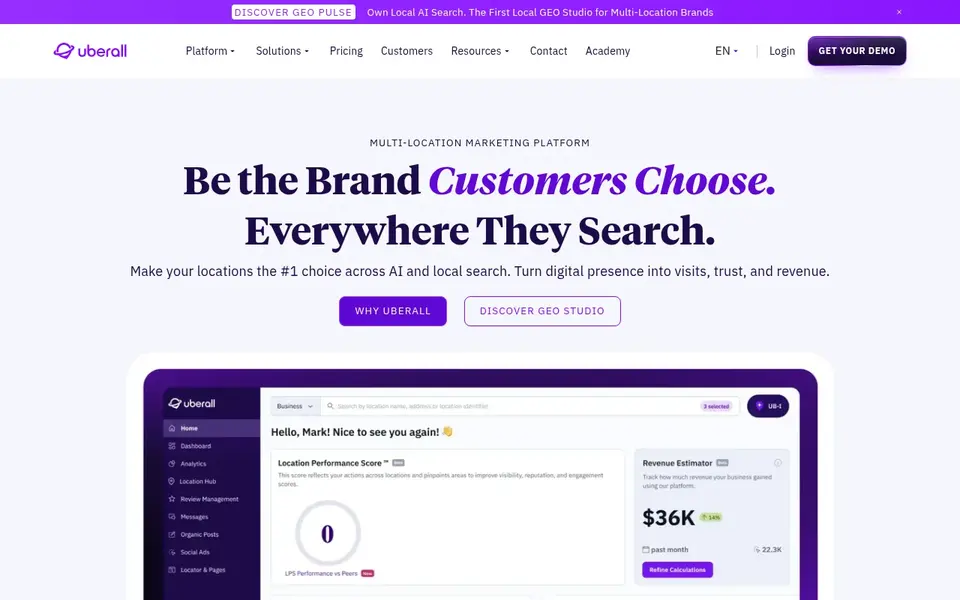
Uberall is a location marketing platform for businesses with several locations. It manages listings, local pages and review monitoring from one place. A shed builder with one workshop and a show site, or a manufacturer with a network of approved installers, is the kind of operation it fits.
The value shows up when each location needs its own consistent data and its own local page. If you have a main yard, a display area and a couple of fitting teams working from different postcodes, Uberall keeps the details straight and gives each location a page that can rank for its own town.
For a single-workshop builder, it is more platform than you need, and the quote-based pricing reflects that. Look at it when location count, not shed count, starts to grow.
- Manages listings at scale
- handles location pages
- supports review monitoring across sites
- Built for larger businesses
- pricing is quote-based
Signpost is a customer messaging and review tool aimed at small local businesses. It sends review requests, reminders and follow-up messages, and it can handle enquiries that arrive by text or web form. For a shed builder, that covers the gap between a quote request and a booked job, which is where many enquiries quietly go cold.
The review side works well after installation, when a short text with a direct link gets a much better response than a paper leaflet. The messaging side helps you answer questions about lead times and base preparation without the office phone ringing all day.
It is not a listing management tool, so your directory data still needs attention elsewhere. If you already have a review process that works, the messaging features alone may not justify the cost.
- Automates review invitations
- handles customer texts and emails
- simple for small teams
- Less depth on listings
- pricing needs a conversation
Nimbata is a call tracking platform. It gives you different phone numbers for different sources, so you can see whether a call came from your Google Business Profile, a paid ad, a directory listing or a flyer. Shed buyers often call rather than fill in a form, especially for questions about delivery and base preparation.
For a shed builder running ads in several towns, this answers a question that analytics cannot: which town and which channel produce calls that turn into jobs. Call recording, where permitted, also helps you hear what customers ask about most, which feeds straight into your service page content.
The limit is that it only tracks calls. If most of your enquiries come through a quote form, the value drops, and you need to handle number display and consent rules properly.
- Tracks which source produced each call
- records calls for quality
- integrates with ad platforms
- Only useful if calls are a main lead source
- needs number management
Trustpilot is a third-party review platform. You claim a profile, invite customers, and the reviews sit on Trustpilot rather than on your own website. For a shed builder, it gives cautious buyers a place to check you beyond Google, which some customers prefer.
The free plan lets you collect and display reviews, and paid plans add invitation tools and widgets. The honest approach is to invite every customer, not just the happy ones, and never offer incentives for positive reviews. A steady trickle of reviews about delivery, base preparation and installation quality is more convincing than a burst of identical five-star comments.
The downside is that you do not own the profile, and it adds another place to monitor. If your Google reviews are strong and active, Trustpilot is optional rather than essential.
- Widely recognised review profile
- free plan available
- invites can be automated
- Reviews live off your own site
- needs consistent invitations
How I chose
I built this list from vendor documentation and public sources, not from hands-on testing. I read what each tool says it does, checked which features sit on which plan, and looked at how the product is positioned. Then I matched that against how a shed builder actually gets work: a workshop address, a delivery radius covering several towns, customers who call with questions about bases and lead times, and a finished job that is the natural moment to ask for a review.
The second filter was limits. Some tools are built for multi-location networks and are simply too much for a single yard. Others do one job well and nothing else, which is fine if you know that going in. I left out tools where the local features are buried or where the fit with a trade business was unclear.
What to check before you buy
- Confirm the tool supports service-area businesses, since you may not want to show your workshop address publicly.
- Check how many locations and listings are included, and what happens when you add a second yard.
- Ask whether review invitations can go out automatically after an installation date.
- Check that rank tracking lets you set individual towns, not just a country or region.
- Confirm call tracking numbers work with your existing phone setup and any ads you run.
- Read the cancellation terms and whether your listing data stays accessible if you leave.
Frequently asked questions
Do I need local SEO tools if I only build sheds in one town?
Not always. If you work in one town, a complete Google Business Profile, a handful of accurate directory listings and a steady flow of reviews will carry most of the weight. Tools help when you serve several towns, when listings drift out of date, or when you cannot tell which channel produces calls.
Which tool should a shed builder start with?
Start with listing management if your name, address or phone appears differently across directories, because that inconsistency undermines everything else. If your listings are already clean, start with a review tool, since recent reviews are what homeowners check before they call a builder.
Can these tools help me rank in nearby towns?
They help you see and manage the inputs, but they do not rank you by themselves. Local rankings come from proximity, relevance and prominence. Accurate listings, town-specific pages, genuine reviews from customers in those towns and a well-filled Google Business Profile are what move the needle.
How do I get more reviews without breaking Google's rules?
Ask every customer, not just the happy ones, and ask at a natural moment such as the day after installation. Send a direct link, keep the request simple, and never offer discounts or gifts in exchange for a review. Do not filter customers or use review gating, and never write reviews yourself.
Is call tracking worth it for a shed builder?
It is worth it if phone calls are a main source of enquiries and you advertise in more than one town. It shows which listings and ads produce calls that turn into quotes. If most enquiries arrive through a form or a messaging app, spend the money on listings and reviews instead.
Sources
See where you really rank - block by block
ProMapRanker scans Google Maps across a grid of your service area. Simple monthly plans from $19, white-label on every plan.
Start freeBrowse all guides
← Best Local SEO Tools for Plant Nurseries in 2026Best Local SEO Tools for Surf Shops in 2026 →
 best local seo tools for pet sitters
Best Local SEO Tools for Pet Sitters in 2026
A practical guide to the best local SEO tools for pet sitters in 2026, covering listing management, reviews, rank tracking and call tracking.
Read → best local seo tools for lawn mower repair shops
Best Local SEO Tools for Lawn Mower Repair Shops in 2026
A practical guide to the best local SEO tools for lawn mower repair shops in 2026, covering listings, reviews, GBP management and local rank tracking.
Read → best local seo tools for horse stables
Best Local SEO Tools for Horse Stables in 2026
A practical guide to the best local SEO tools for horse stables in 2026, covering listings, reviews, call tracking and map rankings for riding schools.
Read → promapranker vs yext
ProMapRanker vs Yext: Local Visibility Tools Compared
Comparing ProMapRanker and Yext for local search visibility, listings management, and geo-grid rank tracking.
Read → ranking in google maps
Ranking in Google Maps: A Beginner's Roadmap
A beginner's roadmap to ranking in Google Maps without the SEO jargon.
Read → digital marketing local business
Digital Marketing Local Business: A Complete Guide
Everything you need to know about digital marketing local business: what it is, why it matters for local SEO, and exactly how to act on it.
Read →More in Local SEO & Google Maps · All guides A to Z by date · Latest guides