 ProMapRanker
Best Local Rank Tracking Tools for Physical Therapists in 2026

Grid map rank tracking by neighborhood · Pricing starts at: See website
Direct answer
Local Falcon is my top pick for physical therapists because its map-grid reports show how a clinic ranks in the actual neighborhoods patients search from, not just one central point. It has no free plan stated, so check its pricing page. If review growth matters more to your clinic, look at GatherUp for review requests and Whitespark for citation and listing work alongside rank checks.
I compared these tools from vendor documentation and public sources, not from hands-on testing. My focus was on what a physical therapy clinic actually needs: seeing rank by neighborhood, keeping the Google Business Profile accurate, and handling reviews without breaking Google's rules.
Key takeaways
- Physical therapy patients usually search from home or work, so a single "average rank" hides the fact that a clinic can rank well in one suburb and be invisible two miles away.
- Grid-based map tracking is the closest thing to seeing what a patient sees when they open Google Maps near your clinic.
- Rank tracking only tells you the position; review tools show whether your Google Business Profile has the signals that keep that position.
- Citation and listing accuracy still matters for a clinic with multiple locations or a recently changed address.
- Pick one rank tracker as your main dashboard and add a review or listing tool only if you have a clear gap.
Quick comparison
| Pick | Great for | Pricing starts at | Free tier | |
|---|---|---|---|---|
| Local Falcon | Grid map rank tracking by neighborhood | See website | No free plan stated | Visit |
 Whitespark | Citation building with local rank tracking | See website | No free plan stated | Visit |
 GatherUp | Review requests and reputation tracking | See website | No free plan stated | Visit |
 BrightLocal | All-in-one local SEO reporting | See website | No free plan stated | Visit |
 Moz Local | Listing management with local visibility checks | See website | No free plan stated | Visit |
 Semrush Local | Clinics already using Semrush | See website | No free plan stated | Visit |
 Uberall | Multi-location physical therapy groups | See website | No free plan stated | Visit |
The best local rank tracking tools for physical therapists compared
Local Falcon is built around the map grid. Instead of one rank number, it scans a set of points around a location and shows where a clinic appears in Google Maps at each point. For a physical therapy practice with patients driving in from several towns, that picture is far more useful than a single city-wide rank.
In practice, I would set the scan center on the clinic address and widen the grid to cover the main catchment area. That shows which nearby suburbs already find the clinic and which ones need more local content or reviews. It pairs well with a Google Business Profile audit, because a weak grid result often traces back to an incomplete profile or thin service pages.
The limit is scope. Local Falcon tracks positions but does not send review requests or fix listings, so a clinic that also needs reputation work will need a second tool. Skip it if you only want one simple rank number and nothing else.
- Map-grid views close to what patients see
- tracks Google Business Profile positions across a scan area
- useful for spotting weak suburbs
- No review request workflow
- grid scans are a snapshot, not a live feed
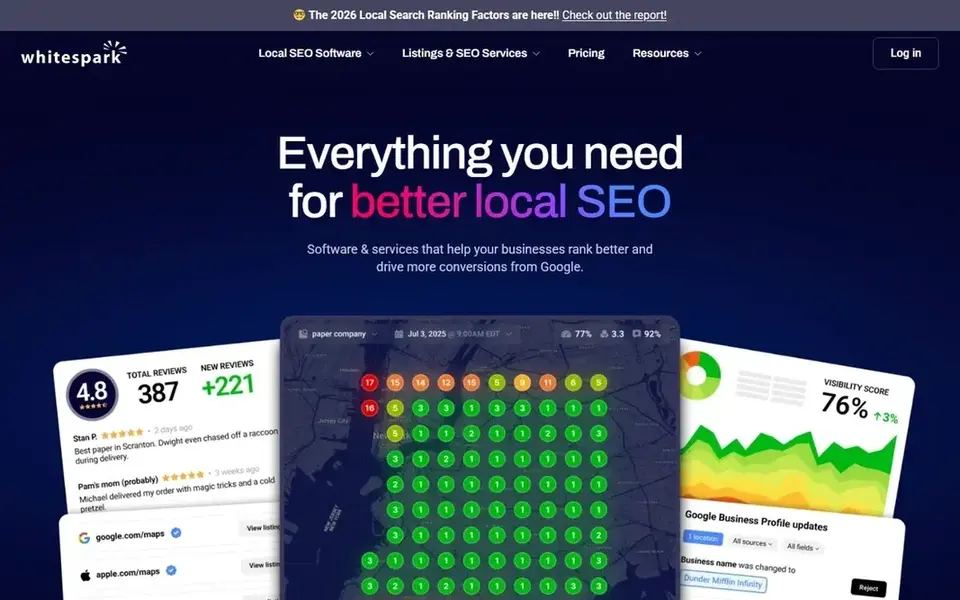
Whitespark is known for citation building, and it also offers local rank tracking. For a physical therapy clinic, the citation side matters when the address, phone number or suite number differs across directories, which is common after a move or a second location opens.
The rank tracking side lets you watch positions for terms like "physical therapy near me" or "sports injury physio" across locations. I would use it after a citation cleanup so you can see whether the corrected listings line up with better map visibility. It is a sensible pick for a clinic that wants the listing foundation fixed at the same time.
The trade-off is effort. Citation work is not instant, and the tool expects you to manage the process rather than doing everything for you. Skip it if you want a set-and-forget dashboard with no listing work.
- Strong citation and listing service
- local rank tracking built in
- good for fixing inconsistent clinic addresses
- Citation work takes time to show up
- not a review management tool
GatherUp focuses on getting and managing reviews. For a physical therapy clinic, reviews are one of the strongest local signals, and a steady flow of them supports map visibility over time. The tool sends requests after a visit and collects responses in one dashboard.
I would connect it to the front-desk workflow so requests go out after a course of treatment ends, not mid-treatment. It is best used alongside a rank tracker rather than instead of one, because it shows reputation trends but not detailed map positions.
The limit is that it depends on patient contact data and staff discipline. If nobody triggers the request, nothing happens. Skip it if reviews are already strong and your gap is purely rank visibility.
- Review request workflows by email and SMS
- review monitoring in one place
- helps track review volume over time
- Rank tracking is not the main feature
- needs a steady stream of patient contacts to work
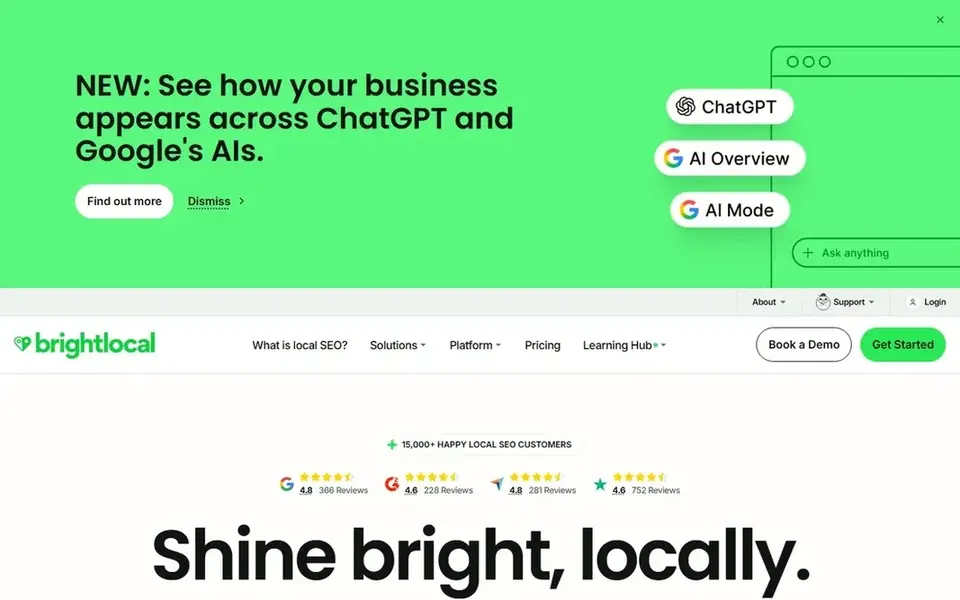
BrightLocal combines local rank tracking, citation checks and review monitoring. It suits a clinic that wants one login for most local SEO tasks, or an agency managing several physical therapy practices.
For rank tracking, it lets you follow keywords by location and build reports that a clinic owner can read without jargon. I would use the citation audit first to catch address mismatches, then set up rank tracking for the main service terms and nearby towns.
The downside is breadth. A single-location clinic may pay for modules it never opens. Skip it if you want a narrow, map-only tool and nothing else.
- Rank tracking, citations and reviews in one place
- report building for clinic owners
- good for agencies serving clinics
- Broad feature set can feel heavy for a single clinic
- some modules go unused
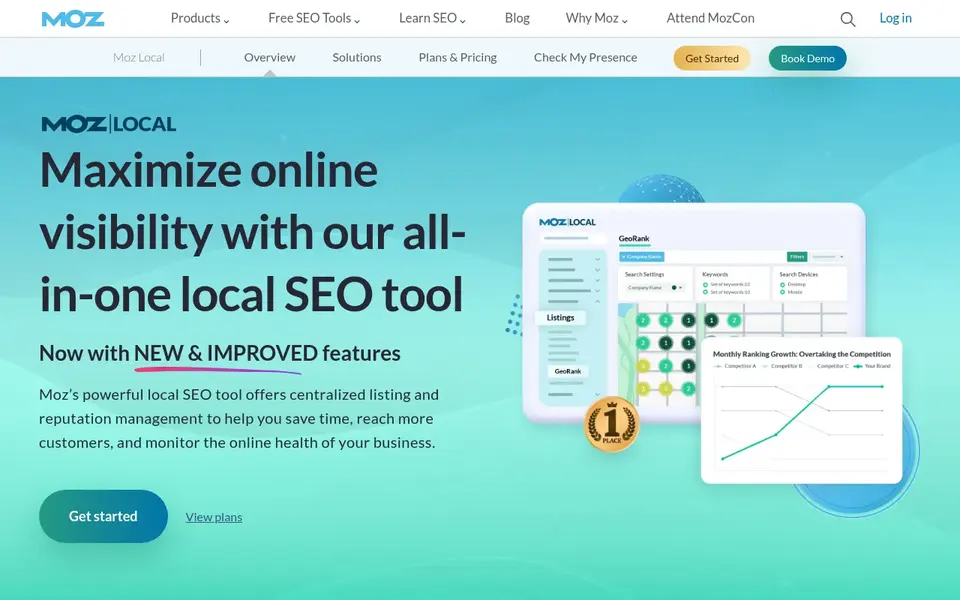
Moz Local handles listings and gives a view of local visibility. For a physical therapy clinic, the main value is keeping the name, address and phone consistent across directories, which supports map rankings indirectly.
I would use it to clean up duplicates after a relocation or a rebrand, then check local visibility scores as a rough health signal. It is not the tool for detailed neighborhood-level rank grids, so treat it as the foundation layer.
The limit is depth on rank tracking. If map-grid positions are your priority, pair it with a dedicated tracker or choose one instead.
- Listing distribution and duplicate cleanup
- local visibility scoring
- familiar Moz interface
- Rank tracking is lighter than dedicated tools
- listing changes depend on directory sync times

Semrush Local adds local rank tracking and listing tools to the main Semrush platform. It makes sense for a clinic that already tracks its website rankings and wants local positions in the same place.
For physical therapy, I would track the main service terms plus the town names patients actually use, and compare website rankings with map rankings. That contrast often shows whether the problem is the site or the Google Business Profile.
The limit is cost and complexity. A clinic that only needs map positions will find it heavy. Skip it unless you already use Semrush for other work.
- Local rank tracking inside a wider SEO suite
- listing management
- useful if you also track the clinic website
- Best value only with the wider Semrush subscription
- overkill for a small clinic with one location
Uberall is built for businesses with several locations. A physical therapy group with clinics across a city or region can manage listings, reviews and location data from one place.
For rank tracking, it is more about keeping each location's data consistent so map visibility holds up. I would use it when the group has grown past a handful of clinics and manual listing checks no longer work.
The limit is fit. A single clinic will find it more than it needs. Skip it unless you manage multiple locations.
- Listing management across many locations
- review handling in one place
- built for multi-location brands
- Aimed at larger operations
- not a simple single-clinic rank checker
How I chose
I built this list from vendor documentation and public sources, not from hands-on testing. I looked at what each tool actually tracks, whether it handles map-grid positions, how it deals with reviews and listings, and where the limits sit for a clinic rather than a large brand.
I also weighed fit for physical therapy specifically. Patients search from home, work and referring doctors' offices, so neighborhood-level visibility matters more than a single city rank. Tools that only give one number ranked lower than those that show a grid or per-location view.
Finally, I checked that every recommendation follows Google's guidelines. None of these tools require review gating or keyword-stuffed business names, and I would not recommend a clinic use them that way.
What to check before you buy
- Confirm the tool tracks Google Maps grid positions, not just organic website rankings.
- Check whether it supports the number of locations you have now and expect to have next year.
- Ask how it handles review requests, and make sure it does not gate or filter reviews.
- See whether listing and citation cleanup is included or sold separately.
- Confirm the reporting is readable for a clinic owner who is not an SEO specialist.
- Check the cancellation terms and whether you can export your data if you leave.
Frequently asked questions
Do physical therapists need a rank tracking tool at all?
Not strictly, but it helps. A clinic that wants to know why it shows up in one suburb and not another needs neighborhood-level data. A single rank number rarely explains that, while a map-grid view usually does.
What is the difference between map rank tracking and website rank tracking?
Website rank tracking shows where your pages appear in standard search results. Map rank tracking shows where your Google Business Profile appears in Google Maps and the local pack. For a clinic, the map result is usually what brings the phone call.
Can rank tracking tools help with reviews?
Some do, some do not. Tools like GatherUp and BrightLocal include review workflows, while Local Falcon focuses on positions. Reviews influence local rankings, so many clinics run a rank tracker and a review tool together.
Is it safe to ask patients for reviews?
Yes, if you ask everyone and do not filter or gate. Do not offer incentives for positive reviews or steer only happy patients to Google. Follow Google's review policies and keep requests neutral.
How often should a clinic check local rankings?
Monthly is enough for most clinics. Check more often after a move, a rebrand or a new location opens, because listing changes take time to settle and you want to catch problems early.
Sources
See where you really rank - block by block
ProMapRanker scans Google Maps across a grid of your service area. Simple monthly plans from $19, white-label on every plan.
Start freeBrowse all guides
← Best Local Rank Tracking Tools for Pet Groomers in 2026Best Local Rank Tracking Tools for Small Business in 2026 →
 best local rank tracking tools for locksmiths
Best Local Rank Tracking Tools for Locksmiths in 2026
A first-person guide to the best local rank tracking tools for locksmiths in 2026, compared from vendor documentation and public sources.
Read → best local rank tracking tools for cleaning companies
Best Local Rank Tracking Tools for Cleaning Companies in 2026
A first-person guide to the best local rank tracking tools for cleaning companies in 2026, compared from vendor docs and public sources.
Read → best local rank tracking tools for car dealerships
Best Local Rank Tracking Tools for Car Dealerships in 2026
A guide to the best local rank tracking tools for car dealerships in 2026, compared from vendor documentation, with grid views, review tracking and GBP tips.
Read → local seo for home inspectors
Local SEO for Home Inspectors
A local SEO guide for home inspectors: Google Business Profile setup, reviews, and realtor-referral-driven local SEO.
Read → local seo for notary services
Local SEO for Notary Services
A local SEO guide for notary services: Google Business Profile setup, reviews, and mobile-notary and same-day local SEO.
Read → promapranker vs synup
ProMapRanker vs Synup: Local Rank Tracking Compared
How ProMapRanker compares to Synup for local rank tracking, reporting, and pricing.
Read →More in Local SEO & Google Maps · All guides A to Z by date · Latest guides