 ProMapRanker
Best Legal Practice Management Software for Law Firms


Firms that want the most widely used platform · Pricing starts at: $49 per user/month
Key takeaways
- Entry prices cluster near $49 to $50 per user per month on annual billing, while full-featured tiers run $89 to $149 per user per month.
- Clio, MyCase, and PracticePanther publish entry prices, while Smokeball, Filevine, LEAP, and Actionstep sell by quote.
- Trust accounting is included in most entry plans, but three-way reconciliation and LEDES billing often sit on higher tiers.
- Document automation matters most for firms that generate the same forms again and again, which is where Smokeball and LEAP stand out.
- Budget for payment processing fees and add-ons, since the per-user price is only part of the yearly cost.
Quick comparison
| Pick | Great for | Pricing starts at | Free tier | |
|---|---|---|---|---|
| Clio | Firms that want the most widely used platform | $49 per user/month | Free trial (7 days) | Visit |
 MyCase | Consumer-facing firms that text clients often | $50 per user/month (billed annually) | Free trial (10 days) | Visit |
 PracticePanther | Firms that want automation without a high price | $49 per user/month (billed annually) | Free trial (7 days) | Visit |
 Smokeball | Document-heavy firms that bill by the hour | quote only | Free trial | Visit |
 Filevine | Firms that need custom workflows and reporting | quote only | No | Visit |
 CosmoLex | Firms that want accounting built in | quote only | Free trial (10 days) | Visit |
 LEAP | Firms that want forms and accounting in one place | quote only | No | Visit |
 Actionstep | Firms that want deep workflow control | quote only | Free trial | Visit |
The best legal practice management software for law firms

Clio Manage is the default choice for most small and mid-size firms, and the reason is breadth. It covers contacts, matters, documents, calendars, tasks, time tracking, billing, and trust accounting in one login, and it connects to more than 200 other tools through its app directory. The entry plan, Starter, starts at $49 per user per month and includes time and expense tracking, online payments, trust and operating account reconciliation, and three electronic signatures a month.
The trade-off is price transparency. Clio publishes only that $49 figure. Core, Signature, and Elite all show a Get pricing button, so a firm cannot compare the full ladder without a sales call. Older published tiers ran $89 to $149 per user per month, which gives a rough sense of the range, but the current quote is the number that counts. Payment processing runs 2.95 percent on standard cards and 1 percent on eCheck and ACH. Firms that already run Clio Grow for intake can fold it in at the Elite tier, which keeps client acquisition and matter work in one system.
- Largest integration library in legal software
- Trust accounting and online payments included from the entry plan
- Only the $49 starting price is published, so higher tiers need a sales quote
- Add-ons such as Clio Accounting cost extra
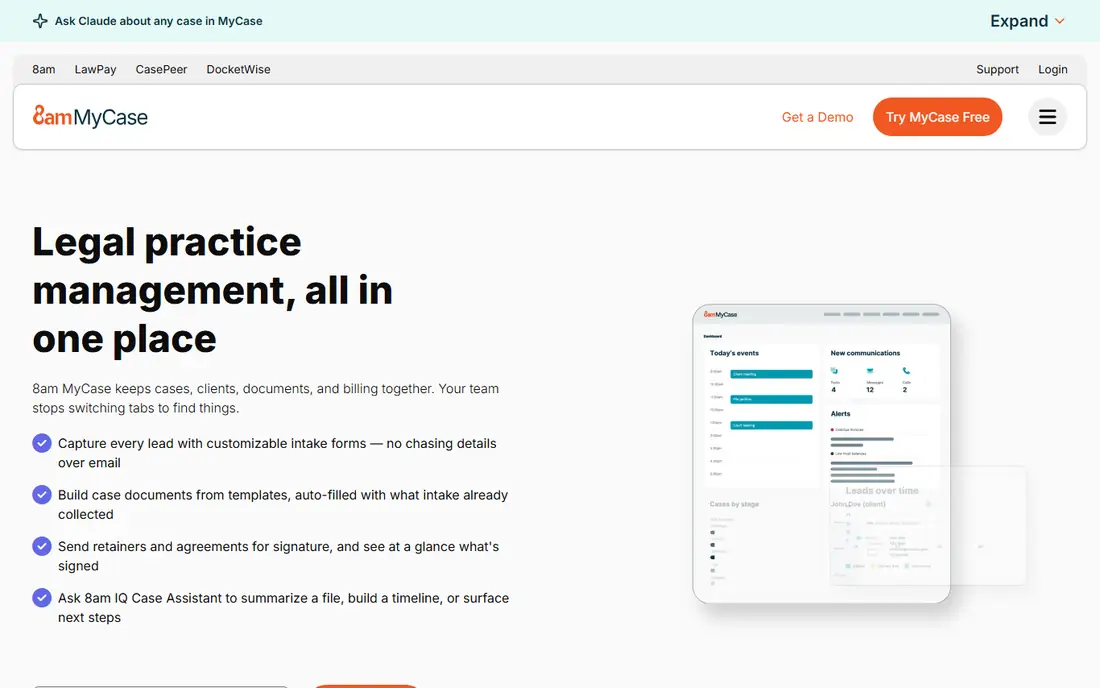
MyCase suits firms whose clients expect quick replies, such as family law, criminal defense, and personal injury practices. The client portal lets clients share documents, sign forms, and pay invoices online, and the built-in two-way texting keeps those conversations inside the matter file instead of on a personal phone. Basic starts at $50 per user per month billed annually, or $60 billed monthly, and includes trust accounting from the start.
Pro costs $100 per user per month billed annually and adds document automation, an AI writing and document assistant, and more reporting. Advanced costs $130 and adds the fullest reporting set. MyCase Accounting is a separate add-on at $39 per user per month for three-way reconciliation on Pro and Advanced. The main weakness is that the cheapest plan is genuinely basic, so a firm that wants automation and deeper reports should budget for Pro rather than Basic.
- Built-in client portal and two-way texting
- Trust accounting included from the Basic plan
- Prices rose in 2026, so older guides quote lower figures
- Advanced reporting needs the Pro or Advanced plan
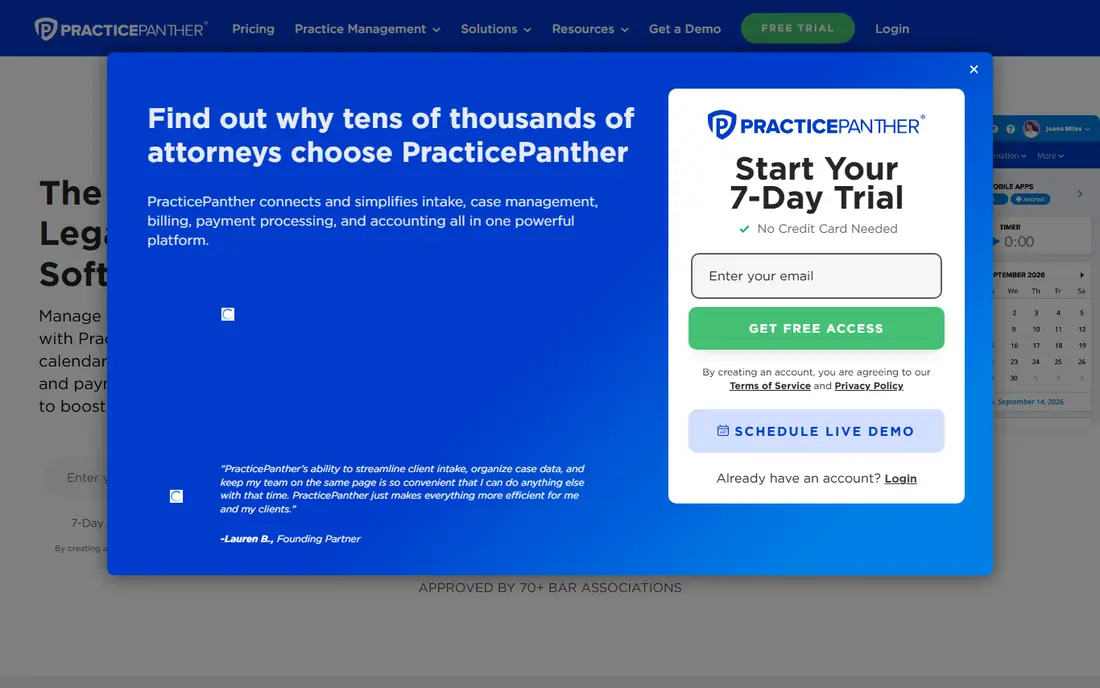
PracticePanther is the value pick among the transparent vendors. Solo starts at $49 per user per month billed annually, or $59 billed monthly, and covers one user. Essential costs $69, Business costs $89, and Business Pro costs $114, all billed annually per user. Every plan includes a secure client portal, and the higher tiers add workflow automation, custom intake forms, and PantherAccounting Plus for trust and operating accounting.
The automation is the draw. Firms can build rules that assign tasks, send reminders, and move matters between stages without writing code, and the Zapier connection links the platform to hundreds of other tools. The limits are real too. Solo is for a single user only, so a two-person firm must step up to Essential, and full accounting waits until Business Pro. Even so, a small firm that wants a clear price and solid automation will find little to fault here.
- Every tier is published, so budgeting is simple
- Strong workflow automation and Zapier links
- Built-in accounting is limited until the Business Pro tier
- The Solo plan caps at one user
Smokeball is built for firms that produce the same documents at volume, such as real estate, estate planning, corporate, and family law practices. Its template library covers more than 20,000 forms, and documents pull matter data into the right fields automatically, which cuts drafting time on routine files. Automatic time capture records work done in emails and documents, which helps firms recover billable time that manual timers miss.
Pricing is the weak point. Smokeball sells four plans, Bill, Boost, Grow, and Prosper+, and publishes no per-seat figure for any of them. Third-party directories list Bill near $49 and Boost near $89 per user per month, but those are estimates, not vendor figures, so treat them as a rough guide only. Trust accounting is included from the Bill plan, and automatic time tracking in full sits on Prosper+. Firms that bill by the hour and draft heavily should ask for a written quote and test the document engine on their own templates during the trial.
- Deep document automation with a large form library
- Automatic time capture from emails and documents
- No published price, so every quote needs a sales call
- The AI assistant Archie is an add-on
Filevine targets firms that want the system shaped around their own process rather than the other way round. Workflows, task sets, and dashboards are configurable in depth, and the platform is widely used by personal injury firms and teams handling large caseloads with many moving parts. Reporting can track a case from intake to settlement, which helps managing partners see where files stall.
The cost of that flexibility is opacity and setup time. Filevine publishes no prices and sells in modules, so two firms can pay very different amounts for different bundles. Aggregators list a starting figure near $87 per user per month, but that is an estimate. Firms should expect a demo, a scoping call, and a longer onboarding period than with Clio or MyCase. The payoff is a system that mirrors the way the firm actually works, which matters more as caseload and headcount grow.
- Highly configurable workflows and dashboards
- Strong fit for personal injury and mass tort work
- Sold in modules entirely by quote, so costs are hard to compare
- Setup takes longer than simpler tools
CosmoLex is the pick for firms that want practice management and accounting in one product. It includes trust accounting, general ledger accounting, and billing without a separate QuickBooks subscription, which removes a whole sync step from the month-end routine. Time tracking, document management, and a client portal sit alongside the accounting core, so a small firm can run most of its back office from one login.
The catch is pricing. The current pricing page shows no dollar figure, and third-party guides disagree on the entry price, with some listing figures near $99 to $139 per user per month. Until a firm gets a written quote, the real cost is unknown, which makes side-by-side comparison awkward. Firms that already run QuickBooks and like it may prefer LeanLaw or Clio plus accounting software, but firms that want one ledger and one login will find CosmoLex hard to match.
- Full legal accounting with trust and general ledger included
- No separate bookkeeping tool needed
- No published price on the current pricing page
- Fewer third-party integrations than Clio
LEAP is a long-standing option for firms that want forms, matter management, and accounting together. Its form library covers many practice areas, and documents can be generated from matter data with little manual entry. Accounting includes trust accounting and billing, so a firm can track a matter from first appointment to final invoice without leaving the system. LEAP also offers a mobile app, which helps attorneys who work away from the office.
Pricing is entirely by quote, and the vendor publishes no figure on its pricing page. That puts LEAP at a disadvantage for firms comparing costs on paper, since a sales conversation is the only way to get a number. The interface also shows its age next to Clio and MyCase, though regular users tend to value depth over looks. Firms that draft heavily from standard forms and want accounting included should request a quote and compare the form library against Smokeball before deciding.
- Large library of legal forms and precedents
- Accounting and matter management in one system
- Quote-only pricing with no public figure
- The interface feels dated next to newer cloud tools
Actionstep gives firms a workflow builder that can model complex matter paths, with templates that assign tasks, set deadlines, and trigger documents as a file moves forward. Billing, trust accounting, and document management are included, and the system suits mid-size firms that run repeatable processes across several practice areas. The dashboard view helps partners watch caseloads, deadlines, and billing across the firm.
Like several tools on this list, Actionstep publishes no price, so budgeting starts with a demo and a quote. The depth that makes it powerful also makes setup slower, since the firm has to design its workflows before the system starts saving time. Firms with simple needs will find Clio or PracticePanther faster to adopt, but firms with defined processes and several attorneys will get more from Actionstep once the templates are built.
- Powerful workflow builder with matter templates
- Billing and trust accounting included
- Quote-only pricing
- The depth of options makes setup slower than simpler tools
How much it costs at three firm sizes
| Firm size | Cheapest honest setup | Mid-range setup | What changes the bill | | Solo attorney | PracticePanther Solo, $49 per user/month | MyCase Basic, $50 per user/month | Add-ons such as accounting and e-signature | | 5 attorneys | Clio Starter, $245 per user/month for 5 seats | MyCase Pro, $500 per user/month for 5 seats | Automation, reporting, and AI features | | 15 attorneys | PracticePanther Business, $1,335 per user/month for 15 seats | MyCase Advanced, $1,950 per user/month for 15 seats | Higher tiers, integrations, and training |
The table uses published annual-billing prices only. Quote-only tools such as Smokeball, Filevine, LEAP, and Actionstep are left out of the sums because no vendor figure exists to add. A solo attorney can start near $49 a month, while a five-attorney firm on a mid-tier plan should expect $500 to $750 a month before payment processing fees. Ask every vendor for the full yearly figure in writing, including add-ons, onboarding, and data migration, before signing.
How we chose
We compared vendor pricing pages, product documentation, and plan feature lists read in November 2026, and we checked which prices each vendor actually publishes. Tools made the list only if they serve law firms directly and cover matters, documents, time, and billing in one system. We left out generic project tools and tools aimed only at a single practice area. Prices come from the vendor pricing pages linked in Sources, and where a vendor publishes no price we say quote only instead of repeating a directory estimate as fact. We did not run hands-on tests, and we did not count review scores as evidence.
What to check before you buy
First, confirm trust accounting in writing. Most tools include basic trust tracking, but three-way reconciliation often needs a higher tier or an add-on, and a firm that handles client funds cannot treat that as a detail. Second, test document automation on your own templates, not the vendor demo files, since form quality varies by practice area. Third, ask how data leaves the system. Export options, migration help, and contract length matter more than the monthly price once a firm has years of matters inside a tool. Fourth, count every seat. Per-user pricing means a part-time paralegal costs the same as a partner, so the headcount on the quote should match the headcount that will actually log in.
Frequently asked questions
What is the cheapest legal practice management software for law firms?
PracticePanther Solo and Clio Starter both start at $49 per user per month, and MyCase Basic starts at $50 per user per month on annual billing. Those are entry prices, so the plan a firm actually needs may cost more. Smokeball, Filevine, LEAP, and Actionstep publish no price, which means their cost can only be learned from a quote. Compare the tier that includes the features you need, not the headline figure.
Does legal practice management software include trust accounting?
Most tools on this list include trust accounting from the entry plan, including Clio, MyCase, PracticePanther, Smokeball, CosmoLex, LEAP, and Actionstep. Three-way reconciliation is different and often needs a higher tier or an add-on, such as MyCase Accounting at $39 per user per month. Ask the vendor to confirm reconciliation, trust reporting, and your state bar rules in writing before you buy.
Is Clio or MyCase better for a small law firm?
Clio suits firms that want the largest integration library and the most widely used platform, while MyCase suits consumer-facing firms that value the client portal and two-way texting. Both start near $49 to $50 per user per month. MyCase includes texting and portal messaging that Clio charges extra for in some plans, while Clio connects to more outside tools. Run both trials with real matters before choosing.
Do I need a separate accounting tool with legal practice management software?
It depends on the product. CosmoLex and LEAP include full legal accounting with a general ledger, so many firms skip QuickBooks entirely. Clio, MyCase, and PracticePanther include trust accounting but need an add-on or an outside tool for full books, such as Clio Accounting or MyCase Accounting. Firms that already run QuickBooks Online often prefer LeanLaw or a Clio integration instead.
Can I migrate my cases from another system?
Yes, most vendors offer migration help, and Clio, MyCase, and PracticePanther all describe self-serve or assisted migration on their sites. The quality of the move depends on how clean the old data is, so ask what migrates, what does not, and whether the vendor charges for the work. Test the result on a few matters before the old system is switched off.
Sources
See where you really rank - block by block
ProMapRanker scans Google Maps across a grid of your service area. Simple monthly plans from $19, white-label on every plan.
Start freeKeep reading
 best local marketing software for franchises
Best Local Marketing Software for Franchises
Compare the best local marketing software for franchises, with real 2026 prices, so every location can run reviews, listings, and ads that stay on brand.
Read → best local competitor analysis software
9 Best Local Competitor Analysis Software for 2026
Compare the best local competitor analysis software for local SEO, with real prices, rival rank tracking, review and citation gaps, and map pack checks.
Read → best link management platform for sms at scale
Best Link Management Platform for SMS at Scale
Compare the best link management platform for sms at scale, with branded short links, click tracking, APIs and bulk tools for high-volume text campaigns.
Read →