 ProMapRanker
Best IoT Platform in 2026


Dashboards, rules and device management at scale · Pricing starts at: $49 per month
Key takeaways
- ThingsBoard suits teams that want dashboards and a rule engine with self-hosting control.
- Blynk and Ubidots suit smaller products that need mobile apps and fast setup.
- AWS IoT Core and Azure IoT Hub suit large fleets already inside those clouds.
- Free tiers help prototypes, but device and data caps decide whether a plan lasts past testing.
- We favored platforms with clear device limits, MQTT support, and published free or entry pricing.
Quick comparison
| Pick | Great for | Pricing starts at | Free tier | |
|---|---|---|---|---|
| ThingsBoard | Dashboards, rules and device management at scale | $49 per month | Yes | Visit |
 Blynk | Mobile apps for connected products | Free | Yes | Visit |
 Ubidots | Small fleets and simple monitoring dashboards | Free | Yes | Visit |
 Particle | Cellular products that need fleet management | $299 per month | Yes | Visit |
 Losant | Visual workflows across devices and business systems | See website | Free trial | Visit |
 Arduino Cloud | Maker projects and small Arduino-based products | Free | Yes | Visit |
 AWS IoT Core | Large fleets already using AWS services | See website | Yes | Visit |
 Azure IoT Hub | Fleets inside the Microsoft cloud | See website | Yes | Visit |
The best IoT platforms
An IoT platform connects devices, stores telemetry, shows dashboards and sends alerts when something changes. The right pick depends on fleet size, connectivity type and whether you need mobile apps, rules or cloud scale. These eight cover maker projects, small products and enterprise fleets.
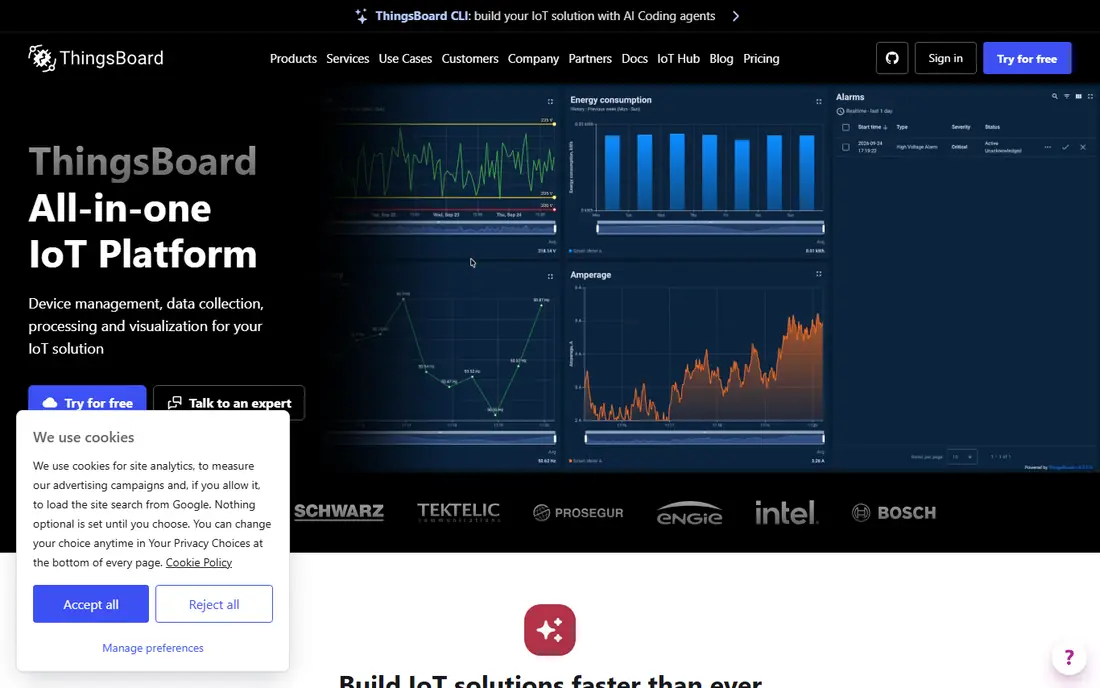
ThingsBoard combines device management, telemetry storage, dashboards and a rule engine that can process data, trigger alerts and forward results to other systems. The cloud free tier covers 5 devices and 1 million data points per month, while paid cloud plans start with Prototype at $49 per month for 50 devices. A self-hosted version gives teams control over data and hosting, with production use terms tied to device count.
The cost of that power is setup effort. Self-hosting at scale involves databases and message brokers, and some device protocols run through a separate gateway service. For teams that want deep rules and custom dashboards and can handle that setup, ThingsBoard offers strong value. For a simple five-device monitor, a lighter tool may be faster.
- Strong dashboard builder and rule engine
- Self-hosted option
- Wide protocol support
- Self-hosting needs database and server care
- Gateway setup adds work for some protocols
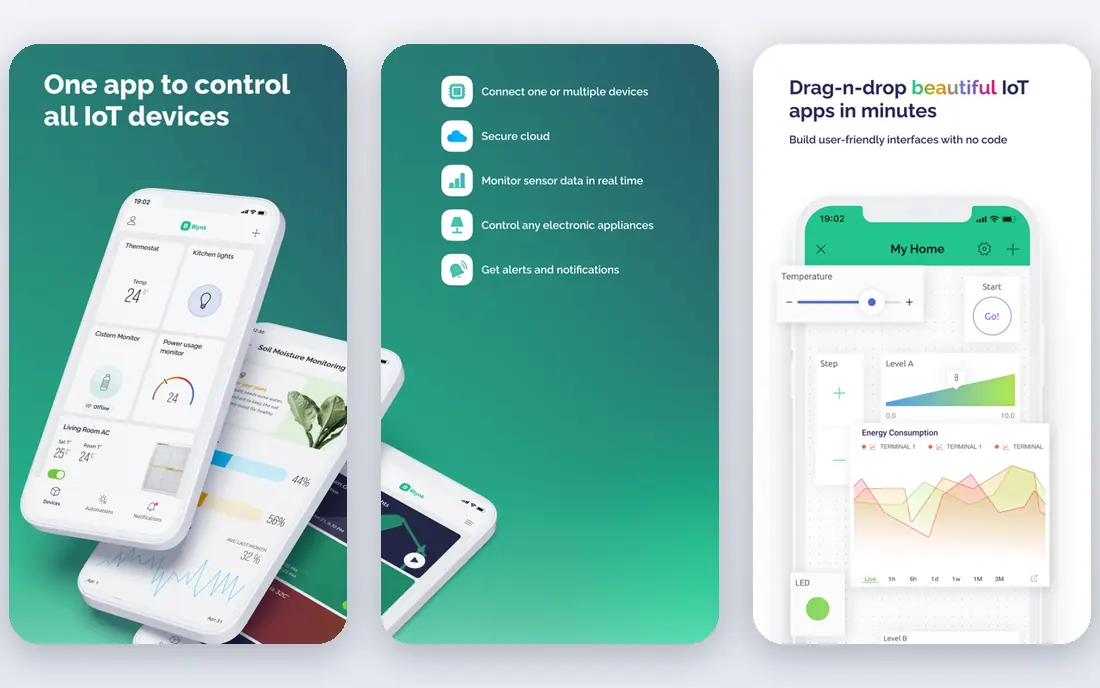
Blynk helps makers and product firms turn a prototype into a connected product with a mobile app. You connect hardware, build app controls and dashboards with low-code tools, and manage devices, users and firmware updates from one console. The free plan covers 5 devices and one user, which suits early testing.
Paid plans start higher, with Pro plans reported around $99 per month, so commercial scale needs a budget check. Blynk suits teams whose product needs a polished phone app more than a complex rule engine. If your main need is industrial dashboards or heavy data processing, compare ThingsBoard or a cloud platform first.
- Low-code mobile app builder
- Device provisioning and user management
- Hardware support is broad
- Paid tiers rise with scale
- Commercial features need higher plans
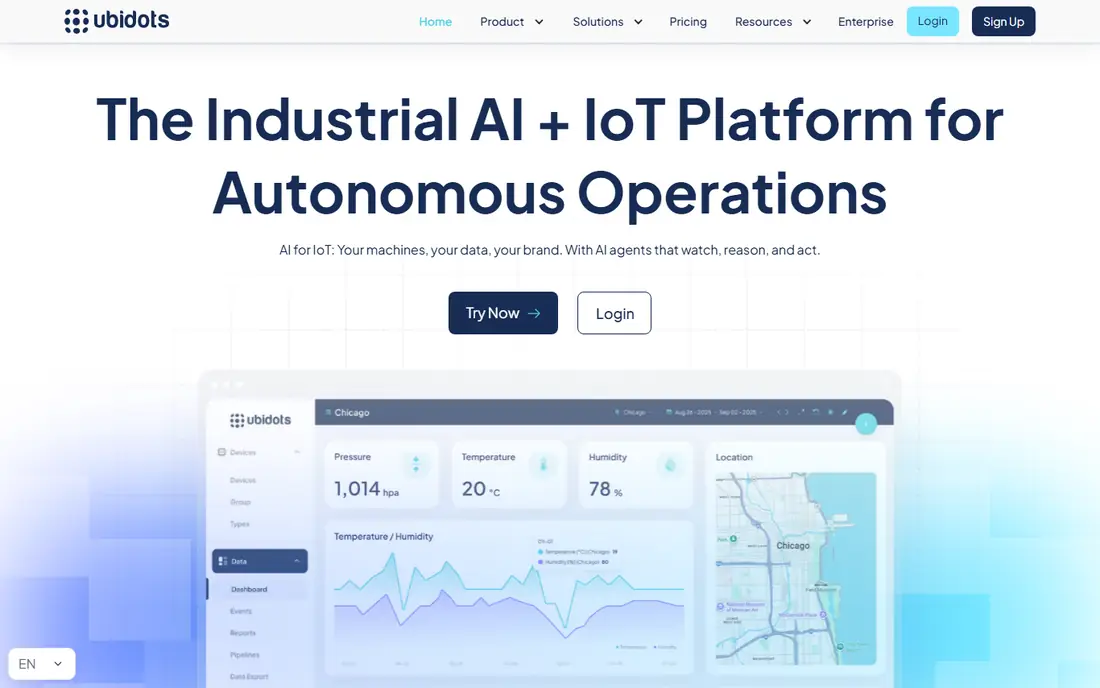
Ubidots focuses on getting sensor data onto a dashboard quickly. Devices send data over MQTT or HTTP, and you build charts, maps and alerts without heavy code. The STEM plan is free for 3 devices for non-commercial use, while commercial pricing starts with the first devices included and then charges per device per month, reported around $4.50 per device.
That per-device model is easy to forecast for small fleets but grows steadily as you add hardware. Ubidots suits classrooms, small farms, building monitors and early products. For hundreds of devices with complex rules, a platform with bulk fleet pricing may work out cheaper.
- Simple dashboards and alerts
- STEM free plan for learning
- Per-device commercial pricing
- STEM plan is non-commercial only
- Larger fleets need careful device math
Particle pairs cellular hardware with a device cloud for managing fleets, pushing firmware updates and checking fleet health. That pairing helps products deployed in the field where Wi-Fi is absent or unreliable, such as trackers, remote sensors and mobile equipment. The platform also links to major clouds for data processing.
Pricing is block-based, with paid plans reported from $299 per block per month, so tiny hobby projects may find it costly. Particle suits firms shipping a real product on cellular networks. For a Wi-Fi prototype on a bench, a free-tier platform will likely serve you better.
- Cellular hardware and cloud together
- Fleet-wide firmware updates
- Strong device cloud tools
- Block pricing starts high for tiny projects
- Cellular focus suits some products less than Wi-Fi
Losant gives teams a visual workflow builder for device data, so a sensor reading can trigger an alert, update a dashboard, call an outside system or start a maintenance task. Device management, dashboards and user access sit in the same platform, which helps firms that want logic without writing a full back-end service.
The main drawback is pricing clarity, since some tiers require a quote or trial discussion. Losant suits firms with a clear workflow need, such as cold-chain alerts or equipment monitoring tied to work orders. For a simple dashboard with a handful of devices, a free-tier tool may be enough.
- Visual workflow engine
- Dashboards and device management
- Business system links
- Pricing is not fully published for all tiers
- Learning curve for workflow logic
Arduino Cloud lets Arduino users connect boards, sync variables and build dashboards with little setup. If your hardware already runs on Arduino boards, the path from sketch to cloud dashboard is short, and the community offers many examples for common sensors and displays. A free plan covers limited devices and Things for testing.
Paid Maker plans raise device limits, and Team plans support more users and devices for small products. Arduino Cloud suits education, prototypes and small products built on Arduino hardware. For non-Arduino fleets or heavy industrial rules, a hardware-neutral platform may fit better.
- Easy start for Arduino boards
- Dashboards and device sync
- Large maker community
- Free plan limits device counts
- Team and product scale needs paid plans
AWS IoT Core connects devices to AWS through MQTT and HTTP, with device registry, security policies and rules that route data to storage, analytics and alerts. Firms already using AWS gain the most, since device data can flow into the same pipelines as the rest of their systems. A free tier covers limited usage for testing.
The trade-off is complexity and billing. Usage-based charges depend on messages, connections and rules, so a busy fleet needs careful monitoring. AWS skill is also needed to set up security and routing well. For large fleets inside AWS, IoT Core is a strong core. For a small standalone monitor, a simpler dashboard platform will be faster.
- Huge scale and device security features
- Links to AWS analytics and storage
- Free tier for testing
- Usage-based pricing is hard to forecast
- Setup needs AWS skill
Azure IoT Hub handles secure device messaging at scale, including commands sent back to devices, device twins for state, and routing to Azure storage and analytics. Microsoft shops can tie device data to existing identity, monitoring and data tools, which keeps governance in one place. A free tier supports limited daily messages for testing.
Like AWS, pricing depends on throughput units and message volume, so forecast with real device counts and message rates. Azure skill is needed for a clean setup. For Microsoft-centered fleets, IoT Hub is the natural hub. For a small product with a phone app, Blynk or Ubidots may get you live sooner.
- Device-to-cloud and cloud-to-device messaging
- Links to Azure analytics
- Free tier option
- Pricing depends on units and messages
- Setup needs Azure skill
How we picked these
We compared official product pages, free tier terms, protocol support and public reviews for IoT platforms live in October 2026. We kept platforms that support device connectivity, dashboards and alerts, and we favored clear device or data limits over vague claims. We did not claim hands-on testing. Where pricing is usage-based or quote-based, we say so and point readers to the vendor pricing page.
How to choose an IoT platform
Start with device count, message rate and connectivity. Count how many devices you will run in a year, how often each one sends data, and whether it uses Wi-Fi, cellular or wired links. Those three numbers decide whether a free tier lasts, whether per-device pricing stays fair, and whether you need cellular hardware support.
Next, test the full loop, not just the dashboard. Connect a real device, send data, build an alert, and check what happens when a device goes offline. Confirm data retention, export options and security features such as device credentials and access controls. Finally, check lock-in. Can you export historical data and move devices to another platform if pricing or needs change? A platform that makes exit hard should earn extra scrutiny before you scale on it.
Frequently asked questions
What is the best free IoT monitoring tool?
ThingsBoard Cloud, Blynk, Ubidots STEM and Arduino Cloud all offer free tiers for small device counts. ThingsBoard suits dashboard and rule testing, Blynk suits mobile app testing, and Ubidots STEM suits non-commercial learning. Check device and data caps, since free tiers stop being free once you pass them.
What is the best IoT platform for small business?
Blynk and Ubidots suit small products and monitoring jobs with fast setup. ThingsBoard suits firms that need custom dashboards and rules. Particle suits cellular products. The best pick depends on whether you need a phone app, a dashboard, cellular coverage or deep rules.
What is the best IoT software for large fleets?
AWS IoT Core and Azure IoT Hub suit large fleets inside their clouds, thanks to scale, security and analytics links. ThingsBoard also suits large fleets that want self-hosting control. Large fleets should test message volume and security setup before committing to one cloud.
Do IoT platforms work with any hardware?
Most platforms support common protocols such as MQTT and HTTP, but board support varies. Blynk and Arduino Cloud are friendlier to maker boards, while Particle centers on its own cellular hardware. Check the supported hardware list and protocol docs for your exact board before buying devices.
How much does an IoT platform cost?
Free tiers cover a few devices, paid plans in this list start around $49 per month for ThingsBoard Prototype, while Particle block pricing starts higher. Cloud platforms bill by usage, so total cost depends on devices, messages and data retention. Model a year of growth, not just the launch fleet.
Can I monitor IoT devices from a phone app?
Yes. Blynk leads on phone apps for connected products, and most platforms offer mobile dashboards or responsive web views. Arduino Cloud and Ubidots also offer mobile-friendly dashboards. If a native app is a core product feature, shortlist Blynk first and test its app builder with your device.
Sources
See where you really rank - block by block
ProMapRanker scans Google Maps across a grid of your service area. Simple monthly plans from $19, white-label on every plan.
Start freeKeep reading
 zeffy payment processor stripe alternatives
Zeffy and Stripe Alternatives for Nonprofits in 2026
Explore zeffy payment processor stripe alternatives for nonprofits. We compare 8 fundraising platforms on fees, donor tools, and nonprofit focus. Check fees.
Read → workday alternatives
Workday Alternatives in 2026
Workday alternatives compared: we review 8 HR and payroll platforms that replace Workday, with pricing, strengths and honest limits for each team size.
Read → what's the best weather app
What's the Best Weather App in 2026
Wondering what's the best weather app? We compare 10 free and paid apps for forecasts, radar, alerts, and Colorado mountain weather for everyday and storm use.
Read →