 ProMapRanker
Best IoT Companies in 2026

Key takeaways
- The best IoT company depends on if you need a cloud platform, an industrial system, or connected hardware, since no one vendor leads all three.
- Cloud-first teams usually shortlist AWS IoT and Microsoft Azure IoT, while factories shortlist Siemens, Cisco, and Cumulocity.
- Security, device management, and edge support matter more than a feature list, since IoT projects fail on operations rather than on demos.
- Most enterprise IoT pricing is by usage or custom quote, so pilot with a real device fleet before committing to a platform.
Quick comparison
| Pick | Great for | Pricing starts at | Free tier | |
|---|---|---|---|---|
 AWS IoT | Cloud-scale device fleets | See website | Free trial | Visit |
 Microsoft Azure IoT | Microsoft-centered enterprises | See website | Free trial | Visit |
 Siemens Insights Hub | Siemens-equipped factories | See website | No | Visit |
 Cisco IoT | Industrial networking and security | See website | No | Visit |
 Samsara | Connected fleet and operations | See website | No | Visit |
 Particle | Developer-friendly connected products | See website | Yes | Visit |
 Losant | Low-code IoT applications | See website | Free trial | Visit |
 Cumulocity | Device management at scale | See website | No | Visit |
 Qualcomm | IoT chips and edge AI hardware | See website | No | Visit |
 Honeywell Forge | Industrial asset performance | See website | No | Visit |
The best IoT companies
The phrase IoT company covers very different businesses, from cloud platforms to factory systems to chips. The companies below are live and active in October 2026, and we compared their official product pages, documentation, pricing notes, and independent platform comparisons. Note that PTC's ThingWorx and Kepware businesses moved to a new company, Velotic, in March 2026, so buyers of that platform should check Velotic rather than assuming the old PTC offer is unchanged.
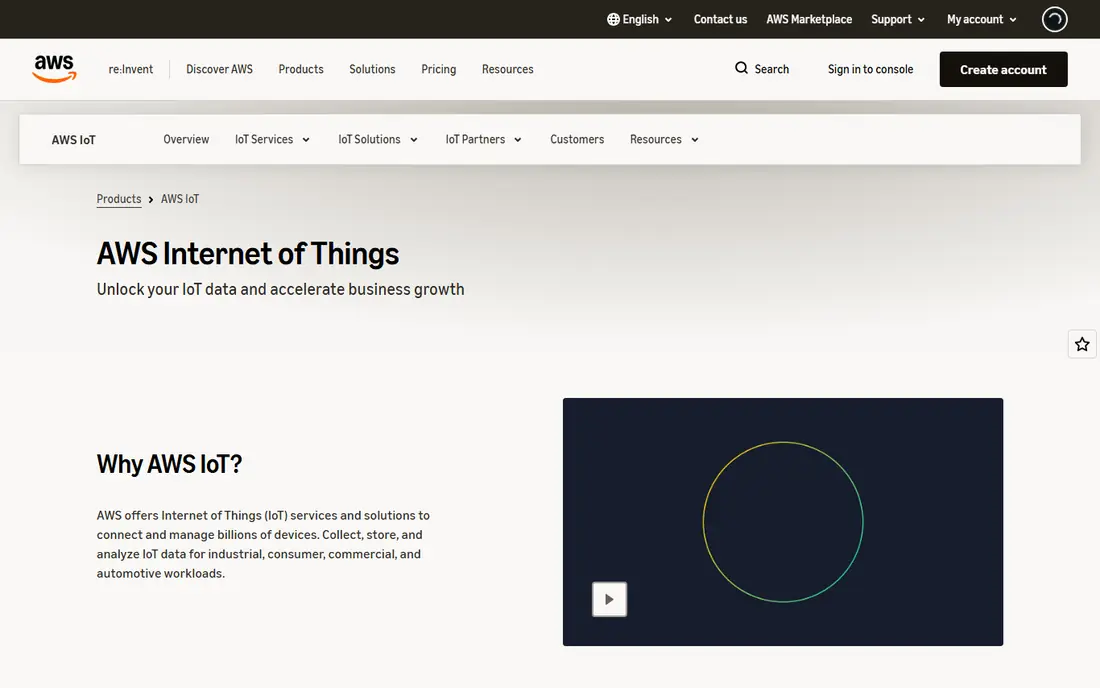
AWS IoT is the default cloud pick for teams already on Amazon Web Services, and its breadth is the reason. IoT Core handles device messaging, SiteWise handles industrial data, and Greengrass runs compute at the edge, all tied to the wider AWS catalog for storage, analytics, and machine learning. That depth suits fleets from thousands to millions of devices, and the free tier lets a team pilot without a large upfront bill.
The trade-off is complexity and cost control. A team new to AWS may need time to wire services together, and message, storage, and processing charges add up if a fleet is chatty. Teams that already use AWS, and teams that need true cloud scale, will get the most value, while small product teams may prefer a simpler platform such as Particle.
- Huge cloud ecosystem with IoT Core, SiteWise, and Greengrass for edge work
- Pay-as-you-go pricing
- Broad device and protocol support
- Many separate services to learn and connect
- Costs can grow with message volume and storage if not monitored
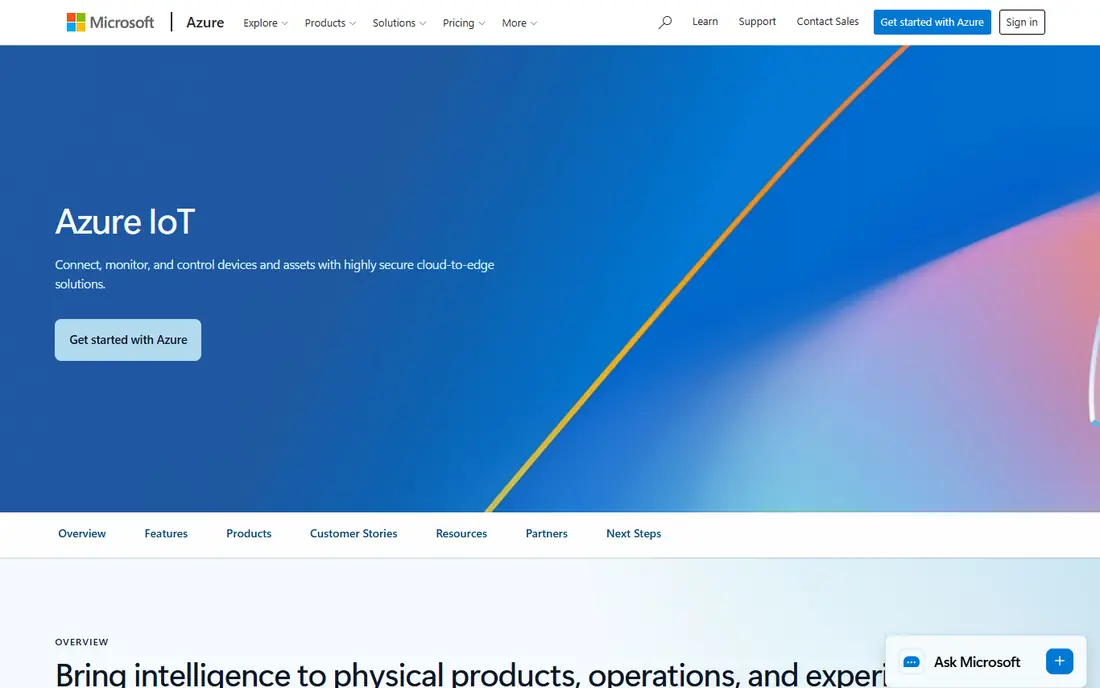
Microsoft Azure IoT suits enterprises that already run on Microsoft tools, since device data can flow into Power BI dashboards, Dynamics workflows, and Microsoft security controls with less custom work. Azure IoT Operations, Digital Twins, and edge services cover factory and building use cases, while IoT Hub handles device messaging at scale. For a company with a Microsoft enterprise agreement, that integration is a real advantage.
The limit is lock-in by convenience. A team that does not use Microsoft elsewhere may find AWS or a vendor-neutral platform simpler, and Azure pricing still spans several services that must be estimated together. Pilot with a real device set, and check how data flows to the dashboards your operations team actually uses.
- Strong fit with Dynamics 365, Power BI, and Microsoft security tooling
- Azure IoT Operations and Digital Twins for industrial work
- Enterprise governance
- Best value requires Microsoft commitment
- Pricing across services needs careful estimation
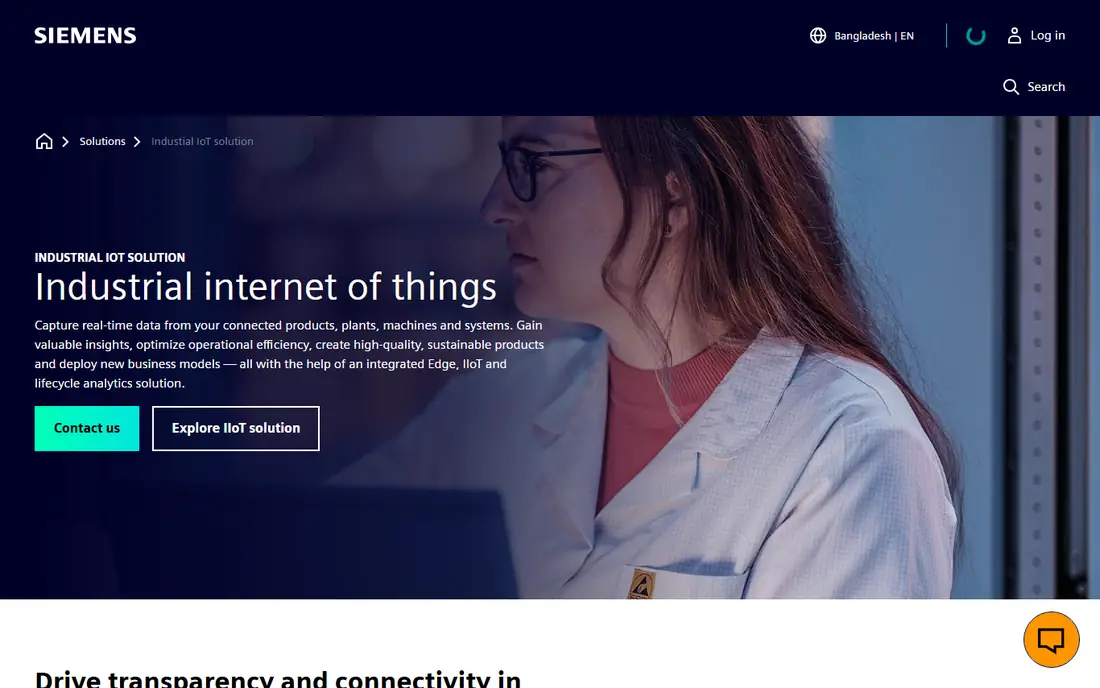
Siemens Insights Hub, formerly MindSphere, is the industrial IoT platform most closely tied to Siemens automation. For a plant already running Siemens controllers and drives, it offers a shorter path to dashboards, predictive maintenance, and digital twins, with native links to Siemens manufacturing tools. Independent 2026 comparisons describe it as the most turnkey option for Siemens-equipped plants, which matches its design.
The drawback is vendor fit. A plant with mixed equipment from many makers may need extra integration work, and a vendor-neutral edge tool may connect faster. Pricing is also by quote, so buyers should scope the plant, the data volume, and the analytics they need before comparing it with AWS or Azure.
- Deep fit with Siemens automation and manufacturing systems
- Digital twin and asset performance tools
- Strong industrial domain knowledge
- Most turnkey for Siemens plants, less so for mixed-vendor sites
- Enterprise pricing by quote
Cisco IoT matters most where connectivity and security are the hard problem, not the dashboard. Its rugged switches, routers, and OT security tools connect factory floors, utilities, and remote sites, while its IoT Operations Dashboard gives visibility into connected devices. For an industrial network that must stay up and stay secure, that foundation is often more important than any single analytics feature.
The limit is application scope. Cisco connects and secures devices, but building a full IoT application usually needs a cloud platform or an application partner on top. Buyers should treat Cisco as the network and security layer, and pair it with AWS, Azure, or Cumulocity for the application layer.
- Rugged industrial networking and OT security strength
- IoT Operations Dashboard for device visibility
- Large enterprise support network
- Networking-led offer, so application building needs other tools
- Enterprise pricing and hardware costs add up
Samsara is the clearest pick for companies whose IoT problem is trucks, equipment, and sites rather than a product they sell. Its platform covers fleet tracking, driver safety, asset monitoring, and industrial sensors, with dashboards built for operations managers rather than developers. Independent 2026 coverage describes it as the pure-play connected operations leader, with strong growth in fleet and industrial monitoring.
The trade-off is scope and cost. Samsara sells hardware plus a subscription, so the total cost includes devices, installation, and monthly fees, and it is not a general platform for building a consumer connected product. Operations teams with fleets, yards, and field assets will get the most value, while product teams should look at Particle or a cloud platform.
- Pure-play connected operations leader with fleet, safety, and industrial monitoring
- Fast-growing platform with AI features
- Clear operations dashboards
- Subscription plus hardware costs
- Best fit is fleet and physical operations, not general device building
Particle suits teams building a connected product, from a sensor device to a smart appliance, without assembling a cloud stack from scratch. Its hardware modules, device cloud, and fleet management tools let a small team prototype, ship, and update devices in the field, and its free developer plan lowers the cost of early work. Documentation and community support also help teams without a large platform engineering group.
The limit is scale and industrial depth. A factory with thousands of legacy machines may need Siemens or AWS SiteWise instead, and cellular data pricing must be modeled as the fleet grows. For a product team shipping its first connected device, though, Particle offers the fastest credible path to market.
- Hardware, cloud, and device management built for product teams
- Free developer plan
- Strong documentation and prototyping speed
- Less suited to very large industrial fleets than AWS or Azure
- Cellular data costs need planning at scale
Losant helps teams that want to build an IoT application without writing a full cloud backend. Its visual workflows connect devices, rules, alerts, and dashboards, which suits operations teams, integrators, and mid-size product companies. Device management, data visualization, and edge agent support cover the common jobs, and the platform is easier to learn than a hyperscaler catalog.
The drawback is ecosystem size. A team that needs deep machine learning, a global marketplace, or a very large partner network may still need AWS or Azure alongside Losant. For a focused application with a clear device set and dashboard need, Losant is a strong and pragmatic pick.
- Low-code workflows for building IoT applications quickly
- Device management and dashboards in one platform
- Good fit for mid-size deployments
- Smaller ecosystem than AWS or Azure
- Enterprise features and pricing need a direct quote
Cumulocity is a serious enterprise IoT platform for device management, data integration, and analytics, and it now carries the former Bosch IoT Suite business after Bosch sold that unit. Its strengths are device onboarding, lifecycle management, and streaming analytics, which matter when a fleet grows past the pilot stage. Industrial and enterprise teams that need a vendor-neutral platform often shortlist it alongside Siemens and AWS.
The honest confusion is branding. Buyers who search for Bosch IoT Suite will find Cumulocity instead, and they should confirm the current product name, support path, and migration terms. Pricing is also by quote, so a pilot with real devices is the right way to judge total cost.
- Strong device lifecycle management and streaming analytics
- AIoT features for operational insights
- History as Bosch IoT Suite successor
- Enterprise pricing by quote
- Brand history can confuse buyers, since Bosch sold its IoT Suite to Cumulocity
Qualcomm matters to IoT at the hardware layer, where its chips power cameras, sensors, gateways, and edge AI devices. Its QCS and Snapdragon IoT lines support on-device AI, connectivity, and 5G, while Qualcomm Aware adds device location and awareness services. For a product team choosing the silicon inside a connected device, Qualcomm is often the starting point.
The limit is scope. Qualcomm does not replace a cloud platform or a device management application, so buyers still need a Particle, AWS, or Azure layer above the hardware. Treat Qualcomm as the edge foundation, and judge it on performance, power, connectivity, and long-term chip availability.
- Leading IoT and 5G chip platforms for edge devices
- Snapdragon and QCS lines for edge AI
- Qualcomm Aware for device awareness services
- Chip and platform supplier, not a full application cloud
- Product teams still need software and cloud partners
Honeywell Forge covers industrial software for asset performance, building operations, and connected industrial work, with AI features added for operations teams. It suits asset-intensive industries such as energy, manufacturing, and aerospace, where uptime and compliance matter more than a consumer-style dashboard. Its industrial domain knowledge is the main reason to shortlist it.
The drawback is fit for general IoT product work. A team building a consumer device will not need Forge, and pricing is enterprise and quote-based. Asset-heavy operators with Honeywell equipment, or with strict compliance needs, should compare it with Siemens Insights Hub and AVEVA before deciding.
- Industrial asset performance and connected solutions for buildings, plants, and aerospace
- AI features for operations
- Strong regulated-industry fit
- Enterprise focus with quote pricing
- Best fit is Honeywell-heavy sites and asset-intensive industries
How we picked these
We compared official product pages, documentation, pricing notes, and independent 2026 platform comparisons for IoT companies that are live in October 2026. We kept companies with a current platform or hardware offer, and we favored a mix of cloud platforms, industrial systems, operations tools, and chip suppliers. We marked pricing as See website where vendors price by usage or custom quote, and we noted the Velotic move for ThingWorx rather than listing the old PTC offer as unchanged.
How to choose the right IoT company
An IoT choice is really three choices at once, covering devices, connectivity, and the application that uses the data.
Start with the job, not the vendor
A factory monitoring machines needs different tooling from a company shipping a smart product or a fleet operator tracking trucks. Write down the device count, the data volume, the latency need, and the dashboards or alerts the operations team will actually use. That short spec will rule out most vendors quickly.
Pilot with real devices and real data
A demo with simulated data hides the hard parts, such as device onboarding, firmware updates, offline behavior, and security patching. Run a pilot with real devices in a real site, and measure onboarding time, data reliability, and support response. Check security controls, including device identity, encryption, and update signing, before the fleet grows.
Model the full cost, including data and operations
Cloud message, storage, and analytics charges, cellular data, hardware, and support all shape the total cost. Ask each vendor for a cost model at your expected device count and message rate, not just a platform fee. A cheap platform fee with high data charges can cost more than a higher platform fee with efficient edge processing.
Frequently asked questions
What is the best IoT company overall?
There is no single best IoT company, since cloud, industrial, and hardware needs differ. AWS IoT and Microsoft Azure IoT lead for cloud platforms, Siemens Insights Hub leads for Siemens factories, and Samsara leads for connected fleet operations. Start with your job, then shortlist two or three vendors in that category.
What is the best IoT development company for a new connected product?
Particle is often the fastest pick for a new connected product, thanks to hardware, cloud, and device management in one offer plus a free developer plan. Losant suits teams that want low-code application building, while AWS IoT and Azure IoT suit teams that already use those clouds. Prototype with a small fleet before committing.
How much does an IoT platform cost?
Most enterprise IoT platforms price by usage, device count, or custom quote, so there is no single monthly figure to compare. Cloud platforms charge for messages, storage, and processing, while operations platforms such as Samsara charge a subscription plus hardware. Ask for a cost model at your real device count and data rate.
Is Google Cloud IoT Core still available?
No, Google Cloud IoT Core was discontinued, so buyers should not shortlist it as a live platform in 2026. Teams on Google Cloud should look at other Google services, or at AWS IoT, Azure IoT, Particle, or Losant for device work. Always confirm a platform is live before building on it, since IoT platforms do change.
What security issues should IoT buyers check?
Check device identity and authentication, encryption in transit and at rest, secure firmware updates, and access controls for dashboards and APIs. Ask how the vendor handles vulnerabilities, how devices are revoked if compromised, and whether data residency options fit your industry. Security failures in IoT affect physical sites, not just data, so this review matters more than a feature checklist.
Sources
- https://aws.amazon.com/iot/
- https://azure.microsoft.com/en-us/solutions/iot/
- https://www.siemens.com/global/en/products/automation/industrial-iot.html
- https://www.cisco.com/site/us/en/solutions/iot/index.html
- https://www.samsara.com
- https://www.particle.io
- https://www.losant.com
- https://www.cumulocity.com
- https://www.qualcomm.com
- https://www.honeywellforge.ai
See where you really rank - block by block
ProMapRanker scans Google Maps across a grid of your service area. Simple monthly plans from $19, white-label on every plan.
Start freeKeep reading
 zoho books alternatives
Best Zoho Books Alternatives in 2026
Compare the best zoho books alternatives for small business accounting, from QuickBooks Online and Xero to FreshBooks, Wave, and Sage in 2026, with pricing.
Read → zluri alternatives
Best Zluri Alternatives in 2026
Compare zluri alternatives for 2026, with SaaS management platforms for app discovery, spend tracking, renewals, and automation for IT, finance and procurement.
Read → zerobounce alternatives
Best ZeroBounce Alternatives in 2026
Best zerobounce alternatives for list hygiene: compare 8 email verification tools for bulk cleaning, real-time checks and catch-all handling in 2026 today.
Read →