 ProMapRanker
Best Data Integration Tools in 2026

Key takeaways
- Fivetran suits teams that want fully managed ELT with minimal maintenance, while Airbyte suits teams that want open source control and custom connectors.
- Pricing models differ sharply, with Fivetran billing by monthly active rows, Airbyte by credits or capacity, and Stitch and Skyvia by row or record tiers.
- Qlik Talend and Informatica fit enterprises that need data quality, governance, and complex transformations, but both are quote based and heavier to run.
- Hevo, Stitch, and Skyvia give smaller teams a faster, no code start, while Matillion fits cloud warehouse teams that transform data inside the warehouse.
Quick comparison
| Pick | Great for | Pricing starts at | Free tier | |
|---|---|---|---|---|
 Fivetran | Fully managed warehouse loading | Free | Yes | Visit |
 Airbyte | Open source pipelines | $20 per month | Yes | Visit |
 Qlik Talend | Enterprise integration and quality | See website | Free trial | Visit |
 Informatica | Enterprise governance and ETL | See website | Free trial | Visit |
 Stitch | Simple SaaS replication | $100 per month | Free trial | Visit |
 Matillion | Warehouse transformation | See website | Free trial | Visit |
 Hevo Data | No code real time pipelines | $239 per month | Free trial | Visit |
 Skyvia | Budget cloud sync | $79 per month | Yes | Visit |
The best data integration tools
We compared connector breadth, pricing units, deployment options, transformation approach, and current pricing for tools live in October 2026.
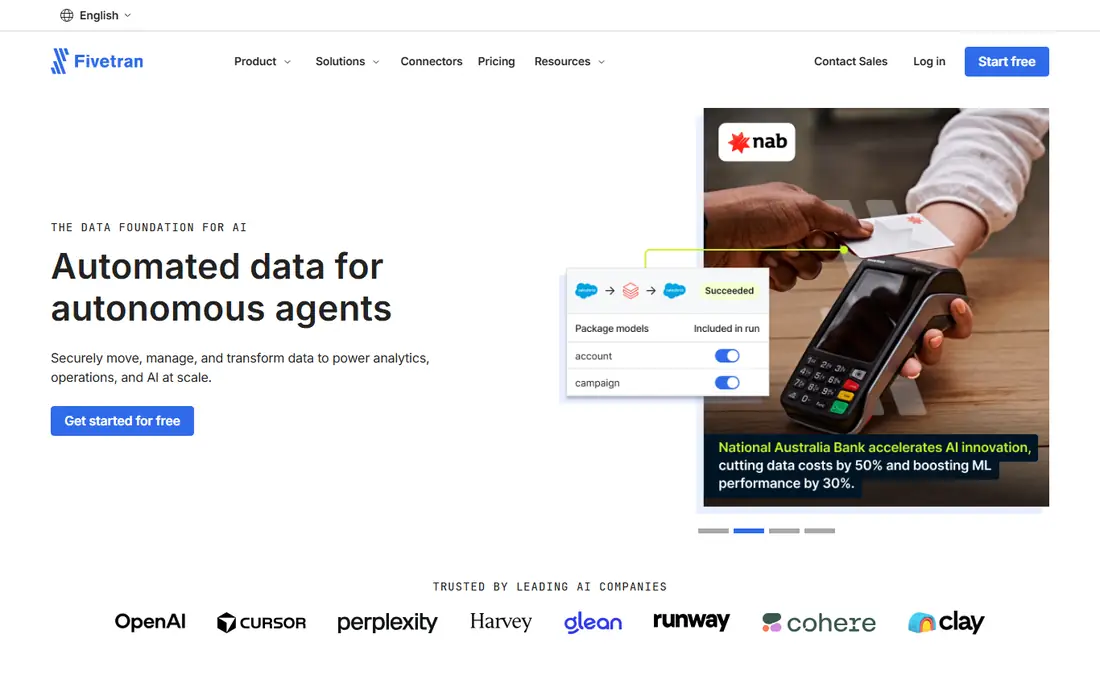
Fivetran is the hands off choice for loading SaaS, database, and file data into a warehouse. Connectors are managed by Fivetran, schema changes are handled automatically, and syncs run on a schedule with monitoring built in. That low maintenance model is why many analytics teams choose it over building pipelines by hand. Pricing is the catch. Fivetran bills on monthly active rows, counted per connection since March 2025, and deletes and history mode changes count toward paid rows since January 2026. A free plan covers up to 500,000 monthly active rows, while paid contracts carry a $12,000 annual minimum and a $5 monthly minimum per standard connection. High churn tables can get expensive, so model a peak month before signing.
- More than 700 fully managed connectors
- Automatic schema handling
- Now bundles dbt after the June 2026 merger
- Bills by monthly active rows per connection
- $12,000 annual contract minimum on paid plans
- Costs scale with data churn
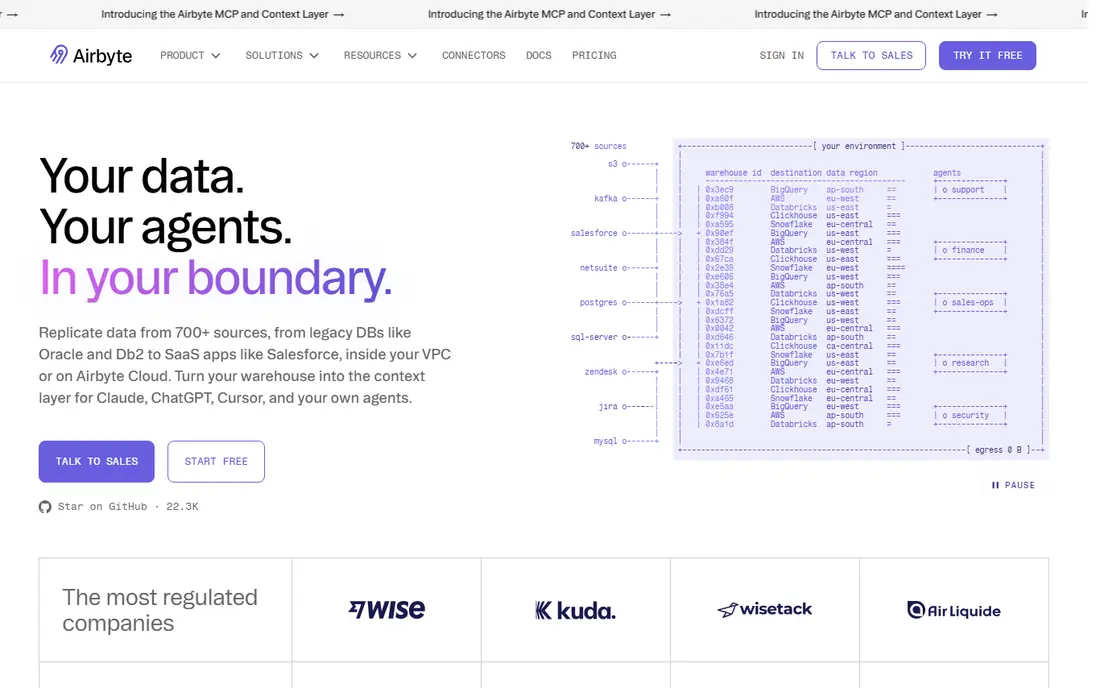
Airbyte gives teams control that Fivetran does not. The core is open source, so you can self host, fix a connector, or build a custom one with the Connector Builder, low code CDK, or Python CDK. Cloud plans remove the operations burden while keeping the same connector library and code base. Cloud pricing starts at $20 per month for Standard and $189 per month for Plus in recent vendor comparisons, with Pro and Enterprise Flex priced on Data Workers, dedicated compute capacity, so row counts do not drive the bill. That capacity model suits high volume or spiky workloads better than row billing. Choose Airbyte if your team can maintain pipelines or wants to avoid vendor lock in on connectors.
- Open source core you can self host
- More than 700 connectors
- No code connector builder with AI help
- Self hosting needs operations time
- Cloud pricing by credits or capacity needs careful sizing
- Transformation is left to dbt or orchestrators
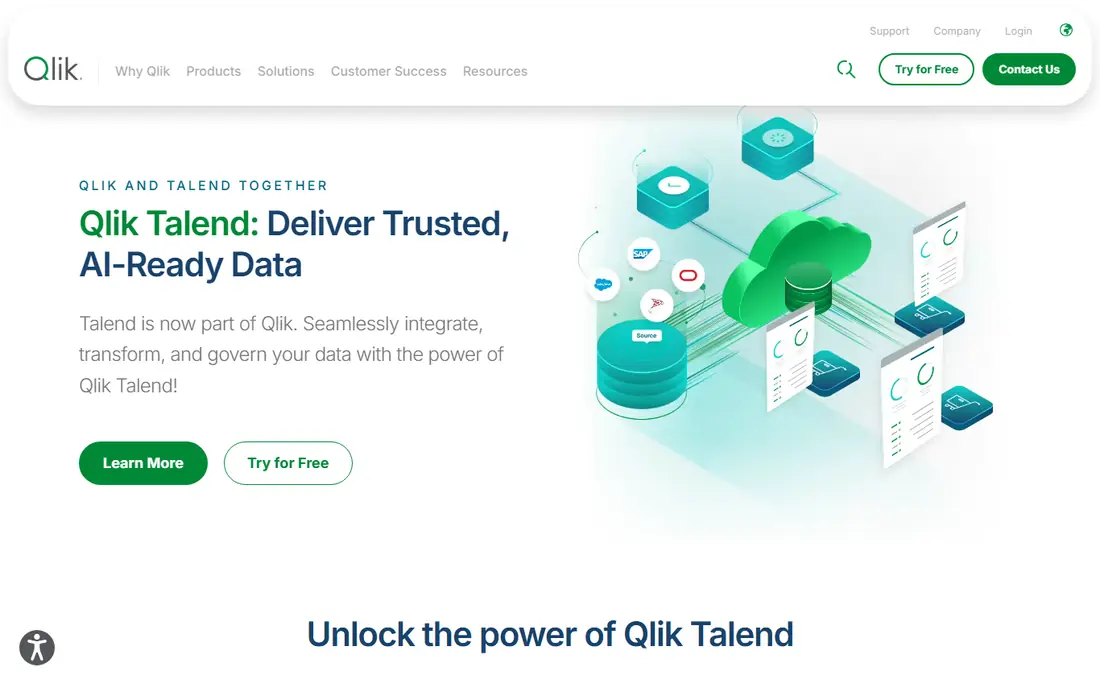
Qlik Talend Cloud combines data integration with data quality and governance, which matters for enterprises that cannot just move dirty data into a warehouse and hope for the best. Visual jobs handle complex transformations, data profiling, and cleansing alongside ingestion, and deployment can be cloud, client managed, or hybrid. Pricing is quote only across four Cloud editions, metered on data moved, job executions, and duration, with third party reports putting Starter around $12,000 to $30,000 per year and larger estates far higher. That makes Talend a poor fit for a small team that only needs SaaS replication. For a regulated enterprise with quality rules, it is a strong, if expensive, platform.
- Broad connector and transformation library
- Built in data quality and governance
- Hybrid and cloud deployment options
- Quote only pricing across editions
- Pipelines are heavier to build than configured connectors
- Larger estates cost well into six figures
Informatica Cloud Data Integration is the enterprise incumbent in this list, built for organisations that treat data integration as part of a wider data management program. Visual mappings support low code and pro code work, governance and lineage track data from source to report, and the platform handles cloud, hybrid, and on premises sources. Pricing is quote based, with a 30 day trial and a free Cloud Data Integration offer in some listings, but production costs depend on IPUs and services used. Implementation needs skilled data engineers and a clear governance plan. Pick Informatica when compliance, lineage, and complex enterprise transformations outweigh the desire for a quick no code setup.
- Deep enterprise ETL and data management
- Strong governance, lineage, and quality features
- Wide system coverage
- Quote based pricing by IPUs and services
- Complex to implement and operate
- Overkill for simple replication
Stitch, now part of Talend, remains a useful simple ELT tool for small and mid sized teams. You pick sources, pick a warehouse destination, and let Stitch replicate data on a schedule, with monitoring and schema handling built in. The appeal is speed: a basic pipeline can be running in an afternoon without a data engineering team. Standard pricing starts at $100 per month for 5 million monthly active rows, one destination, and 10 sources, rising to $1,250 per month for Advanced and $2,500 per month for Premium. That row tier model is easy to understand, but it caps sources and destinations per tier. Choose Stitch when your pipelines are simple, batch based, and well within those limits.
- Simple setup for SaaS replication
- Clear row based tiers
- 14 day free trial
- No free tier beyond the trial
- Limited transformation
- Not suited to real time or very large scale pipelines
Matillion is built for teams whose warehouse is the center of their data work. Pipelines load data and then transform it inside Snowflake, BigQuery, Databricks, or Redshift, using push down processing so the warehouse does the heavy work. Visual jobs, SQL, and Python cover most transformation needs, and dbt integration fits teams already using dbt. Pricing is credit based and not published as a simple list price in recent comparisons, with older listings around $2.00 to $2.70 per credit by tier and typical deployments cited from $1,000 per month upward. A free trial lets you test warehouse performance before committing. Pick Matillion when transformation inside the warehouse matters more than simple replication.
- Visual ELT inside cloud warehouses
- Push down processing
- Dbt integration and Python support
- Credit based pricing is not published as a simple list price
- Transformation heavy design needs warehouse skills
- Not a real time CDC tool
Hevo Data suits mid market teams that want real time pipelines without writing code. Sources are configured visually, transformations can be applied in the pipeline, and data flows to warehouses and destinations with monitoring and error handling. That no code speed helps product and analytics teams that lack a dedicated data engineering group. Pricing is event based, with recent comparisons listing $239 per month for 5 million events and higher tiers for larger volumes, plus a free trial. Older listings cite $279 per month, so confirm the current plan before budgeting. If your data changes constantly and you need near real time freshness, Hevo is stronger than batch only tools such as Stitch.
- No code pipeline setup
- Real time and batch replication
- Broad SaaS and database connectors
- Event based pricing rises with volume
- Entry price is higher than Stitch or Skyvia
- Enterprise features need higher tiers
Skyvia is the budget pick for cloud sync, ETL, ELT, and reverse ETL in one platform. The free tier covers 10,000 records per month, and paid Basic plans start at $79 per month billed annually, or $99 monthly, for 5 million records. All pre built connectors are available even on basic plans, and pricing does not depend on user count or support tier. Sync frequency is the main limit, with hourly sync on Standard and faster sync on Professional and higher tiers. For small teams, agencies, and businesses syncing SaaS data to a warehouse or spreadsheet, that trade off is acceptable. Larger enterprises with strict real time needs should look at Hevo, Fivetran, or Airbyte Pro instead.
- Free tier for small datasets
- Paid plans from $79 per month billed annually
- No code visual pipelines and reverse ETL
- Paid tiers scale by records per month
- Hourly sync on lower tiers
- Less suited to very large enterprise estates
How we picked these
We compared official feature pages, pricing pages, connector catalogs, and public reviews for tools live in October 2026, focusing on products that move data from sources to warehouses or applications, not only dashboards or reverse ETL alone. We weighted connector breadth, pricing unit transparency, deployment options, transformation approach, and monitoring, and we used See website where vendors do not publish a clear list price. Prices in this category change with volume, so model your largest sources at peak before choosing a billing model.
How to choose the right pricing model
Start by measuring how your data behaves, not by counting connectors. High churn tables favour capacity or flat fee models, while small stable sources fit usage based plans with free tiers. Estimate monthly changed rows, events, and data volume for your largest sources, then compare that with each vendor billing unit.
Test with your hardest source first
Pick the source with the messiest schema, the largest table, or the strictest permissions, and run a trial pipeline on it. A tool that handles that source cleanly will handle the easy ones, while a tool that struggles there will cost you time every week.
Decide where transformation lives
Fivetran and Airbyte leave transformation mainly to dbt, Talend and Informatica transform inside their own jobs, and Matillion transforms inside the warehouse. Your team skills should decide this, since a visual tool with no SQL owner and a SQL tool with no warehouse owner both fail in different ways.
Frequently asked questions
What is the best data integration platform for a small team?
Skyvia, Stitch, and Hevo Data are the strongest small team picks, depending on budget and freshness needs. Skyvia is cheapest, Stitch is simplest for batch replication, and Hevo suits teams that need near real time pipelines.
What is the best data integration tool for large enterprises?
Qlik Talend and Informatica lead for enterprises that need data quality, governance, and complex transformations at scale. Fivetran and Airbyte also serve large teams, with Fivetran favouring managed simplicity and Airbyte favouring open control.
What is the best ETL platform for data integration to Snowflake?
Fivetran, Airbyte, and Matillion all work well with Snowflake, with Matillion strongest for transformation inside Snowflake and Fivetran strongest for managed loading. Test sync speed and cost on your largest Snowflake tables before committing.
What is the best data integration software with a free plan?
Airbyte Core is free to self host, Fivetran offers a free plan up to 500,000 monthly active rows, and Skyvia offers a free tier for 10,000 records per month. Free tiers suit trials and small workloads, but production pipelines usually need a paid plan.
How do data integration tools charge?
Tools charge by rows, events, volume, credits, capacity, or flat subscription, depending on vendor. Fivetran uses monthly active rows, Airbyte Cloud uses credits or capacity, Stitch uses row tiers, and Matillion uses credits, so compare total cost at your peak volume.
Is Fivetran or Airbyte better?
Fivetran is better for teams that want fully managed pipelines with minimal maintenance, while Airbyte is better for teams that want open source control, custom connectors, and self hosting. The right choice depends on whether you value convenience or control more.
Sources
See where you really rank - block by block
ProMapRanker scans Google Maps across a grid of your service area. Simple monthly plans from $19, white-label on every plan.
Start freeKeep reading
 zeffy payment processor stripe alternatives
Zeffy and Stripe Alternatives for Nonprofits in 2026
Explore zeffy payment processor stripe alternatives for nonprofits. We compare 8 fundraising platforms on fees, donor tools, and nonprofit focus. Check fees.
Read → workday alternatives
Workday Alternatives in 2026
Workday alternatives compared: we review 8 HR and payroll platforms that replace Workday, with pricing, strengths and honest limits for each team size.
Read → what's the best weather app
What's the Best Weather App in 2026
Wondering what's the best weather app? We compare 10 free and paid apps for forecasts, radar, alerts, and Colorado mountain weather for everyday and storm use.
Read →