 ProMapRanker
Best CRO Companies in 2026

Key takeaways
- The best CRO company depends on your traffic and maturity, since a testing program needs enough sessions to reach sound results.
- Research-led agencies suit teams that need to learn why visitors leave, while landing page specialists suit teams that need fast page wins.
- Ask how the agency prioritizes tests, reports results, and handles losing tests, since those answers reveal more than a headline lift claim.
- Most CRO agencies price by custom monthly retainer, so confirm the scope, the test volume, and the contract length before signing.
Quick comparison
| Pick | Great for | Pricing starts at | Free tier | |
|---|---|---|---|---|
 Invesp | Research-led full-service CRO | See website | No | Visit |
 Conversion Rate Experts | Research-led enterprise programs | See website | No | Visit |
 WiderFunnel | Prioritized testing at scale | See website | No | Visit |
 Speero | Mature experimentation programs | See website | No | Visit |
 Conversion | Enterprise experimentation and pricing | See website | No | Visit |
 The Good | Ecommerce and SaaS experience gains | See website | No | Visit |
 SplitBase | DTC landing pages and offers | See website | No | Visit |
 Cro Metrics | Experiment-led growth across channels | See website | No | Visit |
 Spiralyze | Fast predictive testing for SaaS | See website | No | Visit |
 KlientBoost | CRO paired with paid media | See website | No | Visit |
The best CRO companies
Conversion rate optimization is not a redesign, and it is not a single A/B test. The agencies below run research, testing, and measurement programs, and we compared their official service pages, published case studies, pricing notes, and public reviews.
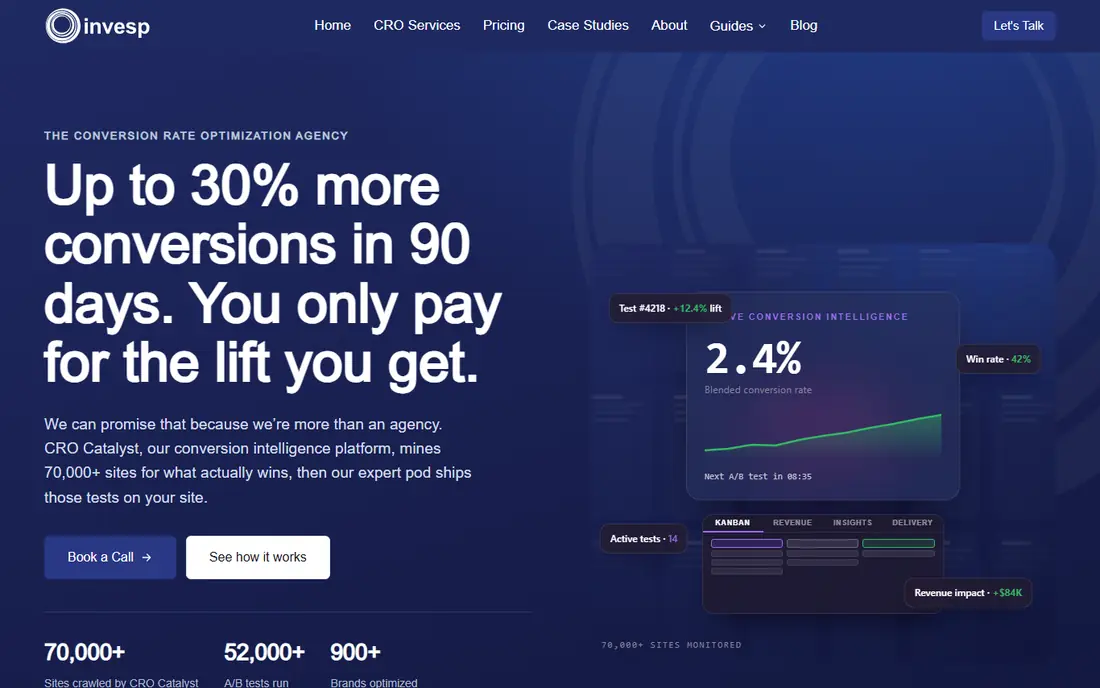
Invesp is a steady first shortlist pick for companies that want a full CRO program rather than a landing page tweak. Its service pages cover conversion audits, customer research, analytics, landing page work, and A/B testing, with reporting through its CRO Catalyst platform. Published case material also names clients across ecommerce and B2B, which helps buyers check relevance to their own market.
The honest limit is pace. A research-led program spends time on interviews, surveys, and journey mapping before it ships many tests, so teams that want a test live this week may feel impatient. For companies with steady traffic and a real need to understand buyers, though, that research is the point, and it often prevents wasted tests.
- Long track record since 2006
- Research, personas, and journey work before testing
- Performance-based and fixed-fee options described on its site
- Research-heavy process can feel slower than a quick-win shop
- Monthly programs suit established sites better than tiny startups
Conversion Rate Experts
Great for: Research-led enterprise programs
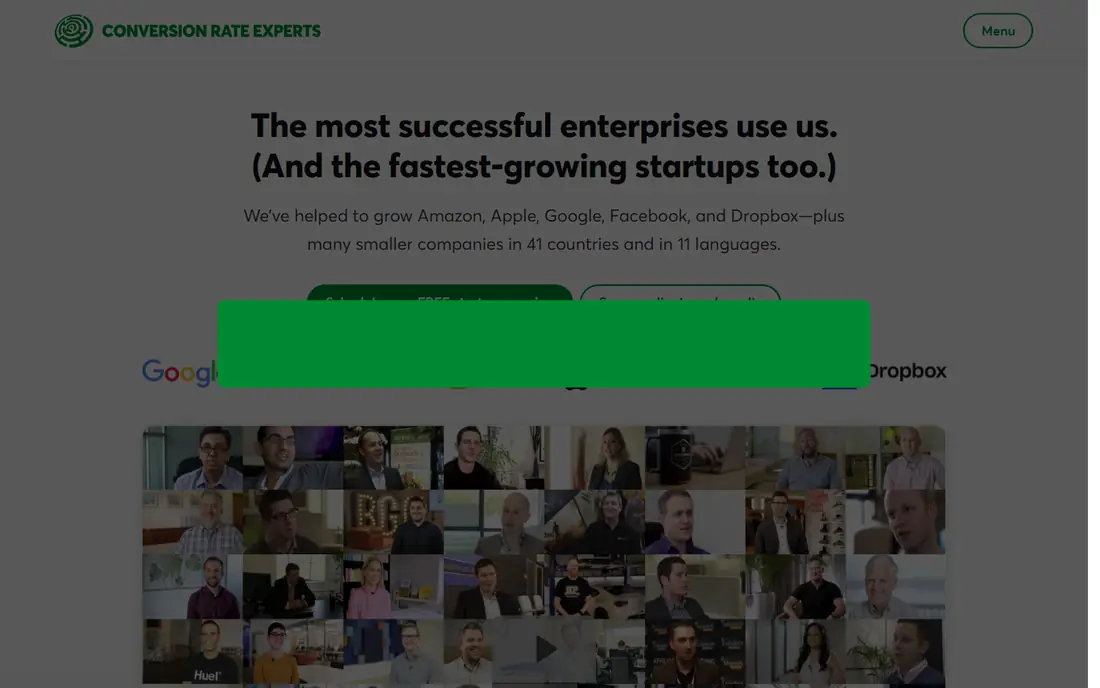
Conversion Rate Experts is known for a methodical, research-first approach to high-value funnels, where a small lift can be worth a large sum. Its offer includes research, journey mapping, design, testing, and training, and it can hand the program to an internal team over time. That training option appeals to companies that want to build skill in-house rather than rent an agency forever.
The trade-off is fit and cost. The agency is geared to enterprise clients with complex funnels, and smaller companies may find the engagement too large. Teams with high average order values or long sales cycles should ask about fit early, while smaller stores may get faster value from a DTC specialist.
- Deep research and usability focus
- Can run the program, train your team, or split the work
- Long history with high-value funnels
- Built for larger budgets and slower-moving organizations
- Not a low-cost option for small stores
WiderFunnel suits companies that already test but need a sharper system for choosing what to test next. Its PIE prioritization framework scores ideas by potential, importance, and ease, which helps teams avoid testing minor button colors while a checkout problem sits untouched. Its case material covers SaaS, ecommerce, and lead generation at scale.
The limit is creative breadth. Teams that also need brand work, copywriting, or a full redesign may need a second partner, since WiderFunnel centers on experimentation. If your main problem is test selection and velocity, though, that focus is an advantage rather than a gap.
- Formal prioritization framework for test ideas
- Strong testing volume for larger sites
- Clear process for experiment design and analysis
- Less emphasis on brand and creative execution than some rivals
- Best fit needs solid traffic levels
Speero, formerly CXL, is the pick for companies that want to build a lasting experimentation capability, not just buy a few tests. Its work covers strategy, research, audits, design, and program consulting, with an emphasis on fixing the data, staffing, and approval problems that slow testing. That program view helps large companies where testing stalls for organizational reasons rather than a lack of ideas.
The drawback is readiness. A company without enough traffic, analytics maturity, or internal buy-in may not get value from a program-design engagement. Smaller teams should ask whether a project audit or sprint fits better, while mature teams will find Speero a strong partner.
- Strong program design for internal experimentation teams
- Research, analytics, and testing implementation
- Enterprise and fintech case work
- Best fit is companies ready to own testing long term
- Published pricing points to a higher monthly commitment
Conversion, sometimes styled Conversion.com, works on the expensive decisions that a simple landing page test cannot settle, such as pricing, packaging, and personalization. Its service pages describe research, testing, and advisory work for large companies, and its published material points to very large client revenue effects over time. For a company weighing a pricing change, that rigor matters more than speed.
The honest limit is scope and cost. This is not a shop for a small store that needs a checkout fix, and the engagement will reflect enterprise pricing. Companies facing a high-stakes product or pricing question, with the traffic to test it, are the right audience.
- Tests major product, pricing, and personalization decisions
- Enterprise-grade research and experimentation
- Advisory as well as full-service options
- Enterprise focus and custom pricing put it out of reach for small companies
- Complex decisions take time to test well
The Good focuses on improving an existing digital experience rather than jumping straight to a redesign. Its process uses research, surveys, journey mapping, design, and development, with testing to validate smaller changes. That approach suits ecommerce and SaaS teams that already have a working product but lose visitors at clear friction points.
The trade-off is breadth. Companies outside ecommerce or SaaS, or those needing paid media and lifecycle work, may need a broader partner. For a store or SaaS site with a known drop-off, though, The Good offers a focused, evidence-led path with a sprint option for a faster start.
- Deep ecommerce and SaaS experience focus
- Research, surveys, and journey mapping before redesign
- Optimization sprints for faster starts
- Narrower scope outside ecommerce and SaaS
- Ongoing work is priced separately from sprints
SplitBase is a strong pick for direct-to-consumer brands that spend heavily to acquire customers and then lose them on the landing page. Its work centers on building and testing pages matched to each ad, audience, and offer, rather than a generic homepage test. That match between ad promise and page content is often where DTC gains hide.
The limit is scope. A company that needs full-site CRO, pricing tests, or product work should confirm whether SplitBase covers that, since its core strength is landing pages and offers. For a DTC brand with paid traffic and a clear landing page problem, it is one of the sharpest fits on this list.
- Landing pages built and tested for specific ads, audiences, and offers
- Strong DTC and subscription experience
- Clear monthly starting point in public comparisons
- Focus on landing pages means site-wide programs need scoping
- Best fit needs meaningful ad spend
Cro Metrics suits brands that want CRO connected to wider marketing, not isolated on one website. Its service pages cover CRO, analytics, design, paid media, and lifecycle marketing, with testing applied across channels. That breadth helps companies where a website lift alone will not move revenue, since email and paid flows also shape conversion.
The drawback is focus. A team that wants a pure, deep website testing program may prefer WiderFunnel or Speero, while Cro Metrics fits teams that want growth experiments across the funnel. Ask how test volume is split across channels, so website work does not get crowded out.
- Testing across websites, paid media, email, and retention
- Mid-market and enterprise experience
- Large experiment history cited on its site
- Broader channel scope can dilute pure CRO focus
- Custom pricing requires a scoping call
Spiralyze promises speed by using results from past tests to choose new ideas, and it offers fees tied to test uplift alongside standard pricing. That model appeals to SaaS and ecommerce teams that want tests launched quickly and want the agency to share the risk. Its service pages cover predictive testing, landing pages, design, and development.
The honest caution is attribution. Performance-linked pricing only works when both sides agree on how lift is measured, what counts as a win, and what happens with losing tests. Buyers should settle those rules in writing, and confirm the baseline period, before the first test goes live.
- Predictive approach that draws on past test results
- Fast test launches for SaaS and ecommerce
- Performance-linked fee options described publicly
- Published pricing points to a high monthly level
- Predictive claims need a clear explanation of how results are attributed
KlientBoost is the practical pick when the problem spans both sides of the click, since it pairs paid media with landing page optimization. A company whose ads drive the wrong traffic, or whose pages waste good traffic, can fix both in one engagement. Its broader agency bench also covers design and development for landing pages.
The limit is depth. Teams that need complex multivariate programs, pricing experiments, or enterprise experimentation governance may find a pure CRO agency stronger. For growth-stage companies that need paid and page work together, though, the bundle is efficient and easier to manage.
- CRO bundled with PPC and landing page work
- Useful when traffic quality and page experience must improve together
- Broad agency bench
- Less depth on complex multivariate testing than pure CRO shops
- Paid media scope can dominate the engagement
How we picked these
We compared official service pages, published case studies, pricing notes, and public reviews for agencies that run CRO as a core service in October 2026. We kept agencies with a visible testing method and published client work, and we favored a mix of research-led, testing-led, DTC, and enterprise firms. We marked pricing as See website where the agency prices by custom retainer, and we avoided repeating headline lift claims as promises, since results depend on traffic, offer, and baseline.
How to choose the right CRO company
The wrong agency choice usually comes from buying speed when you need learning, or buying research when you need a page fix.
Match the agency to your traffic and stage
A site with low traffic cannot run many tests to a sound result, so an audit, a usability review, or a landing page project may beat a monthly testing program. A site with steady traffic and a mature team can support a full program, with prioritization and a test roadmap. Ask each agency what test volume your traffic can support, and how long a test typically runs.
Ask about method before you ask about price
Good questions include how ideas are prioritized, how sample size is set, how results are reported, and what happens when a test loses. Ask to see a sample report, including a losing test, since that shows honesty about measurement. Also confirm who designs, builds, and analyzes tests, and whether development is included in the retainer.
Set the contract around learning, not lifts
No honest agency can promise a fixed lift before an audit, so be wary of guarantees tied to revenue. A better contract sets test volume, reporting cadence, and decision rights, with a short initial term to prove fit. Review the first month on process quality, not just on wins, since a sound program often finds its best tests after early research.
Frequently asked questions
What is the best CRO company for small businesses?
Small businesses often do best with a focused project, such as an audit or a landing page engagement, rather than a large monthly program. The Good and SplitBase suit ecommerce and DTC teams, while KlientBoost suits teams that also need paid media help. If traffic is low, invest in traffic and basic analytics first, since tests need sessions to reach sound results.
What is the best CRO company for enterprise teams?
Enterprise teams usually shortlist Conversion Rate Experts, Speero, WiderFunnel, and Conversion, since those firms handle complex funnels, program design, and high-stakes decisions. The right pick depends on if you need research, test velocity, internal capability building, or pricing experiments. Ask each firm about governance, data handling, and how it works with internal teams.
How much does a CRO company cost?
Most agencies on this list price by custom monthly retainer, and public comparisons point to programs starting around several thousand dollars per month, with enterprise programs higher. Project sprints can cost less for a defined scope, while performance-linked fees vary with the uplift model. Always confirm what is included, especially design, development, and analysis time.
How long does CRO take to show results?
A single test can show a result in weeks if traffic is high, but a meaningful program usually needs 60 to 90 days to move from research to a test roadmap and early wins. Low-traffic sites need longer, since tests take more time to reach a reliable sample. Judge the first month on research quality and test setup, not only on revenue.
Should I hire a CRO company or build an in-house team?
Hiring an agency suits teams that need speed, outside perspective, and a proven method without hiring several specialists. Building in-house suits companies with steady testing volume and a long-term need for experimentation. Many companies start with an agency, then use a firm such as Speero or Conversion Rate Experts to train an internal team over time.
Sources
See where you really rank - block by block
ProMapRanker scans Google Maps across a grid of your service area. Simple monthly plans from $19, white-label on every plan.
Start freeKeep reading
 zoho books alternatives
Best Zoho Books Alternatives in 2026
Compare the best zoho books alternatives for small business accounting, from QuickBooks Online and Xero to FreshBooks, Wave, and Sage in 2026, with pricing.
Read → zluri alternatives
Best Zluri Alternatives in 2026
Compare zluri alternatives for 2026, with SaaS management platforms for app discovery, spend tracking, renewals, and automation for IT, finance and procurement.
Read → zerobounce alternatives
Best ZeroBounce Alternatives in 2026
Best zerobounce alternatives for list hygiene: compare 8 email verification tools for bulk cleaning, real-time checks and catch-all handling in 2026 today.
Read →