 ProMapRanker
Best Cloud Platforms for Customer Data Storage


Multi-cloud warehousing with strong governance · Pricing starts at: $2.00 per credit
Key takeaways
- BigQuery is the cheapest way to start scanning customer data, at $6.25 per TiB with the first TiB free each month.
- Snowflake, Redshift, and Databricks all bill by usage, so your bill follows query volume, not headcount.
- MongoDB Atlas and Neon are the only options here with a permanent free tier for small customer datasets.
- ClickHouse Cloud suits real-time analytics on customer events, with compute from $0.2181 per unit-hour.
- Microsoft Fabric is the forward path for Azure shops, while Synapse remains the hold for existing workloads.
Quick comparison
| Pick | Great for | Pricing starts at | Free tier | |
|---|---|---|---|---|
| Snowflake | Multi-cloud warehousing with strong governance | $2.00 per credit | Free trial (30 days) | Visit |
 Google BigQuery | Serverless SQL analytics on Google Cloud | $6.25 per TiB scanned | Yes | Visit |
 Amazon Redshift | AWS-native warehousing next to S3 | $0.375 per RPU-hour | Free trial (90 days) | Visit |
 Databricks | Lakehouse for analytics plus machine learning | $0.22 per DBU | Yes | Visit |
 ClickHouse Cloud | Real-time analytics on customer events | $0.2181 per compute unit-hour | Free trial (30 days) | Visit |
 MongoDB Atlas | Document storage for customer profiles | Free; Flex from $8 per month | Yes | Visit |
 Azure Synapse Analytics | Azure warehouse, Spark, and pipelines in one place | $5 per TB processed | No | Visit |
 Microsoft Fabric | One capacity for warehouse, lakehouse, and Power BI | $262.80 per month | Free trial (60 days) | Visit |
 Neon | Serverless Postgres for app customer data | Free; Launch usage-based | Yes | Visit |
The best cloud platforms for customer data storage
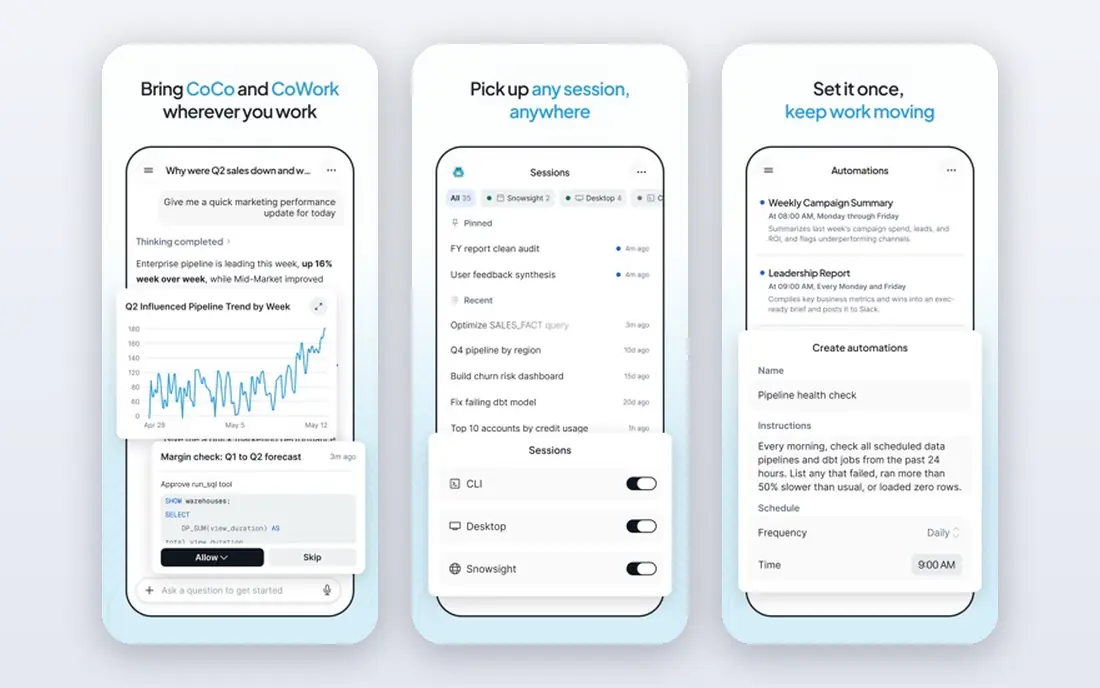
Snowflake is the reference cloud data warehouse for storing customer records at scale. Storage and compute are separate, so you can keep years of customer history in storage while warehouses scale up only when queries run. Virtual warehouses come in sizes from X-Small to 6X-Large, and they bill per second with a 60 second minimum, which keeps short queries cheap. Secure data sharing lets you share customer aggregates with partners without copying data.
The Standard edition lists on-demand credits at $2.00 per credit in AWS US East, with storage billed per TB per month on top. There is no permanent free tier, only a 30 day trial with $400 in credits, so small teams should size their first warehouse carefully. Snowflake fits multi-cloud teams and companies that need strong governance, masking, and sharing, while a team with spiky, low volume queries may find BigQuery cheaper.
- Storage and compute scale separately
- Virtual warehouses bill per second
- Secure data sharing without copying data
- No permanent free tier, only a 30 day trial
- Credit pricing needs careful warehouse sizing
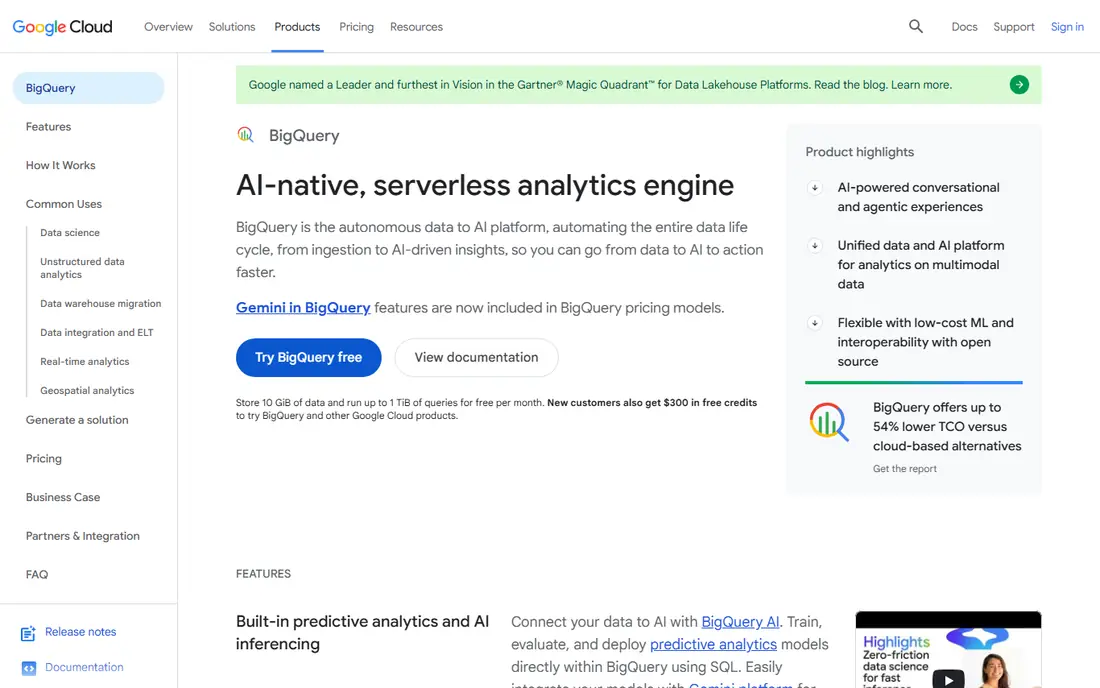
Google BigQuery is a fully serverless warehouse: there are no clusters to size, no servers to patch, and queries run against data in Google Cloud storage. On-demand pricing charges $6.25 per TiB scanned, and the first TiB each month is free, so a small team can run real customer analytics before spending anything. For steady workloads you can buy capacity by the slot-hour from $0.04 on the Standard edition.
The trade off is query discipline. A broad scan across a large customer table costs the same whether it returns 10 rows or 10 million, so partitioning and clustering matter. BigQuery fits teams already on Google Cloud, and teams with seasonal or irregular query volume, since quiet months cost nothing. Teams that need a fixed monthly bill should look at slot commitments or a credit based warehouse instead.
- No clusters to size or manage
- First 1 TiB of queries free each month
- Capacity pricing from $0.04 per slot-hour
- Broad scans cost the same whether they return 10 rows or 10 million
- No fixed monthly bill on demand
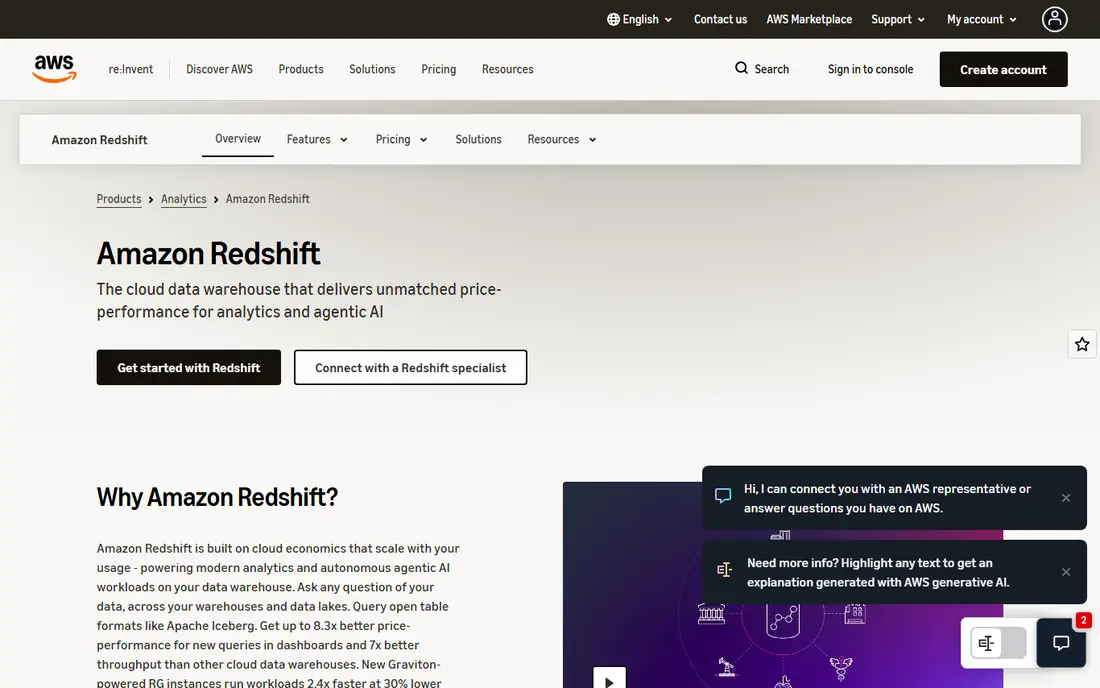
Amazon Redshift is the warehouse for teams that already live in AWS. Serverless mode bills $0.375 per RPU-hour in US East, with a 60 second minimum per activation and no compute billing while idle, while provisioned RA3 nodes suit steady workloads. It reads data from S3, integrates with Glue and Athena, and supports materialized views and stored procedures for customer reporting.
There is no permanent free tier, though new accounts get a $300 serverless credit for 90 days, or 750 hours a month for two months on provisioned nodes. The main cost risk is idle capacity on provisioned clusters, which is why serverless is the better start for most customer data workloads. Redshift fits AWS-native teams that want their warehouse next to their S3 data lake.
- Serverless mode bills only when queries run
- Deep integration with S3, Glue, and Athena
- Materialized views for reporting
- No permanent free tier
- Provisioned clusters can bill for idle capacity
Databricks is a lakehouse, which means customer data stays in open formats in your own cloud storage while SQL warehouses, Spark jobs, and machine learning run on top. Unity Catalog governs access across all of it, so a customer record is protected the same way in a dashboard and in a training job. SQL Classic lists at $0.22 per DBU, Pro at $0.55, and serverless SQL at $0.70 per DBU with compute included.
The free edition covers non-commercial use with no expiry, and new accounts get $400 in trial credits for 14 days. The strength is breadth: the same platform that stores customer data also builds the churn model and serves the dashboard. The weakness is complexity, since a team that only needs SQL reports may find a simpler warehouse faster to run. Databricks fits teams that combine analytics with machine learning.
- Data stays in open formats in your own storage
- Unity Catalog governs every workload
- SQL, Spark, and ML in one platform
- More complex than a pure SQL warehouse
- Serverless SQL at $0.70 per DBU costs more than Classic
ClickHouse Cloud is a managed columnar database built for real-time analytics on event data, which makes it a strong store for customer clickstreams, sessions, and product usage. Compute starts at $0.2181 per unit-hour on the Basic tier, and storage costs $25.30 per compressed TB per month, with compute scaling to zero when idle. The open source engine is free to self-host, so the cloud price is only for the managed service.
There is no permanent free tier, only a 30 day trial with $300 in credits. The Basic tier cannot scale, so a growing workload needs the Scale tier, which starts much higher. ClickHouse fits teams that need fast aggregations over billions of customer events and are happy with SQL. Teams that need heavy transactional writes or a full lakehouse should look at Databricks or Snowflake instead.
- Fast aggregations over billions of events
- Compute scales to zero when idle
- Open source engine is free to self-host
- No permanent free tier
- Basic tier cannot scale, so growth needs the much higher Scale tier
MongoDB Atlas is the managed cloud database for customer data that does not fit neat tables: profiles, preferences, order history, and support threads in one document. The free M0 tier gives 512 MB of storage forever, Flex clusters start at $8 a month with usage capped at $30, and dedicated M10 clusters start at $0.08 an hour, listed as $56.94 a month. Clusters run on AWS, Azure, or Google Cloud.
Atlas fits product teams that store customer records as documents and need global distribution, search, and vector features in the same database. The limits are that analytics over large customer datasets need Atlas SQL or an export to a warehouse, since document queries are not a replacement for columnar SQL. For operational customer data with flexible fields, Atlas is the most direct fit in this list.
- Free M0 tier with 512 MB forever
- Flex clusters cap at $30 a month
- Documents fit profiles, orders, and support threads
- Analytics over large datasets need Atlas SQL or a warehouse export
- Document queries are not columnar SQL
Azure Synapse Analytics
Great for: Azure warehouse, Spark, and pipelines in one place
Azure Synapse Analytics is Microsoft's workspace for warehouse, Spark, and pipelines in one place. Serverless SQL pools bill $5 per TB processed, with a 10 MB minimum per query, so exploring Parquet or Delta files in a lake costs nothing when idle. Dedicated SQL pools start at DW100c, $1.51 an hour in US East, and can pause when nobody is querying. It fits teams that already run Azure and Power BI.
Microsoft now tells new warehouse buyers to start with Fabric, and Synapse is the hold for existing workloads. There is no permanent free tier, though a new Azure account includes $200 in credit for 30 days. Synapse fits enterprises with a large Azure footprint and existing Synapse workspaces. New buyers should compare Fabric F2, which costs about the same as a business-hours DW100c, before choosing Synapse.
- Serverless SQL costs nothing when idle
- Dedicated pools can pause
- One workspace for SQL, Spark, and pipelines
- Microsoft now steers new buyers to Fabric
- No permanent free tier
Microsoft Fabric is a single capacity that covers warehouse, lakehouse, pipelines, and Power BI in one service. You rent capacity units, and the smallest F2 costs $262.80 a month pay as you go in the US, or $156.33 a month on a one year reservation. OneLake storage is billed separately at $0.023 per GB per month. Every workload draws from the same pool, so a report refresh and a warehouse query share one bill.
The trade off is that capacity is always on, so a quiet month costs the same as a busy one, unlike the serverless tools here. Below F64, every Power BI viewer also needs a Pro license, which adds $14 per user a month. Fabric fits Microsoft shops that want one platform for data and reporting, and teams that already pay for Power BI. Small teams with spiky workloads should price BigQuery or Neon first.
- One capacity covers warehouse, pipelines, and Power BI
- F2 is $262.80 a month pay as you go
- Reservations cut the price by about 40 percent
- Capacity is always on, so quiet months cost the same
- Viewers below F64 also need a Power BI Pro license
Neon is serverless Postgres with instant branching, which makes it a practical store for customer data in web and SaaS apps. Compute scales to zero after 5 idle minutes and wakes in milliseconds, so a side project with a small customer table costs almost nothing while it sleeps. The free plan includes 100 CU-hours and 0.5 GB of storage per project, and Launch bills $0.106 per CU-hour with storage at $0.35 per GB-month.
Launch has no monthly minimum, and typical spend for a small app is around $15 a month. Branching is the standout feature: every pull request can get its own copy of the customer database for testing, which is hard to do with a warehouse. Neon fits developers who want Postgres for customer records and are building an app, not a BI warehouse. Teams that need heavy analytics should pair it with a warehouse rather than query it directly.
- Compute scales to zero after 5 idle minutes
- Instant branching for testing
- Free plan covers 100 CU-hours per project
- Usage-based bills need monitoring
- Heavy analytics belong in a warehouse, not in Postgres
How we chose
We compared vendor pricing pages and documentation in November 2026, and we checked each list price against the vendor's own published rates where we could. We favoured platforms that store customer data in the cloud with clear usage pricing, a free tier or trial, and SQL or document access. We did not claim hands-on testing. Prices are list prices in USD for the default region shown on each pricing page, and they change by region, edition, and commitment, so confirm the live price before you budget.
What to check before you buy
Check how you will be billed before you commit: per credit, per TiB, per RPU-hour, per DBU, and per CU-hour all behave differently as volume grows. Check storage pricing separately, since compute and storage are billed on different meters on every platform here. Check whether your data must stay in one cloud or move between clouds, since only Snowflake, Databricks, and Atlas run natively on all three. Check retention and export rules, so you can move customer data out without a surprise fee.
| Monthly data volume | First pick | What you spend | Watch out | | Under 1 GB | Neon Free | $0 | Analytics need a warehouse | | 1 to 100 GB, spiky queries | BigQuery on demand | $6.25 per TiB scanned | Broad scans cost more | | 100 GB to 1 TB, steady BI | Databricks SQL Classic | $0.22 per DBU | Complexity for SQL-only teams | | 1 TB or more, multi-cloud | Snowflake Standard | $2.00 per credit | No permanent free tier | | Microsoft shop | Fabric F2 | $262.80 a month | Always-on capacity |
Frequently asked questions
What is the cheapest cloud platform for customer data storage?
For analytics, BigQuery is cheapest to start: the first TiB of queries each month is free, then $6.25 per TiB scanned. For app data, Neon and MongoDB Atlas both offer a permanent free tier, with Neon giving 100 CU-hours per project and Atlas giving 512 MB on the M0 tier. The cheapest option depends on whether you run reports or store live customer records, and on how much data you scan each month.
Is Snowflake or BigQuery better for customer data?
It depends on your cloud and your query pattern. Snowflake fits multi-cloud teams and companies that need governance, masking, and data sharing, at $2.00 per credit on Standard. BigQuery fits Google Cloud teams and spiky workloads, since it charges $6.25 per TiB scanned and nothing in quiet months. If your team already runs one cloud, pick the warehouse that lives there.
Do I need a data warehouse or a database for customer data?
You need both for different jobs. A database like Neon or MongoDB Atlas stores live customer records that your app reads and writes every day. A warehouse like Snowflake or BigQuery stores history for reports, segments, and analysis. Small teams can start with one database and add a warehouse when reporting slows the app down or when analysts need history the app does not keep.
How much does it cost to store 1 TB of customer data?
Storage is the smaller part of the bill. Snowflake lists storage at $23 per TB per month in AWS US East, ClickHouse Cloud lists $25.30 per compressed TB, and BigQuery storage is about $20 per TB per month. Compute is where the money goes: a busy warehouse can cost hundreds of dollars a month in credits or slot-hours while storage stays near $25. Model compute first, then add storage.
Can I start for free?
Yes, on several platforms here. Neon and MongoDB Atlas offer permanent free tiers, BigQuery gives 1 TiB of queries and 10 GB of storage free each month, and Databricks offers a free edition for non-commercial use. Snowflake, Redshift, and ClickHouse Cloud offer trials with credits instead: $400 for 30 days, $300 for 90 days, and $300 for 30 days. Fabric offers a 60 day trial.
Sources
- https://www.snowflake.com/pricing/
- https://cloud.google.com/bigquery/pricing
- https://aws.amazon.com/redshift/pricing/
- https://www.databricks.com/pricing
- https://clickhouse.com/pricing
- https://www.mongodb.com/pricing
- https://azure.microsoft.com/en-us/pricing/details/synapse-analytics/
- https://azure.microsoft.com/en-us/pricing/details/microsoft-fabric/
- https://neon.com/pricing
See where you really rank - block by block
ProMapRanker scans Google Maps across a grid of your service area. Simple monthly plans from $19, white-label on every plan.
Start freeKeep reading
 best CRM software for salons
Best CRM Software for Salons Compared
Compare the best CRM software for salons with client records, booking, marketing and loyalty in one place. See prices, trials and the right fit for your team.
Read → best CRM software for roofers
Best CRM Software for Roofers
best CRM software for roofers compared on price, pipelines, estimates, and insurance workflows, so a roofing company can pick the system that fits its crews.
Read → best CRM software for med spas
Best CRM Software for Med Spas in 2026
Compare the best CRM software for med spas, with real prices and lead tracking features, so you can pick a CRM that turns more inquiries into booked treatments.
Read →