 ProMapRanker
Best B2B Platform for Huge Databases


Enterprise cloud data warehousing · Pricing starts at: $2 per credit (usage based)
Key takeaways
- Most platforms here bill by usage, not by seat, so the monthly total depends on data scanned, credits burned or hours run.
- BigQuery is the cheapest way to start: the first 1 TiB of queries is free each month, then $6.25 per TiB scanned.
- Snowflake and Databricks are the enterprise defaults, with Snowflake credits from $2 and Databricks DBUs from $0.15.
- ClickHouse Cloud and SingleStore suit teams that want fast analytics on one engine, with storage from about $23 to $25 per TB a month.
- MongoDB Atlas and CockroachDB add a real free tier for document and distributed SQL workloads, with Atlas Flex from $8 a month.
Quick comparison
| Pick | Great for | Pricing starts at | Free tier | |
|---|---|---|---|---|
| Snowflake | Enterprise cloud data warehousing | $2 per credit (usage based) | Free trial ($400 in credits) | Visit |
 Databricks | Lakehouse analytics and AI workloads | $0.15 per DBU (usage based) | Free trial (14 days) | Visit |
 Google BigQuery | Serverless analytics on Google Cloud | $6.25 per TiB scanned | Yes | Visit |
 Amazon Redshift | Analytics inside AWS | $0.375 per RPU-hour (usage based) | Free trial ($300 credit) | Visit |
 ClickHouse Cloud | Fast OLAP queries at low cost | $0.2181 per compute unit-hour (usage based) | Free trial (30 days, $300 credits) | Visit |
 SingleStore | Transactions and analytics in one engine | $0.99 per hour (usage based) | Yes | Visit |
 MongoDB Atlas | Document data at huge scale | $8 per month (Flex) | Yes | Visit |
 CockroachDB | Distributed SQL across regions | $0.092 per vCPU-hour (usage based) | Yes | Visit |
The best B2B platforms for huge databases
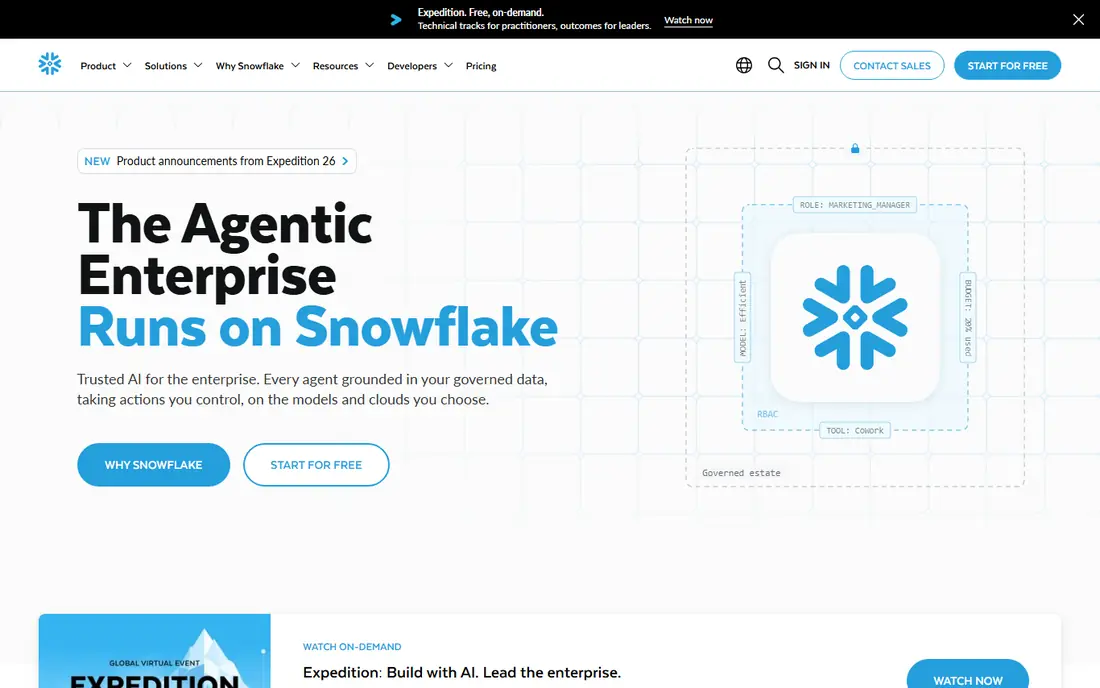
Snowflake is the default cloud data warehouse for large B2B teams, and its design explains why. Compute and storage scale separately, so you can run a large warehouse for a heavy query and shut it down after, while the data sits in cheap storage. It runs on AWS, Azure and Google Cloud, and it now covers streaming, AI features and data sharing on the same platform. For a team with terabytes of sales, product and finance data, that separation is the main reason to pick it.
On demand in AWS US East, a Platform Credit costs $2.00 on Standard, $3.00 on Enterprise and $4.00 on Business Critical, and storage runs about $40 per TB a month on demand. New accounts get a trial with $400 in credits. The hard part is forecasting: the bill depends on warehouse size and run time, so a query that scans wide can cost more than expected. Set resource monitors and auto-suspend on every warehouse before you load production data.
- Separate compute and storage scaling
- Runs on AWS, Azure and Google Cloud
- Credit pricing is hard to forecast
- Storage bills on top of compute
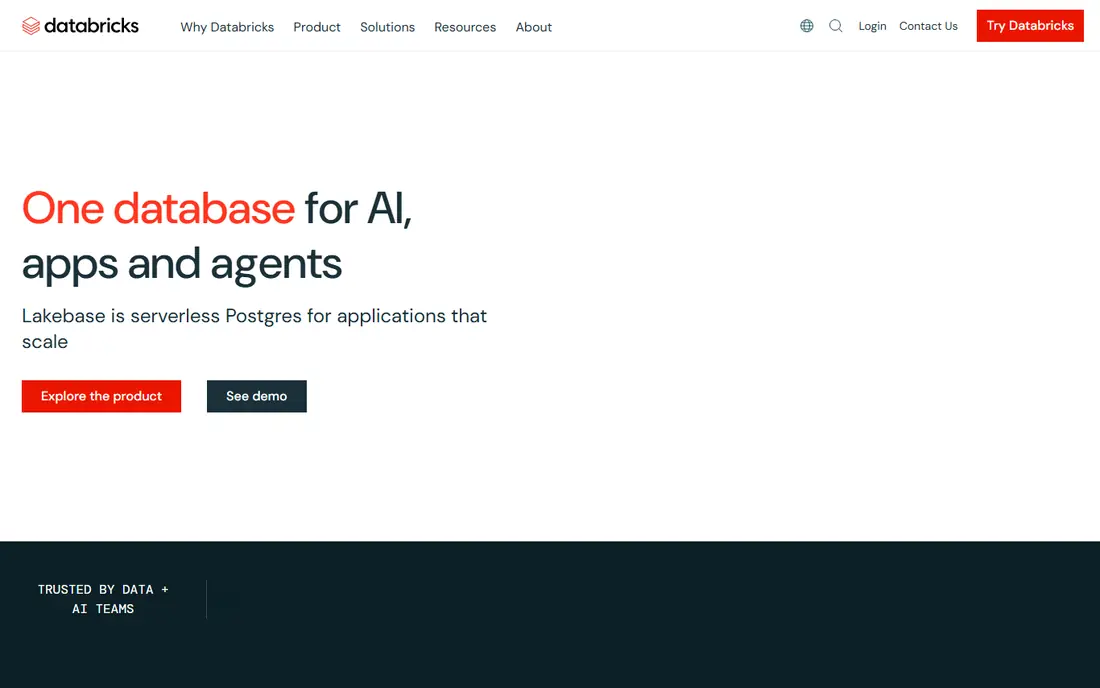
Databricks built the lakehouse idea: one platform where data engineering, SQL analytics and machine learning share the same data in open formats. Teams that train models and run dashboards on the same tables get the most from it, and the notebook experience is the best in this list for data scientists. Delta Lake adds transactions and versioning to cloud storage, so the lake behaves like a warehouse for most queries.
Pricing is per DBU, and the rate depends on the compute type. On AWS Premium in US East, classic jobs compute lists at $0.15 per DBU, SQL Classic at $0.22, all-purpose compute at $0.55 and serverless SQL at $0.70 per DBU, with the cloud machines included only on serverless. The Standard tier no longer exists, so every workspace is Premium or Enterprise. A 14-day free trial lets you test the platform. Watch the split bill on classic compute, where your cloud provider charges for the machines on a separate invoice.
- One lakehouse for SQL, streaming and machine learning
- Strong notebook experience
- Two bills, Databricks plus your cloud provider, on classic compute
- Pricing varies by compute type
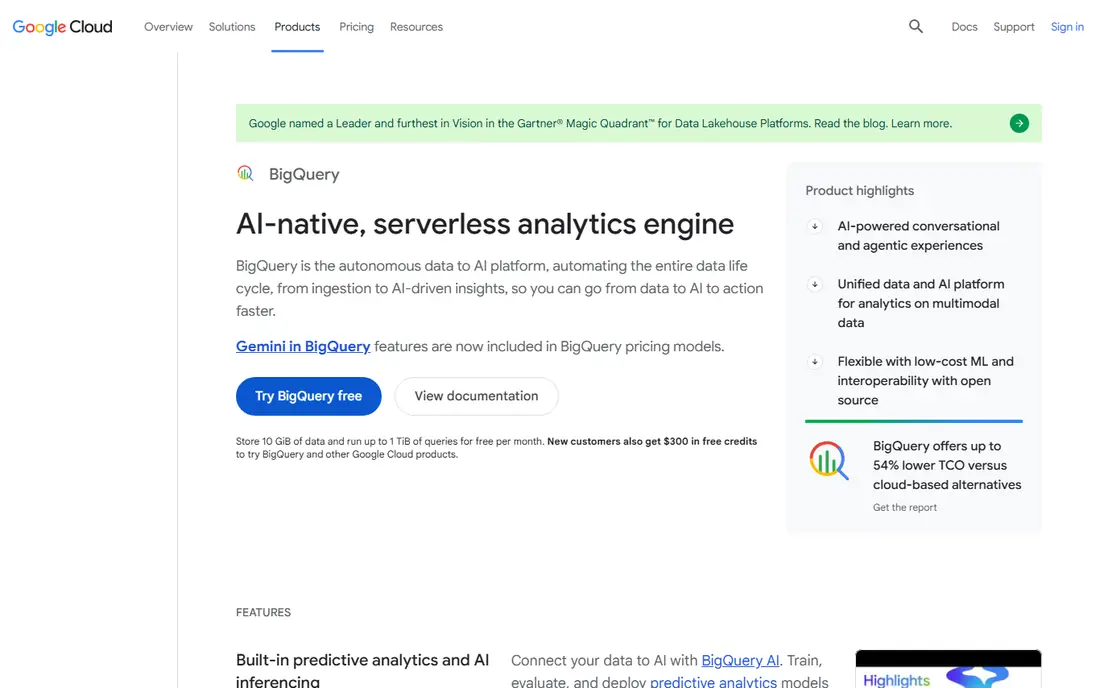
BigQuery is the simplest way to query a huge database if your data already lives on Google Cloud. There are no servers to size or manage: you send a SQL query, Google runs it across thousands of slots, and you pay for the data scanned. It handles petabyte-scale tables, connects to Looker Studio and Sheets, and adds machine learning and AI functions inside SQL, so analysts can build models without moving data out.
On-demand pricing is $6.25 per TiB scanned in the US, with the first 1 TiB per month free, and active storage costs about $0.020 per GB a month with the first 10 GB free. Capacity editions bill per slot-hour from $0.04 on Standard, which suits steady workloads. The risk is a single unfiltered query over a wide table, which can burn the whole free tier in one run. Use partitioned tables, preview query costs before you run, and set cost controls on every project.
- No servers to manage
- First 1 TiB of queries free each month
- A careless query can scan terabytes and cost real money
- Editions need slot commitments
Redshift is the natural analytics choice for a team that already stores data in AWS. It loads tables into managed storage, runs columnar queries fast, and connects to S3, Athena, Glue and QuickSight without moving data far. You can run it as a provisioned cluster or as Redshift Serverless, which bills only while queries run and charges nothing while idle. For dashboards and nightly reporting on AWS data, it is the lowest-friction option here.
Serverless bills at $0.375 per RPU-hour in US East, with a 4 RPU minimum that works out to about $1.50 an hour while active. Provisioned RA3 nodes start at $0.543 an hour for ra3.large, and managed storage costs $0.024 per GB a month. New accounts get a $300 credit with a 90-day expiry. The catch is the provisioned side: a cluster bills for every hour it runs, so pausing it when idle is the main cost control. Serverless removes that job, but heavy dashboard use can still add up.
- Deep integration with S3, Athena and the AWS stack
- Serverless option with no idle charge
- Provisioned clusters bill while they run, even when idle
- RA3 pricing is hard to compare
ClickHouse is an open source columnar database built for analytical queries, and its cloud service wraps it in managed hosting. It scans billions of rows in seconds, which makes it a strong pick for event data, logs and product analytics where dashboards aggregate huge tables all day. The open source core runs under Apache 2.0, so a team can self-host the same engine and skip the cloud bill entirely if it has the staff to run it.
ClickHouse Cloud bills compute and storage separately. Basic compute runs $0.2181 per unit-hour in AWS US East, storage costs $25.30 per compressed TB a month, and a small always-on Basic service works out to about $66 a month in the vendor worked example. There is no permanent free tier, only a 30-day trial with $300 in credits. Basic is a single replica that cannot scale, so a team that needs high availability must move to Scale, where example bills start near $499 a month.
- Very fast aggregations on huge tables
- Open source core you can self-host
- No permanent free tier
- Single-replica Basic tier cannot scale
SingleStore is a distributed SQL database that handles transactions and analytics in the same engine, so a B2B app can serve live traffic and run reports on the same tables. It stores rows for fast writes and columns for fast scans, which removes the nightly copy from an operational database to a warehouse. That shape suits SaaS products, real-time dashboards and multi-tenant apps where the same data feeds the product and the reports.
Helios cloud pricing is usage based. The smallest Standard workspace, S-00 with 2 vCPU and 16 GB of memory, costs $0.99 an hour in US East, and compute credits list at $3.96 each. Storage costs $0.023 per GB a month in Tier 1 regions. A free Shared tier covers evaluation and development. The main work is forecasting: credits per hour change with workspace size, region and edition, so run the vendor pricing examples with your own workload before you commit to a size.
- One engine for row and columnar workloads
- Free Shared tier to start
- Credit pricing needs a calculator to forecast
- Smaller community than the big clouds
MongoDB Atlas is the managed cloud for MongoDB, and its pricing ladder is the clearest in this list. The M0 free tier gives 512 MB on a shared cluster, genuinely free, which is enough for development and small projects. Flex, the serverless option, runs about $8 to $30 a month, and dedicated M10 clusters start at about $57 a month with 2 GB of RAM and 10 GB of storage. Atlas adds search, vector search, charts and global clusters on the same platform.
The free tier has hard limits that matter at scale: shared tiers throttle at about 100 operations a second, and the 512 MB storage cap blocks writes once it fills. Dedicated clusters remove the throttle, but the cluster price is the floor, not the bill: data transfer, extra storage and backup retention add up, and there is no spend cap on dedicated tiers. For document data that grows fast, Atlas is easy to start and easy to outgrow, so size the cluster for the workload you expect in six months, not the one you have today.
- Free M0 tier with 512 MB
- Clear ladder from Flex to dedicated clusters
- Shared tiers throttle at 100 operations a second
- Backup and transfer add to the bill
CockroachDB is a distributed SQL database that keeps running when a whole region fails, which is why global B2B products pick it for customer data that must stay up. It speaks Postgres wire protocol, so most Postgres tools and drivers work with it, and it spreads data across regions with strong consistency. For a SaaS product with users on several continents, that combination of familiar SQL and built-in survival is hard to match.
Pricing changed in September 2026 to a vCPU-hour model. Standard lists at $0.092 per vCPU-hour in AWS US East, and the vendor example puts a 2 vCPU cluster with 100 GB at about $203 a month. Mission Critical lists at $0.162 per vCPU-hour for the highest availability SLA. The Basic tier is free with 50 million request units and 10 GiB of storage a month, and new users get $400 in trial credits. The shift from the old request-unit serverless model means older pricing guides no longer apply, so read the current pricing page before you budget.
- Postgres-compatible SQL with multi-region survival
- Free Basic tier with 50M request units
- New vCPU-hour pricing replaced the old serverless model in September 2026
- Enterprise features cost more
Storage cost per terabyte, per month
| Platform | Storage price per TB a month | Notes |
|---|---|---|
| Snowflake | About $40 on demand | $23 per TB on a capacity contract; compute billed separately in credits |
| Google BigQuery | About $20 active, $10 long-term | First 10 GB free each month; queries billed per TiB scanned |
| ClickHouse Cloud | $25.30 per compressed TB | Same rate on every tier; compute billed separately per unit-hour |
| SingleStore | About $23 in Tier 1 regions | $0.023 per GB a month; compute billed separately in credits |
| Amazon Redshift | About $24 managed storage | $0.024 per GB a month; serverless compute at $0.375 per RPU-hour |
| Databricks | Billed by your cloud provider | Tables sit in your own cloud storage, not on the Databricks bill |
| MongoDB Atlas | Bundled in the cluster price | M10 at about $57 a month includes 10 GB; extra storage adds cost |
| CockroachDB | Bundled in the vCPU-hour rate | Vendor example: about $203 a month for 2 vCPU and 100 GB |
How we chose
We compared vendor pricing pages, product documentation and plan limits, and we printed the month we checked each price. Prices in this guide come from vendor pricing pages and service consumption tables read in October and November 2026. Because every platform here bills by usage, we printed the unit price and the storage rate instead of a single monthly figure, and we noted where the vendor hides the price behind a quote. We weighed the compute unit, the storage rate, the free tier, multi-cloud support and scaling limits. No tool was credited with hands-on testing, and no benchmark or performance figure beyond a published vendor claim was invented for this guide.
What to check before you buy
- Region: Snowflake credits cost $2.00 in US East and up to $3.25 elsewhere, and Databricks rates shift by cloud and region, so price the region you will actually use.
- Compute versus storage: Snowflake, ClickHouse and SingleStore bill the two separately, so a cheap storage rate can hide an expensive compute bill.
- Free tier caps: BigQuery gives 1 TiB of queries a month, MongoDB Atlas M0 caps at 512 MB, and CockroachDB Basic caps at 50 million request units, so check the cap against your real workload.
- Egress: moving huge data out of a cloud costs money on every platform here, so keep analytics close to where the data already lives.
- Minimums: Redshift Serverless has a 4 RPU minimum, and ClickHouse Basic cannot scale past one replica, so read the minimums before you size a cluster.
- Commitments: capacity contracts and reserved nodes cut the unit price by 15 to 30 percent, but only if your usage is steady enough to commit.
Frequently asked questions
What counts as a huge database for a B2B platform?
A huge database usually means tens of terabytes or more, or billions of rows that analysts query every day. At that size, a single server struggles, backups take hours, and a bad query can slow the whole product. The platforms in this guide split storage from compute, run queries across many machines at once, and let you scale each side separately, which is what makes them different from a small database on one server.
Which platform is cheapest for a huge database?
It depends on how you query. BigQuery is cheapest for occasional queries, because the first 1 TiB a month is free and then it costs $6.25 per TiB scanned. ClickHouse Cloud is cheapest for constant dashboards, with storage at $25.30 per TB a month and compute from $0.2181 per unit-hour. Snowflake and Databricks cost more per unit, but they suit teams that need governance, sharing and AI features on top of raw storage.
Is Snowflake or Databricks better for huge databases?
Snowflake suits teams that want a managed warehouse with strong governance, data sharing and simple SQL access, and it includes the machines in the credit price. Databricks suits teams that mix SQL analytics with data engineering and machine learning on the same data, and its lakehouse keeps data in open formats. If your team mostly writes SQL and shares data, pick Snowflake. If it builds models and pipelines too, pick Databricks.
Can I start free with a huge database platform?
Yes, on several of them. BigQuery gives 1 TiB of queries and 10 GB of storage free each month. MongoDB Atlas has a free M0 cluster with 512 MB, and CockroachDB Basic gives 50 million request units and 10 GiB free each month. Snowflake, Databricks, Redshift and ClickHouse Cloud offer trial credits instead of a permanent free tier, with $300 to $400 in credits and 14 to 90 days to use them.
How do I estimate the monthly cost?
Start with three numbers: how much data you store, how much compute you run, and how much data you move. Multiply stored terabytes by the storage rate in the table above, then add the compute unit price times your expected hours or credits. Run the vendor pricing calculator with a real week of queries, because a single unfiltered scan can cost more than a month of storage, and that is where most estimates go wrong.
Sources
See where you really rank - block by block
ProMapRanker scans Google Maps across a grid of your service area. Simple monthly plans from $19, white-label on every plan.
Start freeKeep reading
 best chimney sweep software
Best Chimney Sweep Software: 8 Tools Compared
Compare the best chimney sweep software for scheduling, quotes and invoicing. See starting prices, free trials and the right pick for your crew size now.
Read → best childcare management software
Best Childcare Management Software
Compare the best childcare management software for centres and preschools, with billing, attendance, parent messaging, and learning tools in one clear guide.
Read → best channel manager software for hotels
Best Channel Manager Software for Hotels
Compare the best channel manager software for hotels in 2026, with real prices, channel counts and PMS links, so you can stop double bookings and sell rooms.
Read →