 ProMapRanker
8 Best API Documentation Tools Compared


Design-first API teams · Pricing starts at: $44 per month (billed annually)
Key takeaways
- Stoplight at $44 a month and Bump.sh at $50 a month are the cheapest hosted starting points for small API teams.
- Mintlify Pro at $450 a month and ReadMe Pro at $250 a month cost more, and both charge extra for their full AI assistant features.
- Docusaurus costs nothing for the software itself, and it suits teams that can host and maintain a static site.
- Postman is the best fit when docs, testing and collections must live in one workspace.
- Redocly moved to flat plans in 2026, with Pro at $249 a month and unlimited seats and pages.
Quick comparison
| Pick | Great for | Pricing starts at | Free tier | |
|---|---|---|---|---|
| Stoplight | Design-first API teams | $44 per month (billed annually) | Yes | Visit |
 SwaggerHub | Teams standardizing on OpenAPI | $90 per month (billed annually) | Yes | Visit |
 Postman | API testing plus docs in one workspace | $9 per month (billed annually) | Yes | Visit |
 ReadMe | Developer hubs with usage metrics | $250 per month (billed annually) | Yes | Visit |
 Mintlify | Modern SaaS docs with AI help | $450 per month (billed annually) | Yes | Visit |
 Redocly | OpenAPI-first docs as code | $249 per month (billed annually) | No | Visit |
 Bump.sh | Spec change tracking and changelogs | $50 per month | No | Visit |
 Docusaurus | Free self-hosted docs sites | $0 per month | Yes | Visit |
The best API documentation tools
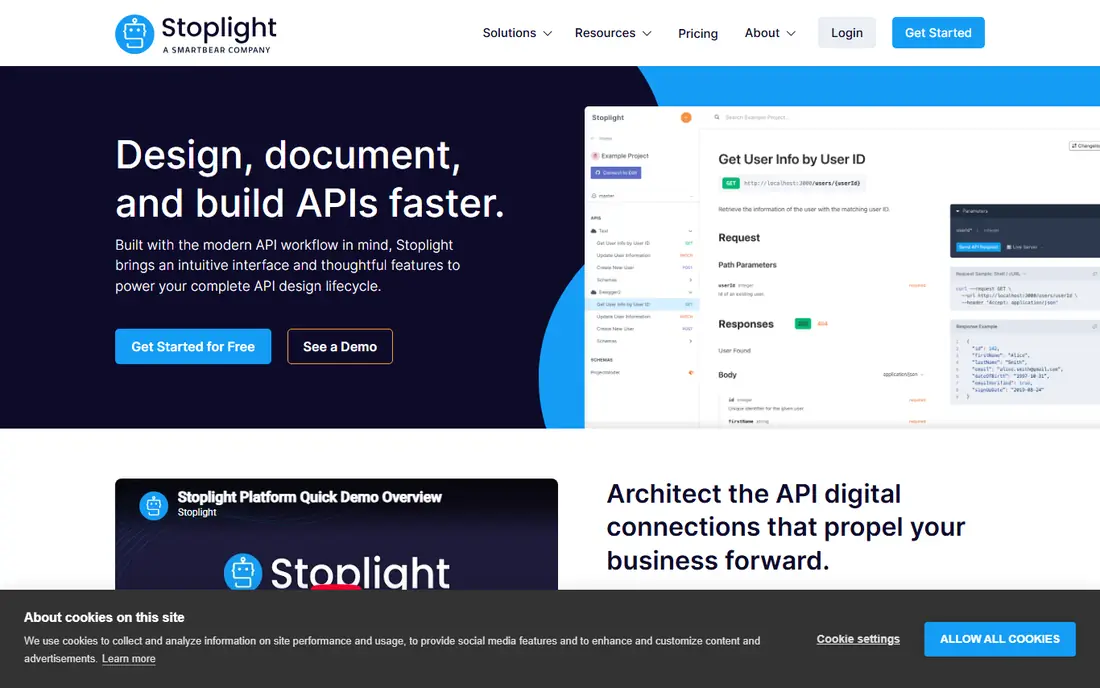
Stoplight is built around designing the API contract before code starts. The visual editor lets a designer shape endpoints, schemas and examples without hand-editing YAML, and Spectral rules check naming, versioning and structure as the spec changes. A team can share one style guide across projects, so new APIs start from the same rules instead of drifting apart over time.
The Basic plan costs $44 a month on annual billing and includes the first 3 users free, with a free plan for 1 user and 1 project. Mock servers let front-end developers work against a contract that does not exist yet, and the hosted docs render the same spec readers will use. SmartBear owns Stoplight, and the hosted platform is still sold and supported. The main trade-off is that the desktop editor is dormant, so teams that liked working offline must use the browser version.
- Visual OpenAPI editor with Spectral linting
- Mock servers and docs in one place
- The desktop Studio editor is dormant, so new work happens in the browser
- Plan user limits push larger teams to higher tiers
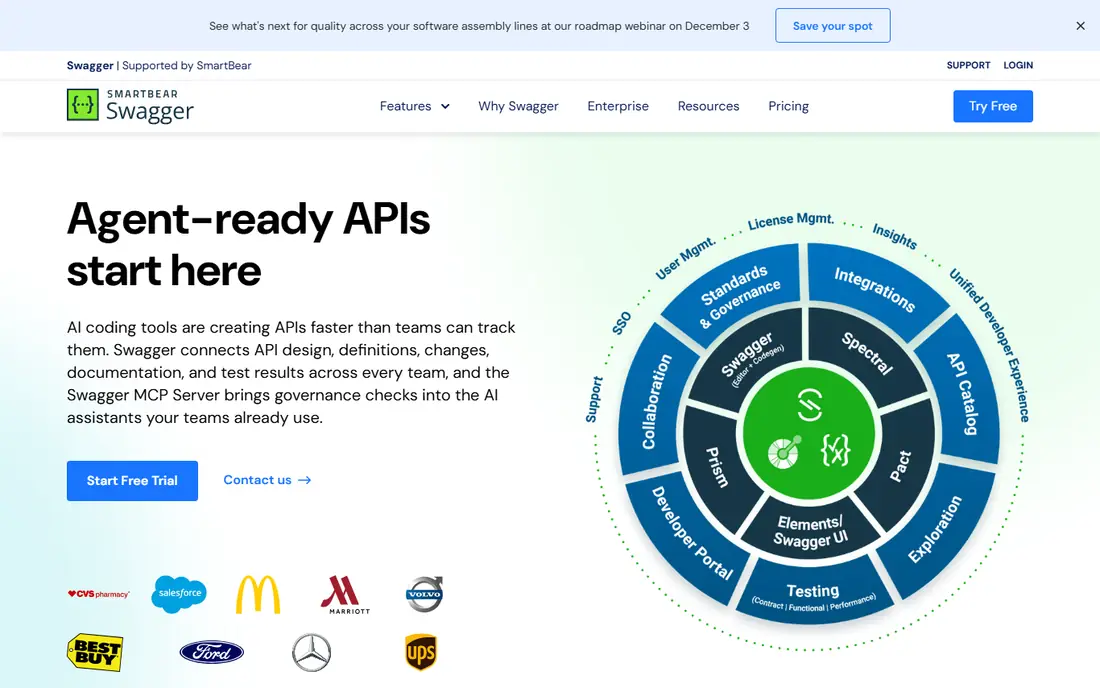
SwaggerHub is the hosted home of the Swagger toolset, and it remains the reference point for OpenAPI design. The editor validates a spec as you type, flags errors early, and keeps the design, documentation and code generation in one place. Teams can push a finished design to source control, deploy it to an API management platform, or trigger a build in Jenkins from the same workspace.
The Team plan costs $90 a month on annual billing for 3 users, and a free plan covers 1 user with basic design and documentation for up to 3 public APIs. Enterprise is custom priced. SwaggerHub suits organizations that already standardize on OpenAPI and want a stable, well-known editor rather than a new design language. The cost grows in steps as the team grows, since each plan band adds a fixed number of seats.
- Mature OpenAPI editor with strong validation
- Deep integrations with source control and CI
- The Team plan covers only 3 users at the entry price
- The interface feels dated next to newer docs tools
Postman starts as an API client and grows into a full platform, which is why so many teams already have it open when they need docs. Documentation generates directly from collections, so the examples readers see are the same requests developers run every day. The public API network also gives a team a ready-made audience, since developers can discover and try an API without leaving Postman.
Pricing changed in March 2026. The Free plan costs $0 for one user, Solo is $9 a month on annual billing for one user, and Team is $19 per user a month on annual billing. Enterprise is quoted by sales. The Solo plan adds custom-branded docs and custom domains, which the free plan lacks. Postman fits teams that test, mock and document in the same place, but a team that only needs docs may find the platform heavier than a dedicated docs tool.
- Huge collection library and public API network
- Docs generate straight from collections
- The free plan is limited to one user
- Docs branding and custom domains need a higher plan
ReadMe turns API docs into a developer hub with guides, reference material and usage data in one place. The interactive reference lets readers try endpoints from the page, and the metrics show which developers made which calls, so a team can see whether docs actually lead to API use. Git sync keeps the docs close to the code, and the review workflow with branches lets writers approve changes before they go live.
The Starter plan is free and includes a custom domain, the interactive API reference, Git sync and usage metrics. Pro costs $250 a month on annual billing for up to five admins, with $20 a month for each extra admin, and Enterprise is custom priced with annual billing only. The full Ask AI assistant is a $150 a month add-on on every plan. ReadMe suits public API programs that care about adoption numbers, not just page views.
- Interactive API reference with a try-it console
- Metrics tie docs use to real API calls
- Pro covers one project and five admins
- The full Ask AI assistant costs $150 per month extra
Mintlify has become the default choice for modern SaaS teams that want docs to look good with little setup. Writers work in MDX files in a Git repository, and the hosted site renders them with search, an API playground and a custom domain. The AI agent can draft descriptions, answer reader questions and open pull requests that update docs when code changes, which cuts the manual work of keeping reference pages current.
The Starter plan is free for up to five editor seats with no AI credits. Pro costs $450 a month on annual billing, or $540 month to month, with unlimited editor seats and 10,000 AI credits a month, and overage costs $0.01 per credit. An assistant answer costs 25 credits, so Pro covers about 400 reader questions a month. Enterprise is custom priced. Mintlify fits teams that want AI help and a polished site, and that can live with metered AI use.
- Clean default design with Git sync
- AI agent writes and updates docs
- AI credits are metered at 10,000 per month on Pro
- SSO and personalization need Enterprise
Redocly is built for teams that treat the OpenAPI file as a first-class engineering artifact. The open-source CLI supports linting, validation, bundling, transformation and local preview, so a spec can pass through CI checks before it ever reaches readers. The hosted platform, Realm, combines the Redoc renderer, a developer portal and an internal API catalog, authored through the Reunite editor with Git-based content.
Redocly replaced its per-seat pricing with flat plans. Pro costs $249 a month on annual billing with three projects, API reference, Markdown and React pages, a mock server, a custom domain, protected docs, the reader assistant and an MCP server. Scale is $729 a month on annual billing with ten projects, and Enterprise is a custom annual contract. There is no free plan, and a 30-day trial gives full access with no credit card required. Redocly suits engineering-led teams that already live in Git and CI.
- Strong CLI for linting and bundling specs
- Flat plans include unlimited seats and pages
- No free hosted plan, only a 30-day trial
- AI assistant pricing after beta is still unpublished
Bump.sh is the most focused tool on this list. It publishes OpenAPI and AsyncAPI documents as hosted docs and hubs, compares each release of a spec with the last one, and detects breaking changes on every plan. The automatic changelog on Pro writes up what changed between versions, so readers and integrators can see the impact of an update without reading a raw diff.
Basic costs $50 a month for ten API docs with a custom domain, and Pro costs $120 a month and adds the API Explorer, branches, rollback and branding removal. Open-source projects can apply for free Pro access. There is no free plan for commercial use, and the 14-day trial runs on Pro. Bump.sh fits teams that publish several APIs and need readers to trust that version changes are tracked, not just posted.
- Automatic diff and changelog on every deploy
- Supports OpenAPI, AsyncAPI and Arazzo
- No free plan, only a 14-day Pro trial
- The API Explorer needs the Pro plan
Docusaurus is a static site generator built by Meta for documentation websites, and it costs nothing for the software itself. It turns Markdown and MDX files into a fast site with built-in search, versioning, internationalization and a blog, and it deploys to free hosting tiers such as GitHub Pages, Netlify or Vercel. The framework is MIT licensed with no usage limits, no feature gates and no enterprise tier.
The trade-off is engineering time. Initial setup takes 8 to 40 hours, and ongoing maintenance takes 2 to 10 hours a month, including upgrades, plugin updates and theme work. API reference pages need a community plugin such as the OpenAPI docs plugin from Palo Alto Networks, since Docusaurus does not ship a native API reference. Docusaurus fits open-source projects and teams with React skills that want full control and zero license cost.
- Free MIT-licensed framework with versioning
- Large plugin ecosystem and search
- No hosted option, you arrange hosting
- API reference needs a community plugin
Which tool fits your team size and budget
| Team size and budget | Best pick | Monthly cost | Why | | Solo developer, $0 budget | Docusaurus or Postman Free | $0 | Free software or a free single-user plan covers the basics | | Small team of 3, under $60 a month | Stoplight Basic or Bump.sh Basic | $44 to $50 | Both cover a small team with hosted docs and a custom domain | | Team of 5, under $100 a month | SwaggerHub Team | $90 | Three seats plus room to add, with mature OpenAPI tooling | | Team of 5, $200 to $300 a month | ReadMe Pro or Redocly Pro | $249 to $250 | Collaboration, private docs and review workflows included | | Team of any size, AI docs wanted | Mintlify Pro | $450 | Unlimited editor seats with 10,000 AI credits a month | | Team that tests and documents together | Postman Team | $19 per user | Collections, testing and docs share one workspace |
How we chose
We compared vendor pricing pages, product documentation and plan pages for each tool in November 2026. Every price in this guide comes from the vendor pricing page listed in Sources, or from a published summary that cites that page with a check date. We compared starting prices on the same billing basis, free plan limits, OpenAPI support, hosting model, Git sync, try-it consoles, AI features and the limits that push a team to a higher tier. We did not run hands-on tests, and we did not count review scores or user counts, since those change often and say little about fit. Prices change often in this category, so confirm the live pricing page before you buy.
What to check before you buy
Check how the vendor counts users, because the same headline price can cover 1 user on one tool and 5 on another. Read the free plan limits, since some free plans allow only one project or one version. Ask whether custom domains, private docs and SSO sit on the plan you are buying or on a higher tier. Confirm how AI features are metered, since Mintlify charges per credit and ReadMe charges a flat add-on. Test the try-it console with your own spec, because some tools need extra setup for authentication. Check export options, so you can leave with your content if the vendor changes pricing. Finally, confirm the renewal price, since several tools in this category repriced more than once in 2026.
Frequently asked questions
Which API documentation tool is best for a small team?
Stoplight Basic at $44 a month is the best starting point for a small design-led team, since it includes 3 users, Spectral linting and mock servers. Bump.sh Basic at $50 a month is close behind for teams that only need hosted reference docs and change tracking. Both have free plans or trials, so a small team can test the editor before committing.
Is there a free API documentation tool?
Yes. Docusaurus is free and open source under the MIT license, with no usage limits, and it runs on free hosting tiers such as GitHub Pages. Postman, ReadMe, Mintlify, Stoplight and SwaggerHub all have free plans too, though most limit the free plan to one user or one project. The free plans suit solo developers and small public APIs.
Do these tools support OpenAPI?
Yes, all eight tools in this guide work with OpenAPI specs. Stoplight, SwaggerHub, Redocly and Bump.sh are built around OpenAPI as the source of truth. Postman imports and exports OpenAPI through collections. ReadMe and Mintlify render OpenAPI references, and Docusaurus does it through a community plugin. Check that your spec version is supported before you commit.
How much should API documentation cost per month?
A solo developer can start at $0 with Docusaurus or a free plan. A small team of three to five people should expect $44 to $120 a month for a hosted tool with a custom domain. A team that wants collaboration, private docs and AI help should budget $250 to $450 a month. Enterprise features such as SSO, audit logs and data residency sit on custom quotes.
What is the difference between ReadMe and Mintlify?
ReadMe focuses on the developer hub, with metrics that tie docs use to real API calls and a review workflow with branches. Mintlify focuses on AI-assisted docs, with an agent that writes and updates pages and an assistant that answers reader questions. ReadMe Pro is $250 a month for five admins, while Mintlify Pro is $450 a month with unlimited editor seats and metered AI credits.
Sources
See where you really rank - block by block
ProMapRanker scans Google Maps across a grid of your service area. Simple monthly plans from $19, white-label on every plan.
Start freeKeep reading
 best chimney sweep software
Best Chimney Sweep Software: 8 Tools Compared
Compare the best chimney sweep software for scheduling, quotes and invoicing. See starting prices, free trials and the right pick for your crew size now.
Read → best childcare management software
Best Childcare Management Software
Compare the best childcare management software for centres and preschools, with billing, attendance, parent messaging, and learning tools in one clear guide.
Read → best channel manager software for hotels
Best Channel Manager Software for Hotels
Compare the best channel manager software for hotels in 2026, with real prices, channel counts and PMS links, so you can stop double bookings and sell rooms.
Read →