 ProMapRanker
Best AI Software for Responding to RFPs and RFQs in 2026

Key takeaways
- Responsive and Loopio lead for large, structured response teams, while smaller tools suit tighter budgets.
- AutoRFP.ai and 1up price in a way that suits teams with many occasional contributors.
- A content library matters more than drafting speed, since outdated answers create risk in every bid.
- Most enterprise tools in this category use quote-based pricing, so budget for a sales conversation.
- Proposal tools such as PandaDoc and Better Proposals fit best when the RFP is short and the output is a signed proposal.
Quick comparison
| Pick | Great for | Pricing starts at | Free tier | |
|---|---|---|---|---|
 Responsive | Large, complex response programs | See website | No | Visit |
 Loopio | Teams that need a governed library | $20,000 per year | No | Visit |
 AutoRFP.ai | AI drafting without per-seat pricing | $899 per month | Free trial | Visit |
 1up | Sales teams answering inside Slack | $250 per month | Yes | Visit |
 Conveyor | Security questionnaires and trust centres | See website | Free trial | Visit |
 Qvidian | Regulated enterprises | See website | No | Visit |
 PandaDoc | Proposals with built-in e-signatures | $19 per user per month | Yes | Visit |
 Proposify | Branded proposals for agencies and sales teams | See website | Free trial | Visit |
 Better Proposals | Freelancers and small teams on a budget | $13 per user per month | Free trial | Visit |
The best AI software for responding to RFPs and RFQs
We compared official feature pages, pricing pages, and public documentation for tools that handle requests for proposals, requests for quotations, and related questionnaires. The list mixes full response platforms with proposal tools, because the right fit depends on how complex your bids are.
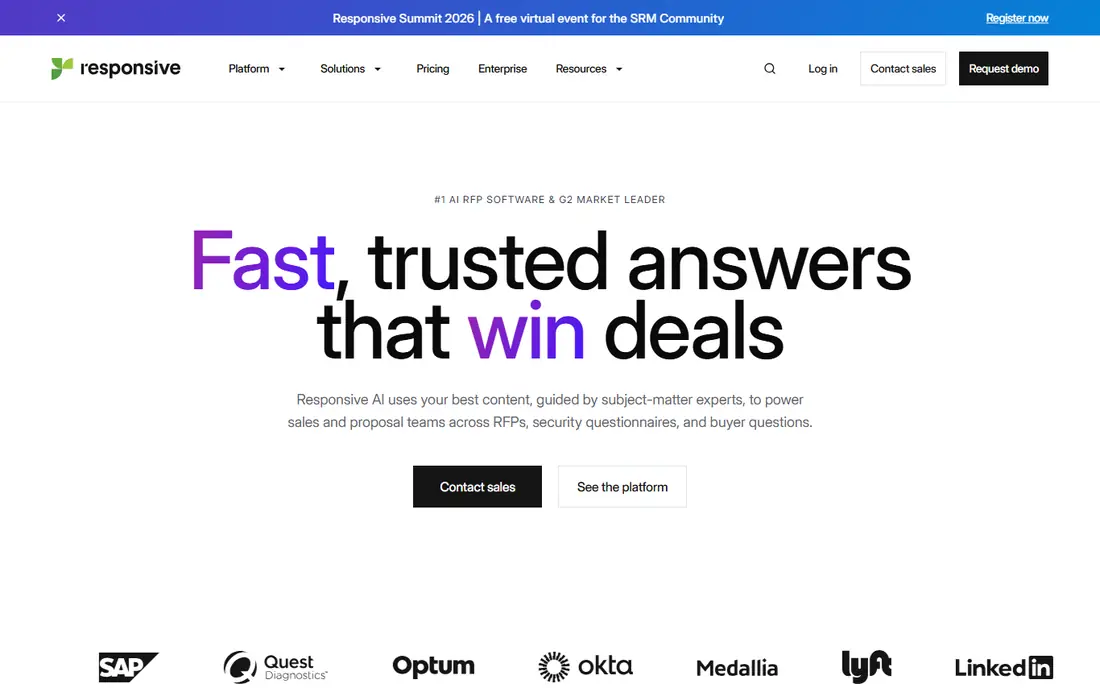
Responsive, formerly RFPIO, handles RFPs, RFQs, RFIs, security questionnaires, and due diligence questionnaires in one system. Its strength is program control. Intake, assignments, deadlines, approvals, and reporting sit alongside the content library, so a manager can see where each bid stands without chasing spreadsheets.
That depth comes with cost and setup time. Small teams may find the workflow heavier than they need, and pricing requires a sales conversation. Choose Responsive when several departments answer bids together and consistency across responses matters more than a low entry price.
- Broad request support
- Strong project controls
- Large content library
- Quote-based pricing
- More structure than small teams need

Loopio is built around its Library, a central store of approved answers that teams reuse across projects. Owners review entries, track history, and retire outdated claims. That governance is the point. A fast AI draft is only useful if the source answer is still true, and Loopio makes that check part of the workflow.
The entry package is aimed at teams, not solo users, and the published starting point is high. It also needs upkeep. If no one owns the library, duplicates and stale answers build up. Pick Loopio when your team already answers similar questions often and wants one approved source.
- Clear library ownership
- Review workflows
- AI-assisted first drafts
- High entry price
- Library needs regular upkeep
AutoRFP.ai generates draft answers from your approved content and past responses, then scores how closely each draft matches its source. That trust score helps reviewers focus on weak answers instead of re-reading every line. The pricing model also stands out, since it does not charge per seat in the same way many rivals do.
The monthly floor is still high for a very small team, and the brand has less history than the established platforms. It fits teams that want AI drafting speed, with a clear check on source quality, and that pull in many contributors who would otherwise each need a seat.
- Source-grounded drafts
- Trust scoring
- No per-seat fee model
- Higher monthly floor for small teams
- Newer brand than Loopio or Responsive
1up answers questions inside Slack, using your knowledge base, so sales staff do not need to leave their main chat tool to find an approved answer. That placement is its main advantage. Many RFP questions arrive as quick messages from a deal team, not as a formal bid document, and 1up handles that flow well.
It is not a full replacement for a bid platform. Complex RFP projects with sections, reviewers, and deadlines still need a tool like Responsive or Loopio. Use 1up when speed of answering matters most, and pair it with a formal tool for large bids.
- Works where sales already talks
- Fast question answering
- Lower entry price
- Less full bid project management
- Best as a companion tool
Conveyor focuses on the security and compliance questionnaires that slow down enterprise deals. Its trust centre lets customers find security documents themselves, which can cut repeat questions. That focus makes it a strong specialist, even if it is not the best general RFP writer.
If your main pain is RFP narrative and pricing tables, a broader platform fits better. If security reviews are the bottleneck, Conveyor addresses that exact step. Many teams use it alongside a main response tool.
- Strong security questionnaire focus
- Trust centre sharing
- Document controls
- Narrower for general RFP writing
- Pricing needs a sales call
Qvidian is aimed at larger, regulated organisations that need tight control over proposal content. Its automation and content management suit banks, healthcare firms, and other teams where a wrong claim carries real risk. The workflow supports structured content, approvals, and reuse across many bids.
That control brings complexity and a sales-led price. Smaller teams will find faster, cheaper options elsewhere. Choose Qvidian when compliance and audit trails matter as much as speed.
- Proposal automation depth
- Controls for regulated teams
- Content management
- Quote-based pricing
- Setup effort for smaller teams
PandaDoc fits the other end of this list. It is a proposal and document tool, not a dedicated RFP library platform. Templates, pricing tables, approvals, and e-signatures make it easy to send a polished proposal and get it signed. That matters when an RFQ response is really a quote plus terms.
For a 100-question RFP with many contributors, PandaDoc will feel thin. Use it when your responses are short, sales-led, and end in a signature, and keep a library tool for complex bids.
- Templates and e-signatures
- CRM links
- Clear pricing
- Not a full RFP library platform
- Weaker for long questionnaires
Proposify helps agencies and sales teams send consistent, branded proposals with interactive pricing and tracking. You can see when a prospect opens a proposal and which sections they spend time on. That feedback helps follow-up, and the templates keep branding steady across a team.
Like PandaDoc, it is not built for long RFP questionnaires. Its value is presentation and closing, not content governance. Pick Proposify when your RFQ work is really proposal work, with a clear price and a need to look polished.
- Strong branding and templates
- Engagement tracking
- Approvals
- Proposal focused
- Limited questionnaire automation
Better Proposals is the budget pick for small teams that need to send professional proposals without enterprise software. Creation is simple, templates are clean, and clients can pay from the proposal. That combination suits freelancers, consultants, and small agencies.
It will not manage a complex RFP program, and it lacks the library governance of Loopio or Responsive. That is a fair trade at this price. Use it for straightforward RFQs and proposals, and move up when bid volume or complexity grows.
- Low entry price
- Simple proposal creation
- Payment collection
- Limited RFP depth
- Fewer enterprise controls
How we picked these
We compared official feature pages, pricing pages, and product documentation, and we checked which request types each tool actually supports. We kept tools that handle RFPs, RFQs, or the proposal stage of a bid, and we removed tools that only offered generic writing help with no response workflow. We favoured tools with a content library or source control, clear pricing or a clear quote path, and a track record of serving proposal teams. Where pricing was not published, we wrote See website rather than guessing a figure.
What to check before you buy
Start by counting your real bid types. A team that answers ten short RFQs a month needs a different tool from a team that answers two large RFPs with security questionnaires. Map your last ten bids by length, number of contributors, and approval steps. That map will tell you whether you need a full platform or a proposal tool.
Library quality comes first
AI drafting is only as good as the content it draws on. Ask how answers are sourced, whether reviewers can approve or reject drafts, and how outdated entries are flagged. A tool that drafts fast from stale content will create more review work, not less. Plan who owns the library before you buy, and budget time for that upkeep.
Pricing and seats
Check whether pricing is per user, per plan, or quoted, and how many occasional contributors you really have. Per-seat pricing can punish teams that pull in experts for one question. Flat or plan pricing, like the models used by AutoRFP.ai and 1up, can suit that pattern better. Also check trial terms, contract length, and what happens to your library if you leave.
Integrations and output
Confirm the tool handles your input formats, such as Word, Excel, PDF, and web portals, and that it exports clean documents. Check links to your CRM, chat tool, and document storage. A tool that cannot accept the file your customer sent will slow every bid, no matter how good its AI sounds.
Frequently asked questions
What is the best AI software for responding to RFPs and RFQs?
For large teams, Responsive or Loopio are the safest defaults because they combine a content library with project controls. For smaller teams, AutoRFP.ai or 1up offer AI drafting at a lower entry point. For short proposals, PandaDoc or Better Proposals may be enough.
Do these tools write the whole RFP for you?
No. They draft answers from your approved content and past responses, but a human should review every claim before submission. Treat AI output as a first draft, especially for pricing, compliance, and technical promises.
How much does RFP software cost?
It ranges from about $13 per user per month for proposal tools to $20,000 per year for Loopio Foundations, and higher for enterprise platforms on a quote. Check seat counts, contract terms, and add-ons, since the starting price is rarely the full cost.
Can these tools handle RFQs as well as RFPs?
Yes, most of them can, but the fit varies. Full platforms handle both, while proposal tools fit RFQs that are really quotes with terms. If your RFQ is a long questionnaire, use a platform with a content library.
Should a small team buy RFP software?
Only if bid volume justifies it. If you answer a few short proposals a month, a proposal tool is enough. If you answer the same questions repeatedly, lose bids to slow responses, or need consistent approved answers, a library-based tool will pay for itself in time saved.
Sources
See where you really rank - block by block
ProMapRanker scans Google Maps across a grid of your service area. Simple monthly plans from $19, white-label on every plan.
Start freeKeep reading
 best contact center software
Best Contact Center Software in 2026
We compared the best contact center software on channels, AI tools, pricing and scale, so you can pick a platform that fits your team size and budget in 2026.
Read → best compliance management software
Best Compliance Management Software in 2026
Compare the best compliance management software in 2026, with framework coverage, automation, audit support and pricing models explained clearly for teams.
Read → best commercial property management software
Best Commercial Property Management Software in 2026
Compare the best commercial property management software for offices, retail, and mixed portfolios, with pricing, accounting, leasing, and honest trade-offs.
Read →