 ProMapRanker
Best AI Music Generation Tools in 2026

Key takeaways
- Suno is the best all-round pick for full songs with vocals, with Pro plans at ten dollars per month and commercial rights on paid tiers.
- AIVA leads for cinematic and orchestral scores, with MIDI export that fits a film or game workflow.
- Soundraw and Beatoven.ai suit video creators best, with royalty-free background tracks and clear commercial licenses.
- Licenses matter more than sound quality alone, since free tiers are usually non-commercial and paid tiers change what you can sell or monetize.
Quick comparison
| Pick | Great for | Pricing starts at | Free tier | |
|---|---|---|---|---|
 Suno | Full songs with vocals | $10 per month | Yes | Visit |
 Udio | High-fidelity songs and remixing | $10 per month | Yes | Visit |
 Mubert | API and streaming background music | $14 per month | Yes | Visit |
 AIVA | Cinematic and orchestral scores | See website | Yes | Visit |
 Soundraw | Royalty-free video background music | $16.99 per month | Free trial | Visit |
 Boomy | Beginners and streaming distribution | $9.99 per month | Yes | Visit |
 Beatoven.ai | Mood-based video scoring | $10 per month | Yes | Visit |
 Loudly | Music plus samples and distribution | $10 per month | Yes | Visit |
The best AI music generation tools
AI music tools now split into three jobs: full songs with vocals, instrumental scores for film and games, and background tracks for video. The eight tools below cover all three, with honest notes on licenses, since the cheapest plan rarely grants the rights a working creator needs.
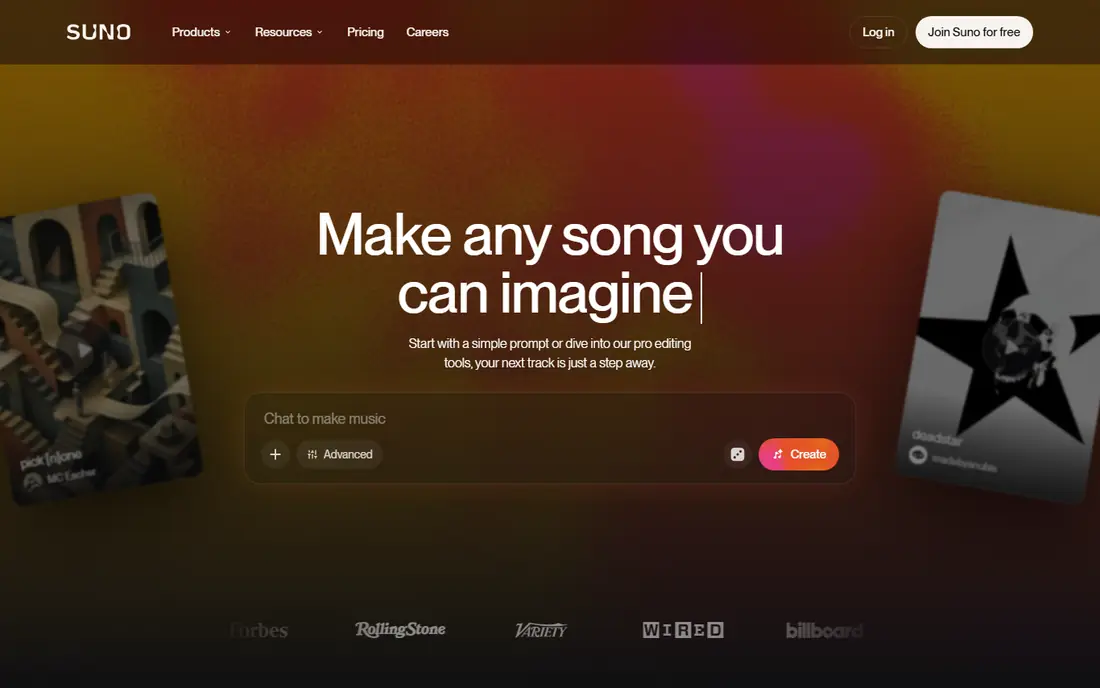
Suno is the market leader for a reason: it turns a text prompt and lyrics into a finished-sounding song, with vocals, structure, and genre feel in one generation. Later versions added stem separation and a studio-style workspace, which help creators who want to edit parts rather than accept a single take. For songwriters testing ideas or creators needing a full track fast, Suno is the shortest path from idea to audio.
Licensing is the part to read carefully. Free credits produce non-commercial output, while Pro plans at ten dollars per month, or eight dollars on annual billing, grant commercial rights on songs made while subscribed. Download caps also apply by plan. Ongoing disputes over training data add uncertainty for commercial releases, so read the current license terms before building a release schedule on Suno alone.
- Strongest vocals and song structure
- Fast iteration from a prompt
- Commercial rights on paid plans
- Free output is non-commercial
- Download caps apply
- Ongoing legal uncertainty around training data
Udio appeals to creators who want to build a song section by section rather than accept a single generation. Its clip-based workflow lets you extend, remix, and reshape parts, which suits producers who think in verses, choruses, and bridges. Audio quality is polished, and vocal realism rivals Suno on many prompts, especially for pop and electronic styles.
The pricing trap is the license split. Standard plans start at ten dollars per month but are non-commercial, while commercial use needs the Pro plan at thirty dollars per month. Free credits cover only a small daily allowance. If you plan to release or monetize Udio tracks, budget for Pro from the start rather than discovering the limit after you fall in love with a song.
- Polished audio quality
- Clip-by-clip song building
- Strong remixing and extension tools
- Commercial rights need the higher Pro plan
- Free credits are limited
- Pricing pages can be hard to read
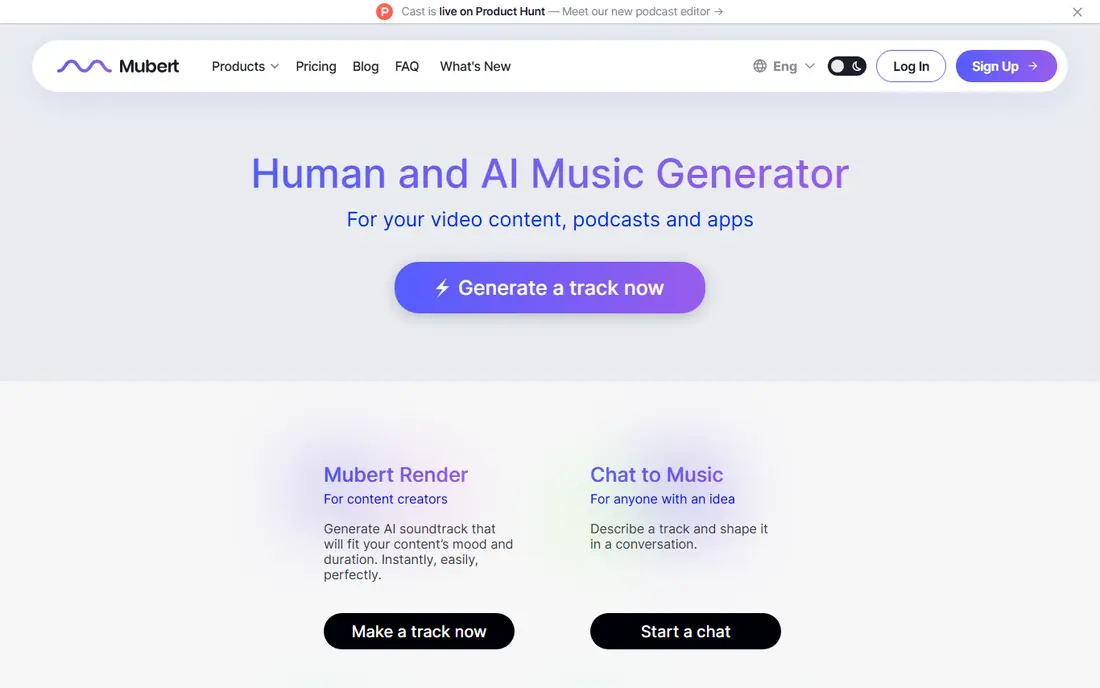
Mubert takes a different path from Suno and Udio: it generates adaptive background music for apps, streams, and videos rather than finished songs with vocals. Developers can call its API to produce endless streams matched to mood and tempo, which suits fitness apps, live streams, and retail spaces. Plan tiers carry clear commercial certificates, which helps teams that need paperwork for clients.
Vocal songwriters should look elsewhere, since Mubert focuses on instrumental beds. The free tier allows limited generations for non-commercial use, Creator plans start near fourteen dollars per month, and full Pro commercial use costs more. For background music at scale, though, Mubert is one of the most practical tools here.
- API for apps and streams
- Clear plan-tier licenses
- Large generative catalog
- No vocals for full songs
- Free tier is non-commercial
- Pro plan costs more for full commercial use
AIVA is built for composers, not pop songwriters. It writes instrumental scores in orchestral, cinematic, and electronic styles, then exports MIDI so you can edit notes in a DAW and pair the result with real instruments. Film, game, and trailer creators get a starting score in minutes, which they can then shape into a finished cue.
Licensing follows a tiered model. The free plan allows a few downloads per month with AIVA retaining copyright, Standard plans allow limited commercial use such as monetized videos, and only the Pro plan transfers full copyright to you. Prices vary by billing period, so check the current plan table. If you need a score you fully own, budget for Pro.
- Strong orchestral and cinematic composition
- MIDI export for DAW work
- Hundreds of styles
- No vocals
- Full copyright needs the Pro plan
- Free tier limits downloads
Soundraw is the safest pick for video creators who worry about copyright claims. Its models are trained on in-house music, and paid plans grant royalty-free commercial use, which means fewer takedown risks on monetized videos. Controls for mood, genre, length, and tempo make it easy to shape a bed that fits a scene without music theory knowledge.
There is no free download tier, only previews, and Creator plans start at sixteen dollars and ninety-nine cents per month, which is higher than some rivals. The catalog is instrumental only, so creators needing vocals must pair it with another tool. For YouTube, ads, and client video work where license safety matters, Soundraw justifies its price.
- Royalty-free tracks on paid plans
- Trained on in-house music
- Easy mood and genre controls
- No free tier for downloads
- Instrumental only
- Monthly price is higher than some rivals
Boomy is the easiest tool on this list to use. Pick a style, generate a song in seconds, then distribute it to streaming platforms from the same account, with a royalty share on releases. Beginners who want to hear themselves as a released artist, rather than learn production, will enjoy how fast Boomy moves from idea to a shareable track.
Control is the trade-off. Boomy offers less fine shaping than Suno or Udio, and the free plan limits saves and releases. Creator plans start at nine dollars and ninety-nine cents per month, with commercial use on higher tiers. If your goal is to learn songwriting and release quickly, Boomy is a friendly start. If you need precise production control, start with Suno or Udio instead.
- Simplest workflow for beginners
- Built-in distribution to streaming platforms
- Vocal options included
- Less control than Suno or Udio
- Free plan limits saves and releases
- Commercial use needs paid plans
Beatoven.ai scores video by mood, which is exactly what podcasters and YouTubers need. Pick an emotion and a length, and the tool builds a track that fits the video rather than forcing a fixed song into an edit. Paid plans include a commercial license measured in download minutes, which suits creators who publish regularly but do not need endless tracks.
The minute caps deserve attention, since heavy publishers can hit them, and pricing pages have changed over time, so confirm the current plan before subscribing. Beatoven is instrumental only, so vocal tracks need another tool. For mood-matched background music at a fair price, it remains one of the best value picks here.
- Mood-based scoring that fits video length
- Commercial license on paid plans
- Affordable entry price
- Instrumental only
- Export minutes cap paid plans
- Official pricing pages change often
Loudly bundles AI music generation with a sample library, stem downloads, and a distribution path, which suits creators who mix generated tracks with loop-based production. Daily free generations let you test styles before paying, and Personal plans start near ten dollars per month. For a creator who wants one account for beats, samples, and release, that bundle is convenient.
Vocal quality trails the leaders, so full songs with convincing singers are not Loudly's strength. Pricing details have also been harder to verify from official pages at times, so confirm the plan and license at checkout. If your work centers on beats, background tracks, and distribution rather than vocal songs, Loudly is a solid all-in-one option.
- AI generation plus samples and stems
- Distribution path for releases
- Daily free generations
- Vocal depth trails Suno and Udio
- Pricing pages can be hard to verify
- Catalog quality varies by genre
How we picked these
We compared official feature pages, pricing pages, license terms, and public reviews for each tool, and we favored products still operating in October 2026 with clear commercial terms. We weighted license clarity alongside audio quality, since a great track you cannot legally use is a poor buy. We did not run hands-on listening tests for this guide, and license terms change, so we urge readers to confirm rights on the vendor site before release.
How to choose by license first
Decide where the track will live before you generate it. Personal experiments can use any free tier, but monetized videos, ads, client work, and streaming releases need a paid plan with commercial rights in writing. Check whether rights cover the track only while subscribed, whether full copyright transfers, and whether Content ID or streaming distribution is allowed. Save the license terms for each track you release, since platforms may ask for proof later. When in doubt, pick a tool trained on licensed or in-house music, such as Soundraw, for client work.
Frequently asked questions
What is the best AI music generation app for full songs?
Suno is the best pick for full songs with vocals, with strong structure and commercial rights on Pro plans. Udio is the closest rival, especially for producers who want clip-by-clip control.
What is the best AI music generation software for film scores?
AIVA leads for cinematic and orchestral scores, with MIDI export that fits a DAW workflow. Soundraw and Beatoven.ai suit simpler video background music rather than full film cues.
Can I use AI-generated music commercially?
Yes, on most paid plans, but terms differ. Suno Pro grants commercial rights, Udio needs its Pro plan for commercial use, and AIVA transfers full copyright only on Pro. Always read the current license before release.
What is the best free AI music generation tool?
Free tiers from Suno, Udio, Mubert, and Beatoven.ai let you test generation at no cost, but free output is usually non-commercial. For a free track you can use more widely, check each tool's paid terms first.
Do AI music tools replace musicians?
They replace some routine background and demo work, but they do not replace arrangement, performance, and taste for finished commercial releases. Most working creators use them for drafts, beds, and ideas, then shape the result further.
Which AI music tool is best for YouTube videos?
Soundraw and Beatoven.ai suit YouTube best, with royalty-free background tracks and clear commercial licenses. Suno suits creators who need a full vocal song as a video feature rather than a bed.
Sources
See where you really rank - block by block
ProMapRanker scans Google Maps across a grid of your service area. Simple monthly plans from $19, white-label on every plan.
Start freeKeep reading
 zeffy payment processor stripe alternatives
Zeffy and Stripe Alternatives for Nonprofits in 2026
Explore zeffy payment processor stripe alternatives for nonprofits. We compare 8 fundraising platforms on fees, donor tools, and nonprofit focus. Check fees.
Read → workday alternatives
Workday Alternatives in 2026
Workday alternatives compared: we review 8 HR and payroll platforms that replace Workday, with pricing, strengths and honest limits for each team size.
Read → what's the best weather app
What's the Best Weather App in 2026
Wondering what's the best weather app? We compare 10 free and paid apps for forecasts, radar, alerts, and Colorado mountain weather for everyday and storm use.
Read →