 ProMapRanker
Best Backstage IO Alternatives in 2026


SaaS portal with self-service actions · Pricing starts at: $30 per seat per month
Key takeaways
- Port and Cortex suit teams that want a polished SaaS portal without building and maintaining their own platform.
- OpsLevel and Configure8 suit teams whose main need is service ownership, maturity, and scorecards.
- Humanitec suits larger teams that need environment orchestration, not just a catalog view.
- Harness, Mia-Platform, and Cycloid suit teams that want a portal inside a broader platform or delivery system.
- Roadie portal sales are closed to new buyers in recent checks, and Atlassian Compass is transitioning, so we excluded both from the main list.
Quick comparison
| Pick | Great for | Pricing starts at | Free tier | |
|---|---|---|---|---|
| Port | SaaS portal with self-service actions | $30 per seat per month | Free trial | Visit |
 Cortex | Production readiness and scorecards | See website | Free trial | Visit |
 OpsLevel | Service maturity and ownership | See website | Free trial | Visit |
 Humanitec | Environment orchestration and portal | $1,979 per month | Free trial | Visit |
 Configure8 | Universal catalog and scorecards | $19 per user per month | Free trial | Visit |
 Harness IDP | Portal inside the Harness platform | See website | Free trial | Visit |
 Mia-Platform | Cloud-native platform with portal | See website | No | Visit |
 Cycloid | Platform engineering with self-service | See website | Free trial | Visit |
The best backstage io alternatives
Backstage, in this article, means the open-source developer portal framework for service catalogs, templates, docs, and search. The tools below offer a similar job as a managed or broader internal developer platform, without requiring a team to build and maintain Backstage itself. We compared official product pages, pricing pages, and recent platform comparisons, and we kept only tools that are actively sold in October 2026. We do not list Backstage itself in this comparison.

Port is the most flexible SaaS portal here for teams that want to model services, teams, APIs, and infrastructure in one place. Its catalog can be shaped to match how a given organisation actually works, rather than forcing a fixed schema. Self-service actions let developers request environments, provision resources, or run approved workflows without waiting for a platform ticket. That mix of catalog and action is why many teams pick Port as a direct managed replacement.
The catch is cost and discipline. At $30 per seat per month for the Basic tier in recent comparisons, a large engineering org will pay a significant annual bill. Port also needs a clear data model: without ownership rules and naming standards, a catalog can grow messy fast. Teams that invest in that model get a portal developers actually use. Teams that skip it may end up with another dashboard nobody trusts.
- Flexible data model and catalog
- Self-service actions for developers
- Many integrations
- Price rises with seats
- Setup needs a clear data model to avoid clutter
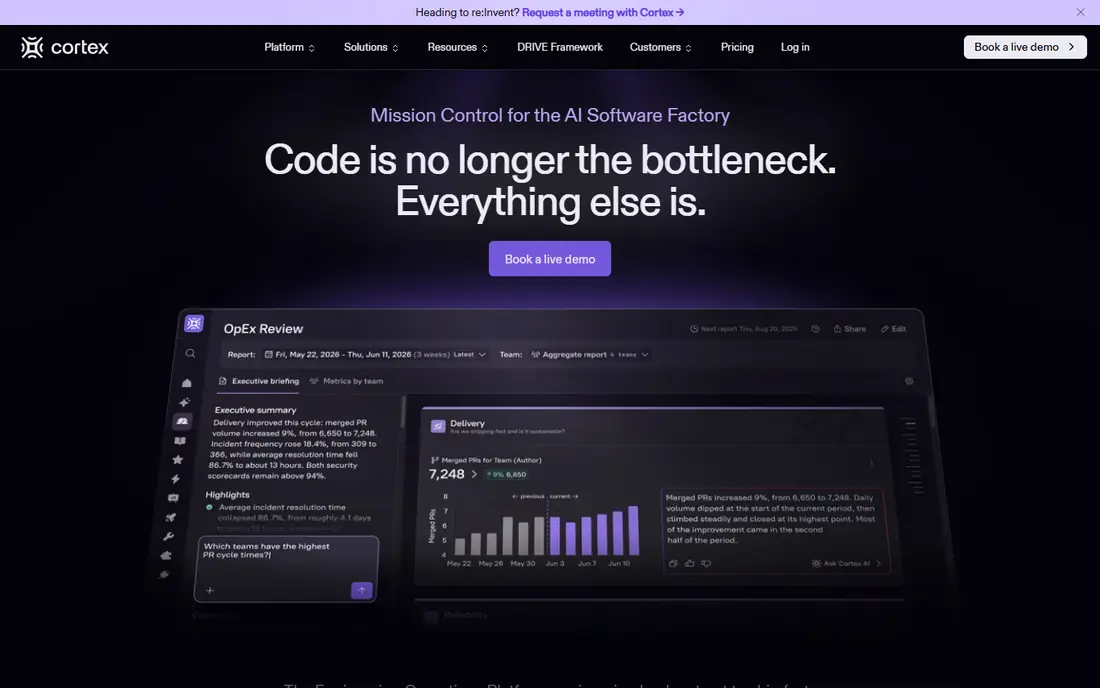
Cortex focuses on a question many portals dodge: is this service actually ready for production. Its scorecards track ownership, docs, tests, security checks, and operational standards, then show which services fall short. That view helps platform and engineering leaders drive migrations and raise standards without chasing spreadsheets. Cortex also offers a catalog, scaffolding, and workflows, so it covers more than scorecards alone.
The trade-off is price clarity and scale. Cortex pricing is quote-based and scales with org size, so small teams should get a formal quote early and compare it with OpsLevel or Configure8. Cortex suits mid-size and larger teams that need readiness as a core workflow. Smaller teams with only a handful of services may find a simpler catalog enough for now.
- Strong scorecards and readiness tracking
- Service catalog and scaffolding
- Workflow automation
- Pricing is quote-based
- Smaller teams may find it enterprise-heavy
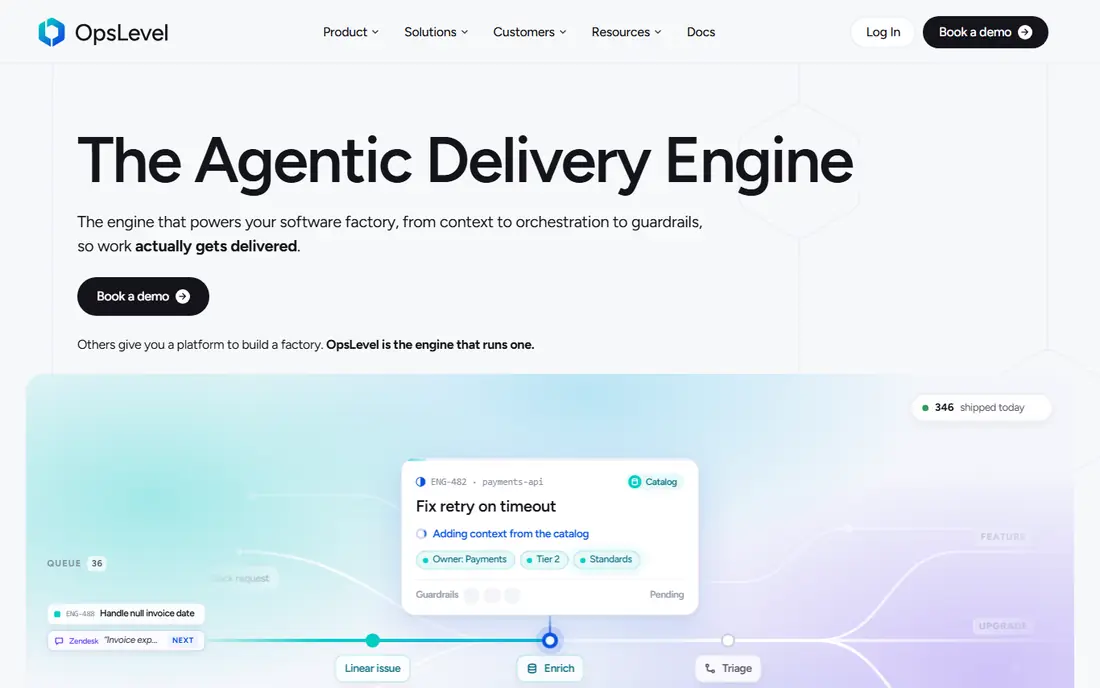
OpsLevel is known for fast catalog creation and maturity tracking. It automates much of the catalog upkeep, so teams do not need to hand-maintain every service record. Scorecards and checks help leaders see which services meet standards for docs, security, testing, and ownership. Automation and self-service workflows help teams fix gaps without waiting for manual follow-up.
The limit is pricing transparency. OpsLevel prices per developer using the portal in recent comparisons, with volume discounts, but does not publish a simple list price for most teams. That means a quote is needed for a real comparison. OpsLevel suits teams that want a catalog and maturity system quickly, without building a custom platform. Teams that need deep environment provisioning should also look at Humanitec.
- Fast catalog setup
- Maturity checks and automation
- Clear ownership views
- Pricing is quote-based
- Deeper workflow needs may need other tools
Humanitec is different from a catalog-only portal: it orchestrates environments. Platform teams define resource templates and rules, developers describe what they need in a Score workload spec, and the orchestrator provisions Kubernetes, serverless, or VM resources across clouds. The portal gives developers and leaders a clear view of services and infrastructure health. That end-to-end model suits teams whose main pain is environment tickets, not just missing docs.
The catch is price and lock-in. Recent comparisons list Teams at $1,979 per month on annual billing, which is steep for small teams. The orchestrator also becomes the source of truth for provisioning, so leaving later means re-implementing that logic. Humanitec suits orgs with roughly 50 or more developers and a real environment bottleneck. Smaller teams should start with a catalog portal first.
- Real environment provisioning from workload specs
- Portable Score spec
- Portal front end
- Steep entry price
- Orchestrator becomes a central dependency
Configure8 offers a universal catalog that organises teams, apps, services, environments, and resources, with scorecards and self-service actions built on that data. Its scorecard library covers many pre-built checks, and custom data can also be scored. Self-service actions use context-aware forms to cut down on day-two busywork. That combination makes Configure8 a practical middle option between a bare catalog and a full orchestrator.
The trade-off is vendor size and proof. Configure8 is smaller than Port or Cortex, so buyers who need a long enterprise track record may ask for more references. The published starting price of $19 per user per month helps small and mid-size teams budget early, which is an advantage over quote-only rivals. For teams that want scorecards plus a clear price, Configure8 deserves a trial.
- Published starting price
- Universal catalog for many entity types
- Large scorecard check library
- Smaller vendor than Port or Cortex
- Some buyers will want a longer track record
Harness Internal Developer Portal is sold as a module inside the Harness platform, not as a standalone portal with a simple list price. That bundling suits teams already using Harness for delivery, pipelines, or governance, since the portal can share identity, templates, and controls with the rest of the platform. Developers get a catalog and self-service view inside a system they may already use daily.
The catch is that teams who only want a portal will need to price a Harness bundle, not just the portal. Recent comparisons note that IDP is an Enterprise-plan module and that newer Flex pricing meters it in subscription units, so a sales conversation is needed. For Harness customers, the fit is natural. For teams with no Harness footprint, a standalone portal such as Port or OpsLevel is usually simpler to judge.
- Portal inside a broader delivery platform
- Templates and catalog
- Governance controls
- No standalone list price
- Best value comes as part of a Harness bundle
Mia-Platform is a cloud-native internal developer platform that covers API and microservice delivery, with portal and developer experience features inside a larger system. It suits organisations that want to standardise how services are built, exposed, and run, especially in regulated or banking-adjacent settings where governance matters. The platform approach helps teams that need more than a catalog view.
The limits are price and scope. Mia-Platform does not publish a simple starting price, so teams need a quote. It is also broader than a portal-only tool, which means implementation takes planning and platform ownership. Teams that only need a catalog and scorecards should compare Configure8 or OpsLevel first. Teams that need a full delivery platform should trial Mia-Platform against Humanitec and Harness.
- Full cloud-native platform for APIs and microservices
- Catalog and developer experience tools
- Strong in regulated sectors
- No published price
- Broader than a simple portal, so setup takes planning
Cycloid combines delivery pipelines with platform engineering features, including self-service stacks, catalog views, and governance. That mix suits teams that want developers to provision approved stacks without handing every request to a platform team. Cost and governance views also help leaders see what is running and whether it follows standards.
The trade-off is focus. Cycloid is not as portal-first as Port or Cortex, so teams that mainly need a beautiful service catalog may prefer a dedicated portal. Pricing is also quote-based for most buyers. For teams that want delivery and platform work in one system, Cycloid is a useful alternative to buying a portal and a pipeline tool separately.
- Combines CI and CD with platform features
- Self-service stacks
- Governance and cost views
- Less portal-first than Port or Cortex
- Pricing needs a quote
How we picked these
We compared official product pages, pricing pages, and recent internal platform comparisons checked in 2026, and we kept only tools that are actively sold as a developer portal or internal platform in October 2026. We excluded Roadie portal plans because recent checks mark them as existing subscribers only, with the vendor now selling a different context product. We excluded Atlassian Compass from the main list because Atlassian states its catalog and scorecard functions will transition into a different product, so new buyers should not start a fresh Compass deployment. Where prices were quote-based, we wrote See website rather than publishing a figure we could not confirm.
How to choose a portal without a long rebuild
Start with the problem you can name in one sentence. If the problem is that nobody knows who owns a service, start with a catalog and scorecard tool such as OpsLevel, Cortex, or Configure8. If the problem is that developers wait days for environments, start with Humanitec or a platform tool such as Harness or Cycloid. If the problem is that developers cannot find docs, APIs, or templates, start with a portal-first tool such as Port. A tool that solves the named problem will get adoption faster than a tool that tries to solve every problem at once.
Next, run a pilot with one team and a small set of services. Import real services, assign real owners, and test one self-service action end to end. Watch whether developers use the portal without being forced, and whether owners keep their records up to date. Check data export, identity integration, and audit logs before a wider rollout. A pilot that uses real services tells you more than a demo with sample data.
Frequently asked questions
Is Backstage itself free?
Backstage is open source, so there is no licence fee for the framework itself. The real cost is engineering time to build, host, upgrade, and maintain it, which is why many teams compare managed portals that charge a subscription but remove that upkeep.
Do I need a full internal developer platform, or just a portal?
A portal is enough if you mainly need a catalog, docs, and templates. A full platform is better if you also need environment provisioning, governance, and delivery controls. Start with the portal need, then add platform features only if a real bottleneck demands them.
How is pricing usually charged for these tools?
Most SaaS portals charge per seat or per developer using the portal, while Humanitec charges by tier and user count. Always price the same team size across vendors, and ask whether read-only users, service accounts, or external users count as seats.
Can these tools work with our existing Git, CI, and cloud tools?
Yes, in general, through integrations and APIs, but coverage varies by vendor. Check the exact integrations for your Git host, CI system, cloud provider, and identity provider during the trial, not just on a marketing page.
What should we check about data export?
Check whether you can export catalog data, scorecard definitions, and templates in a usable format, and what happens if you cancel. A portable data model matters more than a pretty dashboard if you later switch vendors.
Why did you exclude Roadie and Compass?
Recent checks show Roadie portal plans as existing subscribers only, and Atlassian states Compass catalog and scorecard functions will transition into another product. Both facts make them poor picks for a new deployment in October 2026, so we left them out of the main list and noted the reason here.
Sources
See where you really rank - block by block
ProMapRanker scans Google Maps across a grid of your service area. Simple monthly plans from $19, white-label on every plan.
Start freeKeep reading
 zoho books alternatives
Best Zoho Books Alternatives in 2026
Compare the best zoho books alternatives for small business accounting, from QuickBooks Online and Xero to FreshBooks, Wave, and Sage in 2026, with pricing.
Read → zluri alternatives
Best Zluri Alternatives in 2026
Compare zluri alternatives for 2026, with SaaS management platforms for app discovery, spend tracking, renewals, and automation for IT, finance and procurement.
Read → zerobounce alternatives
Best ZeroBounce Alternatives in 2026
Best zerobounce alternatives for list hygiene: compare 8 email verification tools for bulk cleaning, real-time checks and catch-all handling in 2026 today.
Read →