 ProMapRanker
Best Alternatives to Nearshore Software Development Outsourcing in 2026

Key takeaways
- Our reading is plain: this is about alternatives to nearshore outsourcing as a model, so the list covers other engagement models and providers, not only nearshore firms.
- Talent networks such as Toptal, Andela and Turing suit teams that want vetted engineers without handing a whole project to an agency.
- Deel and Remote suit teams that want to hire abroad legally without setting up a local company.
- Offshore firms such as BairesDev, Vention and N-iX suit teams that accept larger time gaps in exchange for depth or lower cost.
Quick comparison
| Pick | Great for | Pricing starts at | Free tier | |
|---|---|---|---|---|
 Toptal | Vetted freelance engineers | See website | No | Visit |
 Andela | Global tech talent teams | See website | No | Visit |
 Turing | AI-vetted remote engineers | See website | No | Visit |
 Deel | Employer of record hiring | See website | No | Visit |
 Remote | Global employment and payroll | See website | No | Visit |
 Upwork | Flexible freelance hiring | Free to join | Yes | Visit |
 BairesDev | Offshore product teams | See website | No | Visit |
 Vention | Offshore dedicated teams | See website | No | Visit |
 N-iX | Central and Eastern European engineering | See website | No | Visit |
The best alternatives to nearshore software development outsourcing
Nearshore outsourcing means hiring a team in a nearby time zone, often in Latin America for US companies. The alternatives below change that trade-off. Some keep control in-house, some move hiring to a talent network, and some move delivery farther away for cost or depth. We compared official service pages, pricing information and public client reviews.
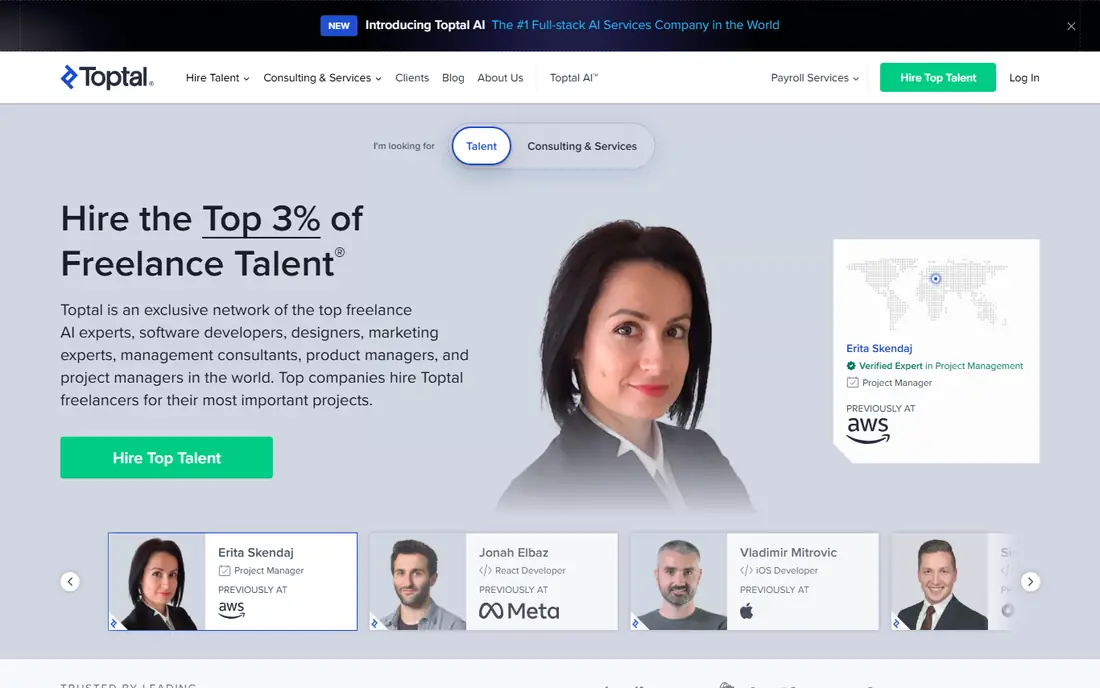
Toptal is a talent network, not a project agency. You describe a role, Toptal matches you with screened freelancers, and you manage the work directly. That keeps roadmap, code and team culture in-house, which is the main reason teams look beyond full outsourcing.
The cost is the catch. Vetted talent and a managed matching process tend to cost more than open freelance marketplaces. Toptal fits best when one or two strong engineers matter more than the lowest hourly rate.
- Screened talent pool
- Fast matching for many roles
- Flexible engagements
- Premium pricing
- Less suited to very large managed teams
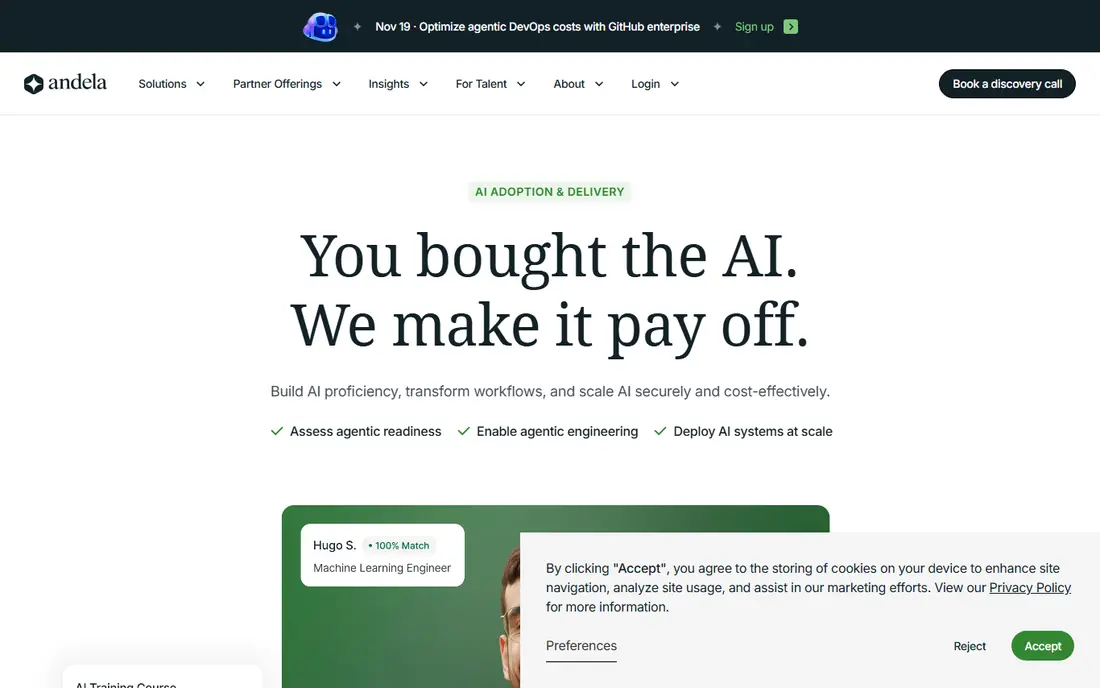
Andela connects companies with technologists from a global pool, with support for building teams over time. It suits companies that want dedicated engineers who stay with a product, rather than short project staff. Matching, onboarding and ongoing support are part of the model.
It is not a quick gig marketplace. You should expect interviews, onboarding and a custom commercial agreement. For teams building a lasting remote team, that structure is an advantage, not a drawback.
- Large global talent pool
- Team scaling support
- Focus on long-term placements
- Hiring process takes planning
- Pricing is custom
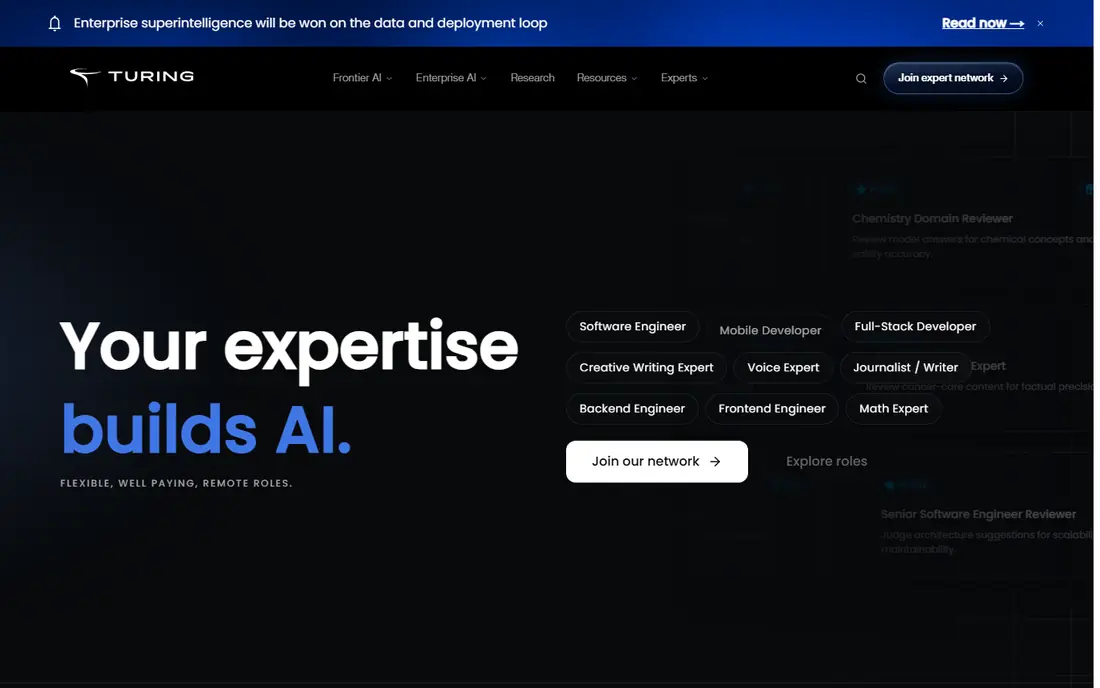
Turing uses vetting and matching to place remote engineers with US and global companies. It is often used for software engineering, data and AI-adjacent roles, where screening for real coding skill matters. Teams can scale up or down without building a recruiting operation in each country.
The trade-off is that you rely on the platform match. You still interview and manage engineers, but you do not run the full sourcing process yourself. That suits fast-growing teams, while teams with very specific domain needs may prefer direct hiring.
- Vetting with tests and matching
- Access to remote engineers at scale
- Cloud-based team tools
- Less control over individual selection than direct hiring
- Custom pricing
Deel is an employer of record service. It hires a worker legally on your behalf in another country, handles payroll, taxes and benefits, and you direct the day-to-day work. That removes the need to set up a company abroad just to hire one or two engineers.
Fees are charged per person, so a large team can become costly compared with a single agency contract. Deel also does not solve recruiting or delivery by itself. It is best paired with your own hiring or a talent network.
- Hire in many countries without a local entity
- Payroll and compliance handled
- Contractor payments included
- Per-person fees add up
- You still manage the work and performance
Remote offers a similar employer of record model, with global payroll, benefits and contractor payments. It suits companies that want one system for employees and contractors across countries, rather than a patchwork of local providers. Its compliance and payroll tools reduce admin work for HR teams.
As with Deel, the model does not find engineers for you or manage delivery. Country rules, benefits and fees differ, so get a quote for your exact locations before comparing it with an agency price. For distributed teams, the admin saving is real.
- Global payroll and benefits
- Compliance support
- Contractor management
- Pricing varies by country and service
- Onboarding still needs your time
Upwork is the most flexible alternative on this list. You can hire a freelancer for a week, a project or an ongoing role, across almost any skill. That flexibility helps when you need a specialist for a short task, or when you want to test a hire before a longer commitment.
Quality control is your job. Profiles, reviews and tests help, but you must screen, interview and manage freelancers closely. Upwork fits teams with strong technical leadership, while teams that want a managed outcome should look at an agency or a vetted network.
- Huge freelancer pool
- Flexible short projects
- Escrow and contract tools
- Quality varies widely
- Screening and management fall on you
BairesDev is a software services firm with teams across Latin America and beyond. It offers staff augmentation, dedicated teams and full project delivery, which makes it a direct alternative when you want an outsourced partner but not a nearshore-only arrangement. Its scale suits larger builds and long-term product work.
Because it is still outsourcing, you need clear ownership, code review and communication routines. Teams that want to keep all knowledge in-house may prefer a talent network or employer of record route instead. For managed delivery at scale, BairesDev is a credible option.
- Large Latin American and global teams
- Staff augmentation and project delivery
- Broad tech coverage
- Still an outsourced model, so control needs clear governance
- Pricing is custom
Vention builds dedicated engineering teams, often from Central and Eastern Europe and other offshore locations. It can cover product design, engineering and QA, which helps startups that need a full team fast. Its model suits companies that want a team, not just individual hires.
The main trade-off is time zone overlap with US teams. Daily standups and pairing need planned overlap windows, and async work must be disciplined. If your work needs constant real-time collaboration, a nearshore or onshore model may still fit better.
- Dedicated product teams
- Design and engineering together
- Experience with startups and scaleups
- Time zone gaps for US teams
- Custom pricing and longer onboarding for large teams
N-iX is a European software engineering firm with strengths in enterprise software, cloud, data and AI work. It suits companies that need complex engineering rather than only front-end or mobile builds. Long-term team partnerships are its core model, with engineers embedded in client product work.
For US clients, time zones and cost sit between nearshore Latin America and lower-cost offshore Asia. That middle position can be right when engineering depth matters more than full-day overlap. Get a team proposal for your stack and timeline, since pricing is custom.
- Deep engineering pool in Europe
- Enterprise and cloud experience
- Long-term partnerships
- Higher cost than some offshore options
- Time zone planning needed for US clients
How we picked these
We compared official service pages, engagement models, hiring and payroll features, and public client reviews. We kept only live providers that offer a real alternative to nearshore outsourcing, whether that is direct talent hiring, employer of record employment, freelance hiring, or offshore delivery. We excluded firms with no clear current service offering and firms that only list jobs without a hiring service.
What to check before you choose
Start with control. Decide whether you want to own the team, own only the outcome, or share both. Talent networks and employer of record services keep control with you, while agencies and dedicated teams take more delivery ownership. That choice shapes contracts, code ownership and day-to-day management more than hourly rates do.
Next, check time zones, communication and legal terms together. Ask how overlap hours work, who owns intellectual property, how data is handled, and how you can scale down or exit. For employer of record hiring, confirm tax, benefits and termination rules in each country. For agencies, confirm who manages quality and what happens when a key engineer leaves.
Finally, trial with a small, real piece of work. Give a candidate team or hire a bounded task with clear success criteria, and review code, communication and delivery speed. That trial tells you more than a sales deck, and it protects you from a large commitment to the wrong model.
Frequently asked questions
What is the main alternative to nearshore outsourcing?
The main alternatives are onshore hiring, offshore hiring, talent networks, freelance hiring, and employer of record hiring. Each changes cost, control and time zone overlap in a different way, so the best pick depends on how much control you want to keep.
Is offshore outsourcing cheaper than nearshore?
Often, but not always. Offshore rates can be lower, yet time zone gaps, communication overhead and management time can offset the saving. Compare total cost, including your own management time, not only the hourly or monthly rate.
What is an employer of record?
An employer of record hires a worker legally in another country on your behalf, handling payroll, taxes and benefits, while you direct the work. Deel and Remote are examples. It helps you hire abroad without setting up a local company.
Should I hire freelancers or use an agency?
Freelancers suit flexible, well-defined work when you can manage quality yourself. Agencies suit managed delivery, larger teams and projects where you want one partner accountable for the outcome. Many teams use both for different work.
How do I protect intellectual property?
Use a written agreement covering IP assignment, confidentiality, data handling and code ownership before work starts. For employer of record and agency models, confirm that assignment flows through the provider to you, and keep code in your own repositories.
How fast can I start with these options?
Freelance marketplaces can start in days, talent networks often take one to four weeks to match and onboard, and dedicated agency teams can take several weeks for larger builds. Employer of record onboarding depends on the country and the worker type.
Sources
See where you really rank - block by block
ProMapRanker scans Google Maps across a grid of your service area. Simple monthly plans from $19, white-label on every plan.
Start freeKeep reading
 zoho books alternatives
Best Zoho Books Alternatives in 2026
Compare the best zoho books alternatives for small business accounting, from QuickBooks Online and Xero to FreshBooks, Wave, and Sage in 2026, with pricing.
Read → zluri alternatives
Best Zluri Alternatives in 2026
Compare zluri alternatives for 2026, with SaaS management platforms for app discovery, spend tracking, renewals, and automation for IT, finance and procurement.
Read → zerobounce alternatives
Best ZeroBounce Alternatives in 2026
Best zerobounce alternatives for list hygiene: compare 8 email verification tools for bulk cleaning, real-time checks and catch-all handling in 2026 today.
Read →