 ProMapRanker
Best Secret Management Tools for Enterprise DevSecOps in 2026


Large teams that want dynamic secrets and full control · Pricing starts at: Free (self-managed Community)
Key takeaways
- HashiCorp Vault is still the most flexible option for large teams, but HCP Vault Secrets reached end of life in 2025 and 2026, so Vault Community, Vault Enterprise and HCP Vault Dedicated are the paths left.
- The three cloud vaults are cheap at small scale: AWS Secrets Manager costs $0.40 per secret per month, Google Cloud Secret Manager charges $0.06 per active secret version after six free ones, and Azure Key Vault Standard bills $0.03 per 10,000 operations.
- Infisical (MIT-licensed core) and Bitwarden Secrets Manager are the strongest open-source picks, and both have free plans that are useful for real projects.
- Dynamic secrets are usually a higher-tier feature: Doppler puts them in Enterprise, Infisical in Advanced ($40 per identity per month billed yearly), and Akeyless limits free accounts to five.
- CyberArk's secrets products now sit under Palo Alto Networks' Idira brand after the acquisition, and pricing is quote-only.
Quick comparison
| Pick | Great for | Pricing starts at | Free tier | |
|---|---|---|---|---|
| HashiCorp Vault | Large teams that want dynamic secrets and full control | Free (self-managed Community) | Yes | Visit |
 AWS Secrets Manager | Workloads that live mostly on AWS | $0.40 per secret per month | Free trial (AWS credits) | Visit |
 Azure Key Vault | Microsoft and Azure shops | $0.03 per 10,000 operations | No | Visit |
 Google Cloud Secret Manager | Teams on Google Cloud | $0.06 per active secret version per month | Yes | Visit |
 CyberArk Secrets Manager (Palo Alto Networks Idira) | Regulated enterprises already using CyberArk | See website | No | Visit |
 Doppler | Developer teams that want fast setup across many environments | Free, then $21 per user per month (Team) | Yes | Visit |
 Infisical | Teams that want open source with a managed option | $20 per identity per month (Pro, billed yearly) | Yes | Visit |
 Akeyless | Hybrid and multi-cloud companies that want SaaS without giving up key control | See website | Yes | Visit |
 Bitwarden Secrets Manager | Budget-conscious teams that want end-to-end encryption | $6 per user per month (Teams) | Yes | Visit |
 Keeper Secrets Manager | Companies already on Keeper for passwords | See website | Free trial | Visit |
The best secret management tools for enterprise DevSecOps
A secrets manager keeps API keys, database passwords, tokens and certificates out of source code and CI logs, and hands them to apps and pipelines only when needed. Here are the ten we would shortlist in October 2026, from heavyweight platforms to lighter tools a small security team can run.
HashiCorp Vault
Great for: Large teams that want dynamic secrets and full control
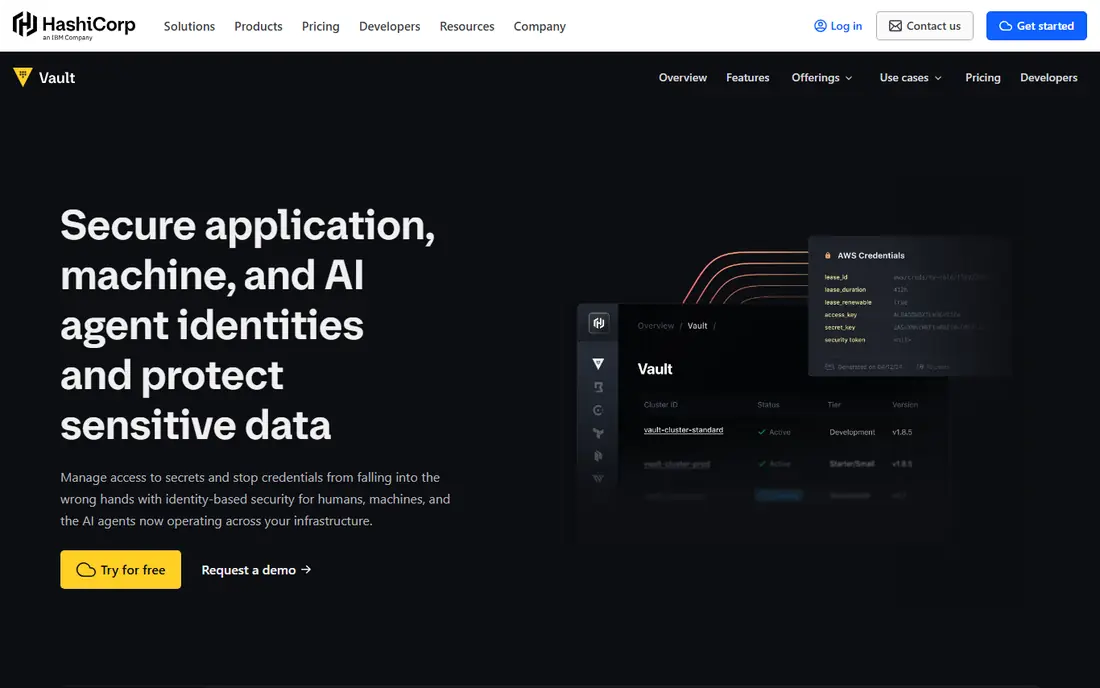
Vault is the tool most security architects have in mind when they say "secrets management", and for good reason. HashiCorp's documentation describes three editions: Community, which you can download or build from the GitHub repo, Enterprise, which needs a license, and HCP Vault Dedicated, a managed service that runs the same binary as self-managed Vault Enterprise. Database secrets plugins can issue short-lived credentials on demand, which is the feature that makes Vault so popular with platform teams.
There are a few changes to know about. HashiCorp is now part of IBM, and its pricing page refers to the "IBM HashiCorp Cloud Platform", with pay-as-you-go billing that starts with a $500 credit. The lighter HCP Vault Secrets product was retired: HashiCorp's support article set end of sale at June 30, 2025, with end of life no later than July 1, 2026. HashiCorp also moved Vault to the Business Source License in 2023, which is why the open-source OpenBao fork exists.
The catch is effort. Self-hosted Vault needs people who understand unsealing, storage, high availability and policy design, and the docs mark Secrets Sync and Secrets Import as Enterprise-only. With a platform team, Vault is our pick; without one, a managed tool below will get you further.
- Community Edition is free to run yourself
- Dynamic database credentials through secrets plugins
- Managed option (HCP Vault Dedicated) runs the same binary as Vault Enterprise
- Running it well takes real operations skill
- Managed and Enterprise pricing is not published as a simple list
If your apps run on AWS, this is the easiest place to start. AWS charges $0.40 per secret per month plus $0.05 per 10,000 API calls, according to its pricing page. Access is controlled with the same IAM policies your team already writes, so there is no new identity system to learn.
New AWS customers who signed up from July 15, 2025 can get up to $200 in Free Tier credits, which apply to eligible services including Secrets Manager. That makes a proof of concept cheap. The weakness is reach. It is excellent inside AWS and much less pleasant for workloads in other clouds or your own data center, and thousands of frequently read secrets can add up without client-side caching.
- Simple per-secret pricing
- Native fit with IAM and other AWS services
- Nothing to host or patch
- Costs grow with secret count and API calls
- Awkward for multi-cloud or on-prem apps
Key Vault stores secrets, keys and certificates for Azure workloads. Azure's retail price list shows Standard and Premium secrets operations at $0.03 per 10,000 transactions in the East US region. Premium adds HSM-protected keys, with RSA 2048-bit keys listed at $1 per key per month plus operations.
For teams that already run identity through Microsoft Entra ID and deploy to Azure, it is the obvious default. The downside is the same as AWS: it is a cloud-native vault, not a cross-platform hub, and the public pricing page shows placeholders until you pick a region, so plan to use the Azure calculator.
- Very low operation-based pricing on the Standard tier
- HSM-protected keys on Premium
- Works with Microsoft Entra ID for access
- Pricing page is hard to read without the calculator
- Best experience is inside Azure
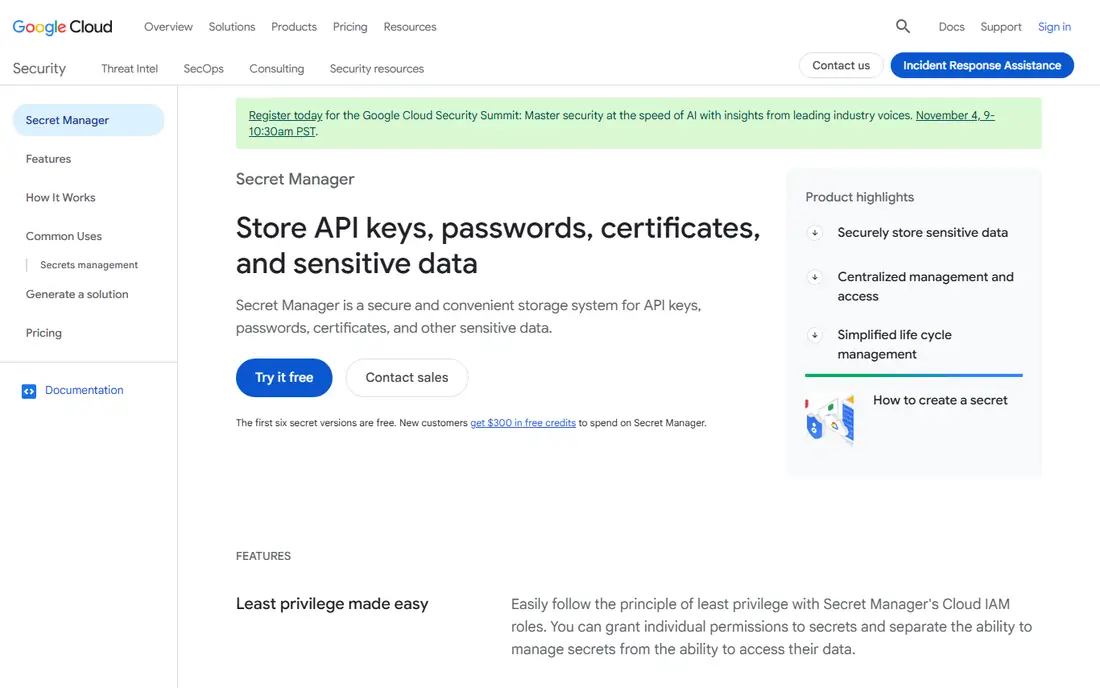
Google's pricing page lists $0.06 per active secret version per month, with the first six versions free, and $0.03 per 10,000 access operations after the first 10,000 each month. Rotation notifications cost $0.05 each after three free ones. For a small service, that can mean a bill of a few dollars or nothing at all.
Google's own example shows 150 active versions costing $8.64 a month, which puts the scale in perspective.
The thing to watch is version count. Every rotation creates a new version, and old ones keep costing money until you disable or destroy them. As with the other cloud vaults, cross-cloud use is possible but not where it shines.
- Free monthly allowance for small projects
- Clear per-version pricing
- Rotation notifications built in
- Each version counts, so frequent rotation adds cost
- Limited value outside Google Cloud
CyberArk Secrets Manager (Palo Alto Networks Idira)
Great for: Regulated enterprises already using CyberArk

CyberArk has long been a standard in privileged access management, and its secrets tools (including the Conjur family) were built for the same buyers. Palo Alto Networks has completed its acquisition of CyberArk, and the secrets management page now sits under the Idira brand on Palo Alto's site.
The product page describes central storage for API keys, tokens, passwords and certificates, policy-based rotation and retirement, role-based access, tamper-resistant audit logs, and discovery of secrets across existing vaults. It also offers a universal workload identity based on SPIFFE that can replace static credentials, which is a good fit for zero-trust programs.
The catch is buying it: no public pricing and no self-serve trial, only a demo request. Ask which product names (Conjur, Secrets Hub, Secrets Manager SaaS) map to what you will license, because public material uses several.
- SaaS or self-hosted, including air-gapped setups
- Automated rotation and expiry by policy
- SPIFFE-based workload identities that expire in hours
- Quote-only pricing
- Product naming has shifted after the acquisition
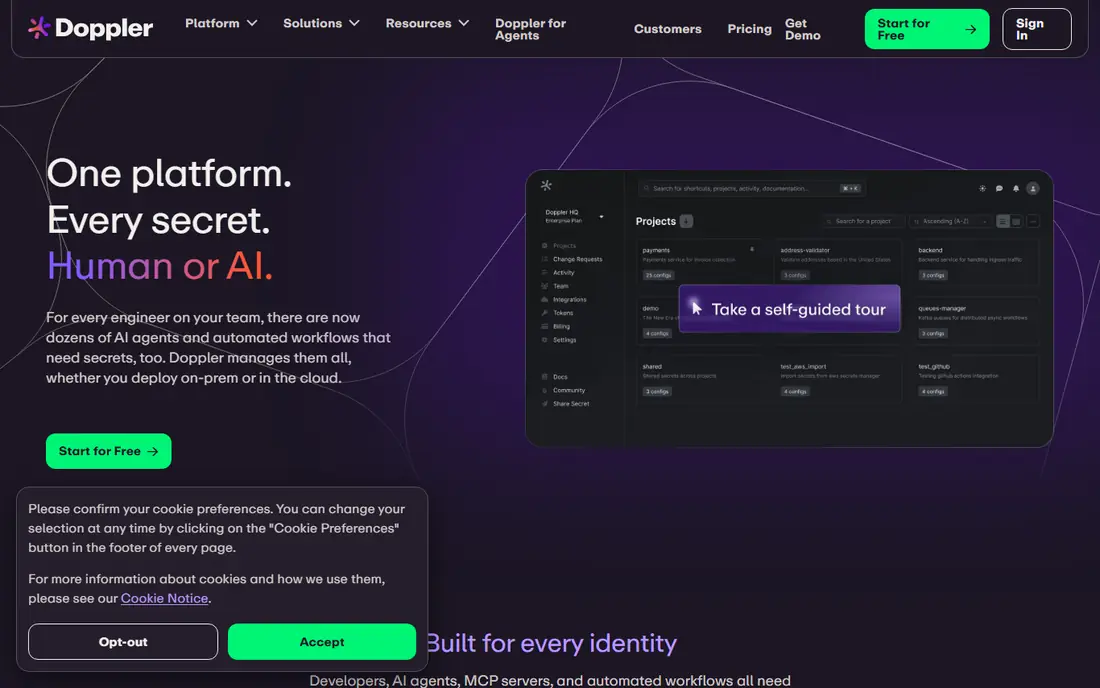
Doppler is the tool developers tend to like first. Its Developer plan is free for three users, then $8 per extra user, and includes the CLI, service tokens, API and webhook access and five config syncs. The Team plan costs $21 per user per month with a 14-day trial and adds SAML SSO, role-based access, change requests, automatic rotation and 90 days of activity logs.
Its strength is the daily workflow: secrets organized by project and environment and injected locally through the CLI, so nobody needs a .env file on their laptop.
For enterprise teams, dynamic secrets, on-prem deployment and enterprise key management are Enterprise-only, and Team add-ons such as custom roles cost $9 per seat per month each.
- Free Developer plan for up to 3 users
- Clean CLI for local development
- Config inheritance and change requests on Team
- Per-user pricing adds up for large orgs
- Dynamic secrets only on Enterprise
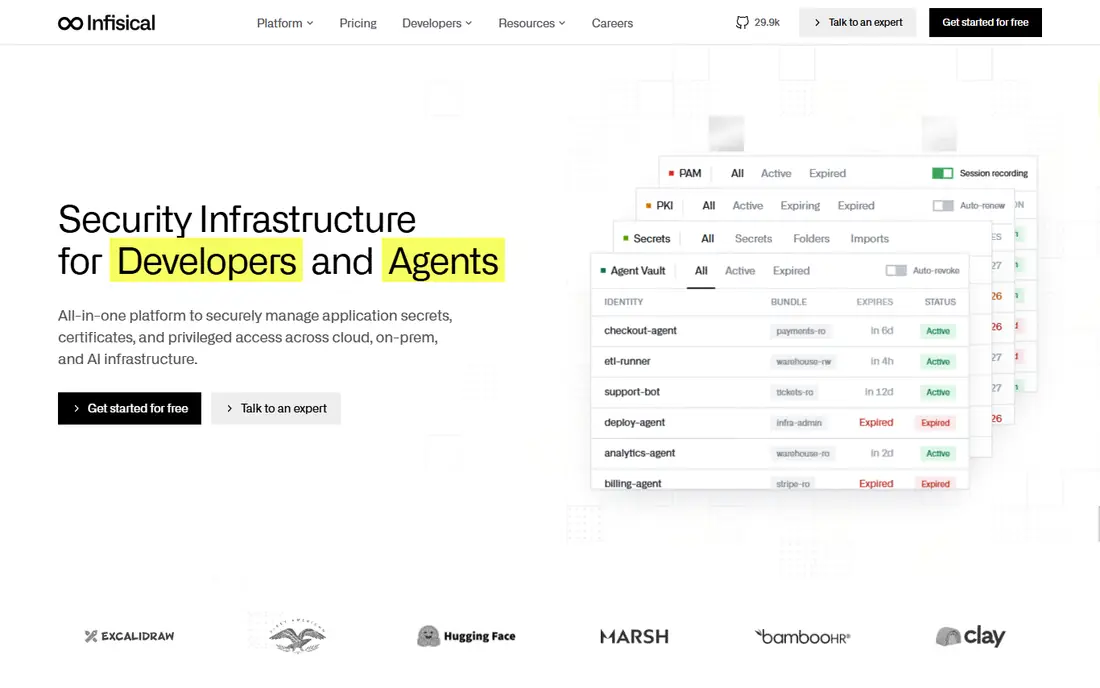
Infisical is the open-source option we would look at first. Its pricing page says the core is MIT licensed and free to self-host. The free cloud plan includes five identities, unlimited projects, three environments and ten secret syncs.
Pro costs $20 per identity per month billed yearly ($23 monthly) and adds SAML SSO, versioning, point-in-time recovery and IP allowlisting. Advanced, at $40 per identity per month billed yearly, adds dynamic secrets, full rotation, custom roles and temporary access. Enterprise adds SCIM, LDAP, approval workflows, external KMS and HSM support and a 99.99% SLA. Infisical also sells certificate management and privileged access modules.
The catch is planning. Billing is per identity, so count people and machine identities before you commit.
- Core platform is MIT licensed and free to self-host
- Generous free cloud plan
- Dynamic secrets, rotation and approval workflows in higher tiers
- Per-identity pricing needs careful counting
- The best governance features sit in Advanced and Enterprise
Akeyless
Great for: Hybrid and multi-cloud companies that want SaaS without giving up key control
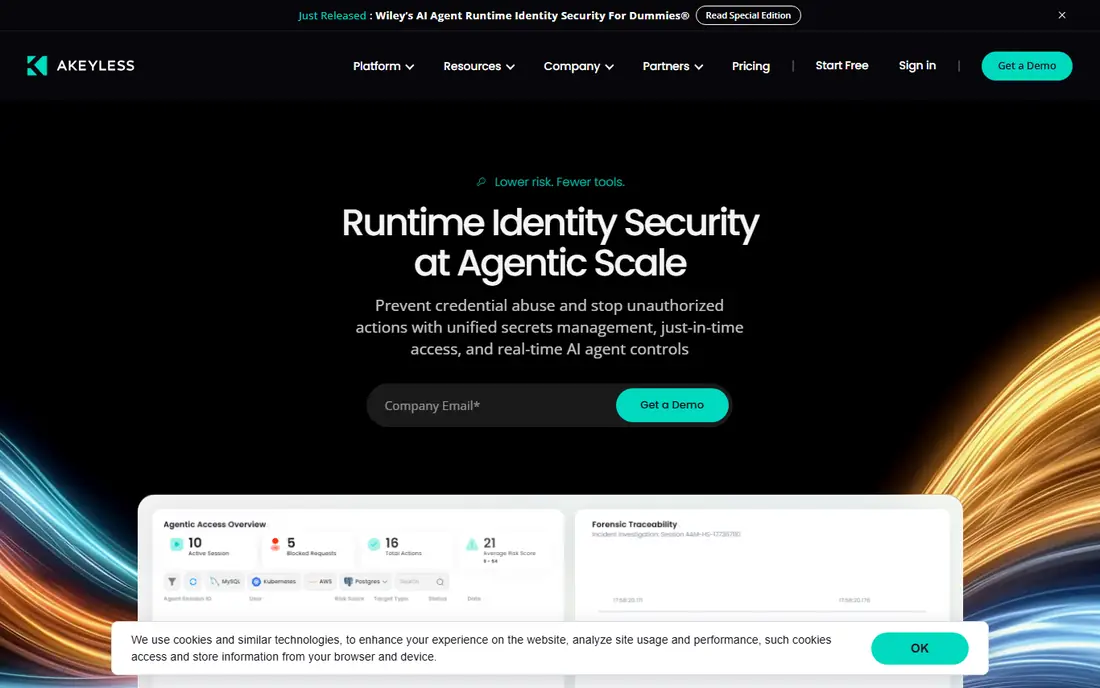
Akeyless runs as a SaaS service, with an optional Hybrid SaaS model that adds gateways in your own network and Zero-Knowledge encryption. That design is meant for companies that want a managed vault but do not want the provider able to read their secrets.
The free plan is useful for a pilot: 5 clients, 500 static secrets, 5 dynamic secrets, 5 rotated secrets, one SSH certificate issuer, one PKI issuer and three days of audit log retention. Enterprise limits are set with sales.
The weakness is that SAML or LDAP sign-in, log forwarding and Zero-Knowledge mode are excluded from the free tier, so treat it as a test drive rather than a production plan.
- Free tier covers 500 static secrets and 5 clients
- Hybrid SaaS with on-prem gateways
- Dynamic and rotated secrets, PKI and SSH certificates in one platform
- No public Enterprise prices
- SAML, OIDC and LDAP sign-in and Zero-Knowledge mode are Enterprise-only
Bitwarden Secrets Manager
Great for: Budget-conscious teams that want end-to-end encryption
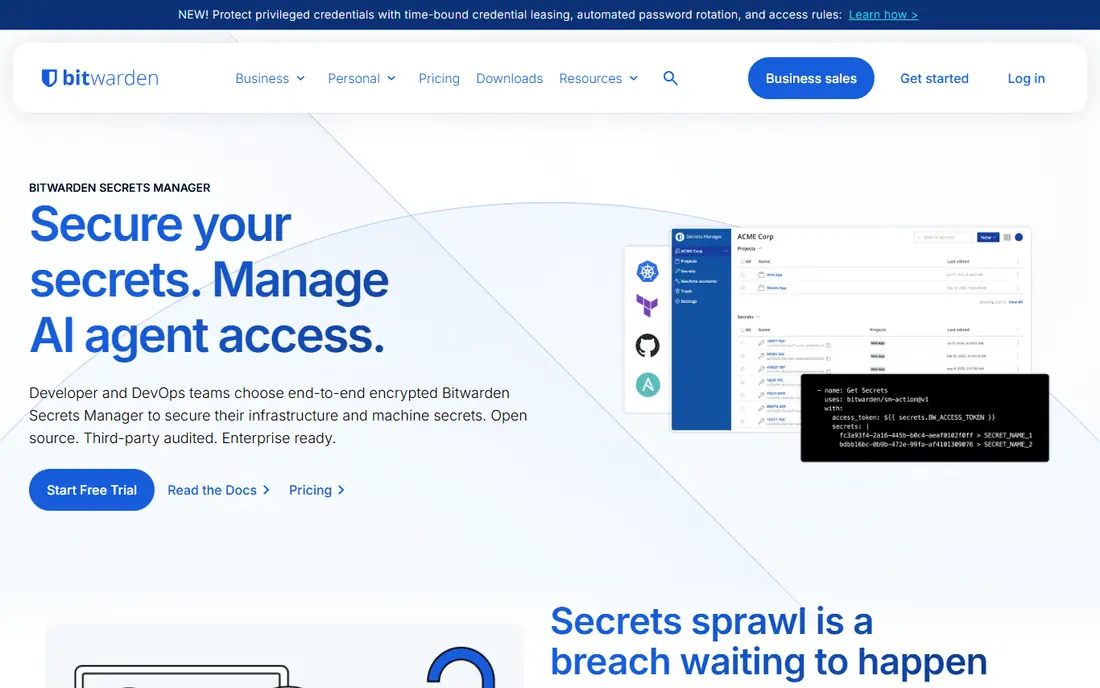
Bitwarden's secrets product follows the same idea as its password manager: end-to-end encryption, so Bitwarden says it cannot read stored secrets. The page describes it as open source and third-party audited.
Pricing is the lowest on this list for per-user plans. The free plan covers two users, three machine accounts and three projects with unlimited secrets. Teams costs $6 per user per month and Enterprise $12 per user per month (billed yearly), with extra machine accounts at $1 each. Enterprise adds SSO, SCIM and self-hosting.
It suits a mid-sized team that mostly needs static secrets injected into pipelines, but it is not a replacement for Vault-style dynamic credentials.
- End-to-end encrypted and open source
- Low per-user pricing
- Integrations for GitHub Actions, GitLab CI/CD, Jenkins and Kubernetes
- Machine account limits per plan
- No dynamic secrets
Keeper Secrets Manager
Great for: Companies already on Keeper for passwords
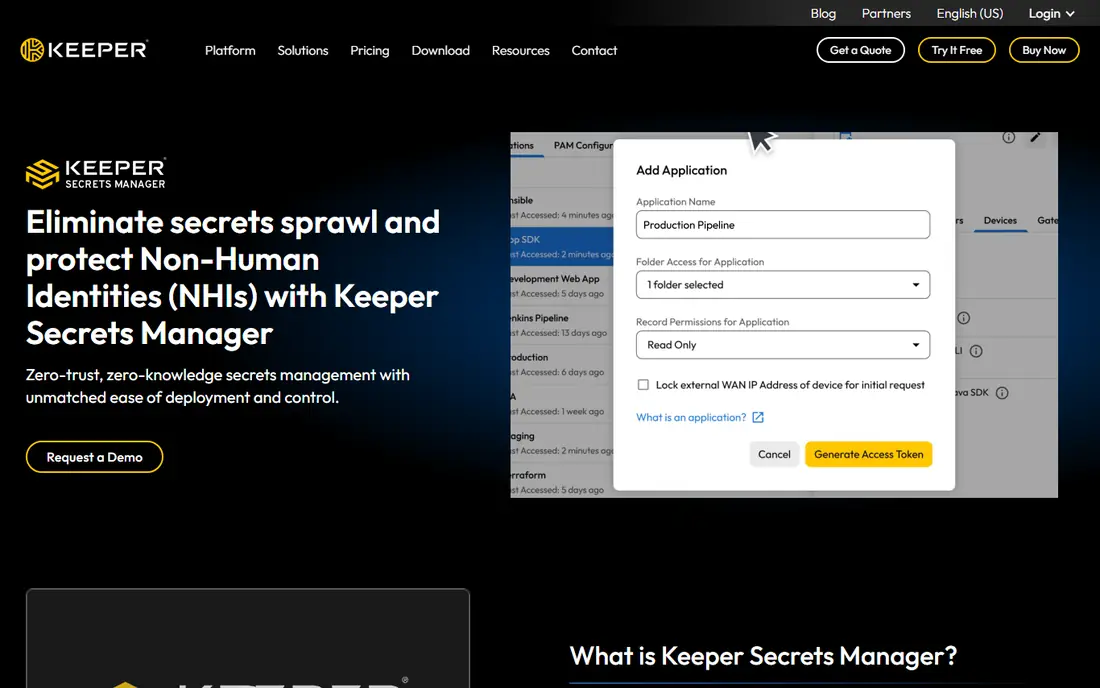
Keeper Secrets Manager is a cloud service for API keys, database credentials, SSH keys and service account passwords. Keeper describes it as zero-knowledge, with secrets only decryptable on devices you designate.
It makes the most sense when Keeper already runs your company's password vault. It is an add-on licensed per user per year and is included with KeeperPAM, with role-based access and SIEM reporting in one admin console.
The trade-off is that you are buying into Keeper's wider platform. Prices are not listed on the product page, and a team that only needs a developer secrets tool may find cheaper standalone options above.
- Zero-knowledge design
- Integrations with GitHub Actions, Jenkins, Terraform, Kubernetes and Docker
- Time-based and event-driven rotation
- Sold as an add-on to Keeper business plans
- No public price on the product page
How we picked these
We compared each product's official pages in October 2026: pricing pages, plan tables, product documentation and support notices. For Azure we used Microsoft's public retail price list, and for HashiCorp we checked the support articles on the HCP Vault Secrets retirement. We did not run these tools in a lab, and we did not use paid analyst reports.
We favored tools sold today that support CI/CD and Kubernetes workflows with audit logs and access controls, mixing established leaders with smaller vendors that publish clear prices.
How to choose a secrets manager for your team
Start with where your workloads run
If 90% of your apps run on one cloud, that cloud's native vault is often the cheapest and simplest choice. If you run on two or more clouds, Kubernetes everywhere or on-prem systems, a vendor-neutral tool such as Vault, Infisical, Doppler or Akeyless saves you from managing several vaults.
Decide if you need dynamic secrets
Dynamic secrets are created on demand and expire on their own, which limits damage if one leaks. They matter most for database and cloud credentials, and most vendors keep them in higher tiers.
Count identities, not just people
Pricing can be per user, per identity, per secret or per API call. Pipelines, services and AI agents all need credentials, so count machine identities too. A tool that looks cheap per developer can get expensive once every service has its own identity.
Check audit, SSO and compliance needs
Security reviews usually ask for SSO, SCIM, audit log retention and SIEM streaming. These are often gated behind paid plans, so confirm them before a pilot becomes a rollout.
Frequently asked questions
What are the best secrets management tools for large companies?
For large enterprises we would shortlist HashiCorp Vault, CyberArk Secrets Manager (now under Palo Alto Networks Idira), Akeyless and Infisical Enterprise. If you are mostly on one cloud, add that cloud's vault. The right answer depends on whether you need self-hosting, dynamic secrets and support for several clouds.
What is the best-rated secrets management software for developers?
Developers often favor Doppler and Infisical because of their CLIs and quick setup. Both have free plans, so a team can try them on a real project before involving procurement. Bitwarden Secrets Manager is a strong low-cost option if you want end-to-end encryption.
Is HashiCorp Vault still free?
Vault Community Edition is free to run on your own servers. Enterprise features need a license, and HCP Vault Dedicated is a paid managed service. The lighter HCP Vault Secrets product has been retired, so new projects should not plan around it.
Can I self-host a secrets manager?
Yes. Vault Community Edition and Infisical can be self-hosted for free, and Bitwarden offers self-hosting on its Enterprise plan. CyberArk and Doppler offer self-hosted or on-prem options for enterprise customers.
Sources
- https://developer.hashicorp.com/vault/docs/about-vault/what-is-vault
- https://www.hashicorp.com/en/pricing
- https://support.hashicorp.com/hc/en-us/articles/41802449287955-HCP-Vault-Secrets-End-Of-Life
- https://aws.amazon.com/secrets-manager/pricing/
- https://azure.microsoft.com/en-us/pricing/details/key-vault/
- https://prices.azure.com/api/retail/prices
- https://cloud.google.com/secret-manager/pricing
- https://www.paloaltonetworks.com/idira/machine/secrets-management
- https://www.doppler.com/pricing
- https://infisical.com/pricing
- https://www.akeyless.io/pricing/
- https://bitwarden.com/products/secrets-manager/
- https://www.keepersecurity.com/secrets-manager.html
See where you really rank - block by block
ProMapRanker scans Google Maps across a grid of your service area. Simple monthly plans from $19, white-label on every plan.
Start freeKeep reading
 philippines best loan apps
Philippines Best Loan Apps in 2026
The Philippines best loan apps for 2026, compared on SEC or BSP registration, loan limits, monthly rates and fees, from GCash GLoan and Maya to Tala and BillEase.
Read → best png to svg free tool
Best PNG to SVG Free Tool in 2026
Looking for the best PNG to SVG free tool? We compared 7 free converters in 2026, from Inkscape and SVGcode to Adobe Express, on tracing quality, limits and privacy.
Read → best gold ira companies
Best Gold IRA Companies in 2026
Comparing the best gold IRA companies for 2026 on published minimums, annual fees, buyback terms and pricing transparency, from Noble Gold to American Hartford Gold.
Read →